










Sattva treatment work becomes largest H1 FY27 revenue stream
Key highlights
- Sattva’s STP and WTP revenue rose 368% to ₹35.6 crore in H1 FY27.
- Sattva’s WSS revenue fell 50% to ₹15.7 crore in H1 FY27 from ₹31.2 crore.
- Sattva recorded ₹18.3 crore of odour-control-system revenue in H1 FY27 versus nil a year earlier.
- Sattva’s H1 FY27 order inflow was ₹242 crore, compared with ₹106 crore in H1 FY26.
powered by IRIS
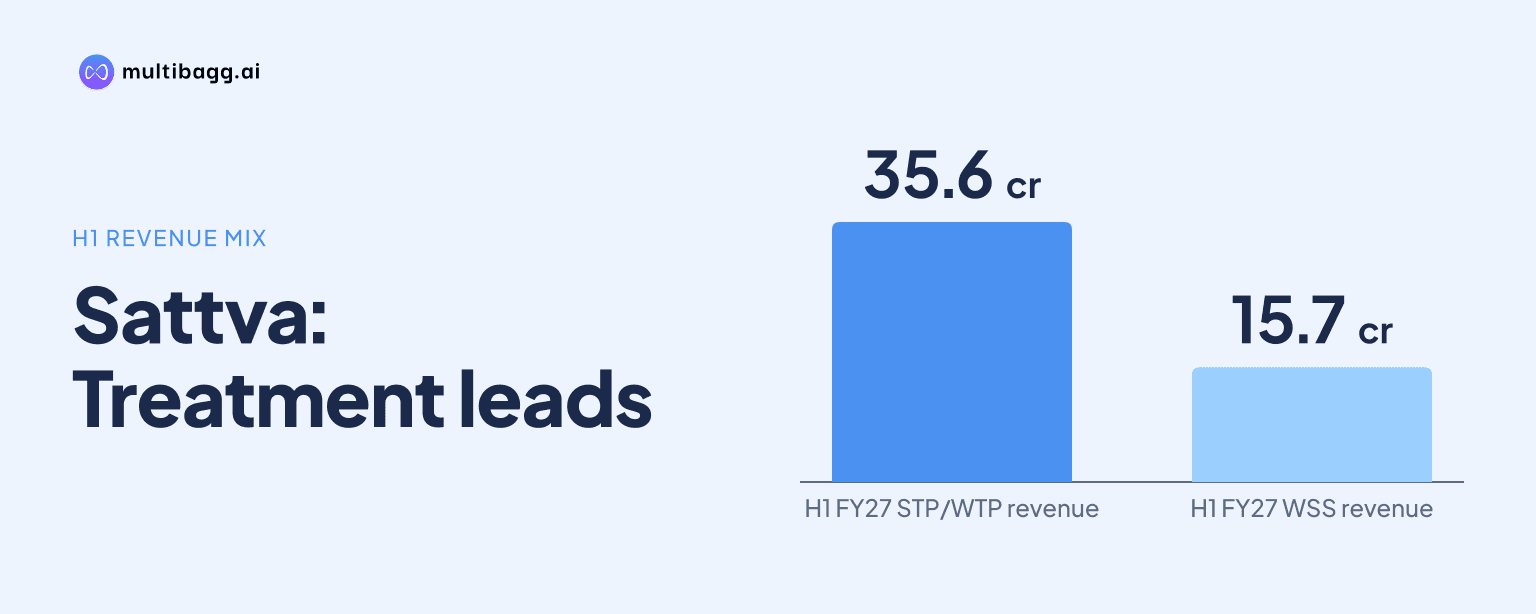
Sattva Engineering Construction Limited’s sewage treatment plant (STP) and water treatment plant (WTP) work became its largest revenue stream in H1 FY27, generating ₹35.6 crore, up 368% year on year, while water supply scheme revenue declined 50% to ₹15.7 crore. Treatment work represented 44% of the ₹81.1 crore revenue total.
Know Sattva Engineering Construction inside out
Results, valuation, peers and who's buying, in one view.
What changed in Sattva’s H1 FY27 revenue mix?
STP and WTP work replaced water supply schemes (WSS) as Sattva’s largest reported revenue segment in H1 FY27. STP and WTP revenue increased by ₹28 crore, from ₹7.6 crore in H1 FY26 to ₹35.6 crore in H1 FY27, while its contribution to revenue rose from 12% to 44%.
WSS revenue fell by ₹15.5 crore and its revenue contribution declined from 48% in H1 FY26 to 19% in H1 FY27. Under Ground Sewerage System (UGSS) revenue also declined, falling by ₹15.4 crore to ₹7.9 crore, and its contribution dropped from 36% to 10%. The movement in these two segments coincided with a higher contribution from treatment work and other services.
Why did STP and WTP become Sattva’s largest segment?
STP and WTP became Sattva’s largest segment because their ₹35.6 crore of H1 FY27 revenue exceeded WSS revenue of ₹15.7 crore by ₹19.9 crore. Sattva describes STP work as the design, construction and commissioning of wastewater treatment facilities incorporating primary, secondary and tertiary treatment processes. WTP work covers water-purification infrastructure including intake, treatment, filtration and distribution systems.
Sattva also disclosed two Bangalore Water Supply and Sewerage Board orders worth ₹123.9 crore for the design, construction and commissioning of 20 million litres per day (MLD) and 10 MLD STPs. The company said the awards marked its expansion into Karnataka. They formed part of its ₹486 crore unexecuted order book as of September 2026, which Sattva said provides revenue visibility for FY27.
The company reported execution capability for projects ranging from 12.5 MLD to 50 MLD and more than 15 ongoing projects. The H1 FY27 segment revenue reflects work recorded during the six months, whereas the 20 MLD and 10 MLD awards remained in the September 2026 order book rather than being identified as H1 revenue.
How much did odour-control systems contribute to H1 FY27 revenue?
Odour-control systems (OCS) contributed ₹18.3 crore in H1 FY27, compared with nil revenue in H1 FY26, according to Sattva’s note on other services. The presentation assigns OCS a 23% contribution to H1 FY27 revenue, behind STP and WTP at 44% and ahead of WSS at 19%.
Other Services rose 666% to ₹21.9 crore in H1 FY27 from ₹2.9 crore in H1 FY26. In addition to the ₹18.3 crore OCS contribution, this line included ₹0.8 crore from the industrial segment, also compared with nil a year earlier. The disclosed OCS and industrial amounts total ₹19.1 crore, while the presentation does not separately identify the remaining ₹2.8 crore within Other Services.
Sattva separately reported a ₹9.5 crore contract with Bimbo Bakeries India as its strategic re-entry into the industry and utility building segment. The stated execution period is 20 weeks. The presentation does not establish a timing or revenue-recognition link between that contract and the ₹0.8 crore industrial revenue reported in H1 FY27.
Got a follow-up? Ask IRIS
Did the business-mix change coincide with higher earnings and cash flow?
Yes. Sattva reported revenue from operations of ₹81.1 crore in H1 FY27, up 25% from ₹65 crore in H1 FY26, and earnings before interest, taxes, depreciation and amortisation (EBITDA) of ₹12.8 crore. EBITDA rose 52% year on year and the EBITDA margin increased by 280 basis points to 15.8%.
Profit after tax was ₹7.4 crore, up 64% year on year, while the profit-after-tax margin increased by 218 basis points to 9.1%. Cash flow from operating activities was ₹15.9 crore during H1 FY27, compared with negative ₹12.7 crore for FY26. These company-level outcomes were reported in the same period as STP, WTP and OCS gained revenue contribution.
Working-capital measures showed different movements. Debtor days increased to 114 days in H1 FY27 from 104 days in FY26, while the cash conversion cycle decreased to 73 days from 126 days. Sattva said 95% of FY26 outstanding trade receivables had been collected as of H1 FY27 and aims to collect 80% to 90% of all pending receivables by November 2026.
What does Sattva expect after H1 FY27?
Management is targeting annual revenue growth of 30% to 35% through FY27 and FY28, following the 25% increase reported in H1 FY27. Management is also aiming for sustainable EBITDA margins of around 15% and profit-after-tax margins of around 9% during those years. These are management targets rather than reported results.
Sattva reported order inflow of ₹242 crore in H1 FY27, compared with ₹106 crore in H1 FY26, and disclosed a ₹225 crore bid pipeline for coming quarters. Management said planned growth would primarily be funded through internal accruals, with incremental debt financing supported by working-capital management. Net debt to equity was 0.1 times in H1 FY27, compared with 0.2 times in FY26.
Conclusion
Sattva’s H1 FY27 revenue mix moved decisively toward treatment and odour-control work. STP and WTP revenue of ₹35.6 crore became the largest segment, while ₹18.3 crore of OCS revenue created a new disclosed contributor. These changes accompanied 25% growth in total revenue to ₹81.1 crore despite lower WSS and UGSS revenue than in H1 FY26.
The next disclosures to watch are execution from the ₹486 crore September 2026 order book, including the ₹123.9 crore Karnataka STP awards, and progress toward collecting 80% to 90% of pending receivables by November 2026. Management’s 30% to 35% annual revenue-growth target through FY28 and its approximately 15% EBITDA-margin aim are the stated benchmarks for later updates.