










Savita Oil Technologies targets cooling with ester platform
Key highlights
- SOTL moved from synthetic ester pilot development in 2015 to commercialisation in 2023.
- QuantiCool is positioned for EV batteries, BESS and data-centre cooling applications.
- SOTL cites 4x heat protection, 35% less friction and an 86% reduction in deposits for ester fluid versus Group II regular synthetic oil.
- SOTL lists 3C+ fast charging as a QuantiCool EV-battery use case.
powered by IRIS
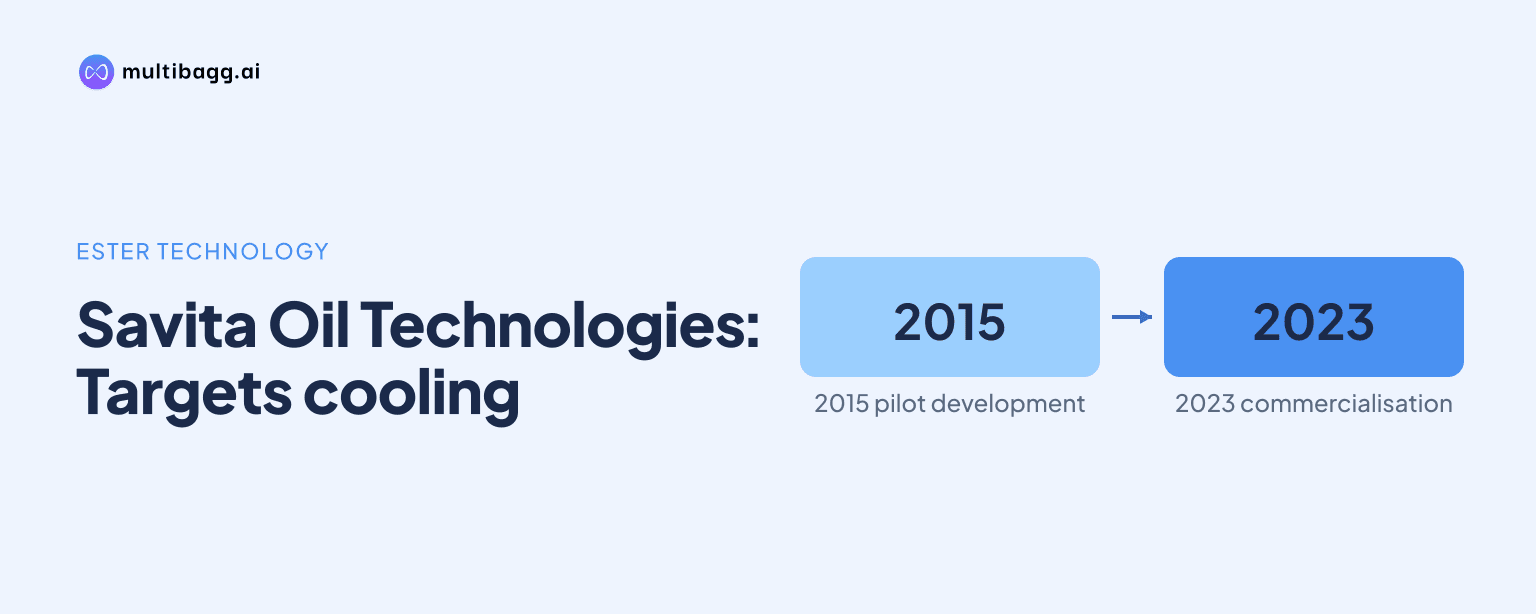
Savita Oil Technologies says it commercialised India’s first synthetic ester plant in 2023, creating an in-house fluid platform for electric-vehicle cooling, battery energy storage systems, data-centre cooling and Savsol Ester5 automotive oils. SOTL progressed from pilot development in 2015 and says the platform is supported by internal research and development facilities.
Know Savita Oil Technologies inside out
Results, valuation, peers and who's buying, in one view.
How did SOTL build its synthetic ester platform?
SOTL built its synthetic ester platform through pilot development in 2015 and commercialised it in 2023, which it describes as India’s first commercial synthetic ester plant. SOTL says it is the first Indian lubricant company to manufacture ester molecules under its Savsol Ester5 range, with ester chemistry developed entirely through in-house research and development, or R&D.
The move from 2015 pilot-scale trailing and testing to a commercial plant in 2023 changed the programme from product validation to manufacturing capability. SOTL identifies a dedicated R&D and pilot facility as the base for this work, and presents the ester molecule as a platform for next-generation cooling solutions rather than solely as an automotive lubricant ingredient.
SOTL describes the synthetic ester base fluid as readily biodegradable and non-toxic, with a higher fire point than conventional mineral base oils. Its presentation says the fluid outperforms conventional mineral base oils and has been tested or approved by LABORELEC, UL, FM Approved and Intertek. These stated characteristics relate to applications where thermal control and fire safety are relevant.
The platform also expands SOTL’s transformer-fluid range. SOTL says it is among the few global players offering mineral, natural and synthetic ester-based transformer fluids, alongside products for industrial, automotive and non-automotive applications. This positions the ester capability as an addition to existing fluid categories rather than a standalone product line.
How is SOTL using esters in electric vehicles and BESS?
SOTL is positioning its QuantiCool synthetic ester-based single-phase immersion coolant for electric vehicles and battery energy storage systems, or BESS. For EV batteries, SOTL says the product is designed to provide cooling, help prevent thermal runaway, enable 3C+ fast charging and support safer electric mobility through direct battery-fluid thermal management.
The EV applications listed for QuantiCool cover passenger EVs, commercial EVs, high-performance EVs, EV industrial drones, EV tractors and next-generation battery chemistries. This range differs from Savsol Ester5’s engine-oil role because QuantiCool is aimed at battery-pack heat management rather than lubrication of mechanical engine components.
For BESS, SOTL describes QuantiCool as a single-phase immersion coolant for direct cell and module immersion. The company says this mechanism is intended to improve cooling, fire suppression and battery life. It lists grid-scale BESS, industrial BESS, peak-saving and peak-load-management systems, transmission and distribution deferral, and renewable-energy integration among potential applications.
The common mechanism across EV and BESS applications is synthetic ester-based immersion cooling, while the end markets are mobility and stationary storage. SOTL does not disclose sales, installed volumes, customer contracts or production capacity for QuantiCool in the presentation. It instead describes the product’s intended operating role in the two battery segments.
Got a follow-up? Ask IRIS
What is SOTL offering data centres?
SOTL is offering QuantiCool glycol-based coolants for direct liquid cooling, or DLC, in data centres, while separately presenting ester-based fluids for immersion cooling. SOTL says it offers ethylene-glycol and propylene-glycol coolants under the QuantiCool brand and describes itself as an Indian pioneer in ester- and glycol-based cooling solutions.
The listed data-centre applications include artificial intelligence and high-performance computing server racks, immersion-cooled data centres, DLC, hyperscale data centres and unified liquid-cooling solutions. Unlike the EV and BESS descriptions, which identify a synthetic ester single-phase immersion coolant, the data-centre description specifically names glycol coolants for DLC applications.
This distinction means the presentation groups data centres within a broader ester-and-glycol cooling portfolio but assigns a different fluid type to DLC. SOTL also includes immersion-cooled data centres in its applications list, connecting the data-centre opportunity to its wider cooling technology range without specifying which installation uses each formulation.
SOTL’s industrial-oils business provides a separate business-to-business and business-to-consumer product base, including compressor, hydraulic, turbine, thermic, transmission, metal-working and spindle oils, plus quench oils. Its industrial growth drivers are infrastructure investment in India, industrial distribution expansion and new customer additions, whereas QuantiCool addresses cooling-specific uses in batteries and computing equipment.
How does Savsol Ester5 fit SOTL’s automotive strategy?
Savsol Ester5 is SOTL’s high-performance automotive lubricant range, using Ester Fluid Technology to target modern engines operating at higher temperatures and under greater component stress. SOTL says the ester component forms a durable protective film on engine surfaces, helping reduce friction and deposits while supporting heat protection and engine protection.
SOTL presents three test-based comparisons for ester fluid against Group II regular synthetic oil: 4x heat protection, 35% less friction and an 86% reduction in deposits. SOTL attributes those results to the Noack Volatility test, the MTM friction test and the Panel Cooker test. They are product-performance comparisons, not reported sales-growth or market-share figures.
SOTL has introduced Savsol Ester 5 Estermax 9000 4T 10W-40, labelled fully synthetic and carrying API SN and JASO MA2 specifications. This automotive product uses the same underlying ester technology that SOTL says can support cooling fluids, but its stated function is lubrication for modern engines rather than battery or server thermal management.
SOTL’s wider growth plan includes increasing its share in mid-tier and top-tier product categories, launching innovations such as synthetic esters, expanding industrial distribution and investing in capacity. SOTL also says it is positioned across transformer, industrial, automotive and non-automotive segments, giving its ester platform multiple stated routes to market.
Conclusion
SOTL’s 2023 commercial synthetic ester plant is the manufacturing and technology base behind its stated move into EV, BESS and data-centre cooling, as well as the Savsol Ester5 automotive range. The presentation provides a 2015-to-2023 development timeline, defined QuantiCool applications and test-based Ester Fluid Technology comparisons, but no revenue or volume disclosure for cooling products.
The next disclosures to watch are SOTL’s stated plans for capacity expansion, industrial distribution growth and a greater mix of mid-tier and top-tier products. The presentation does not specify QuantiCool customer wins, output capacity, commercial deployments or rollout dates, leaving adoption across EV, BESS and data-centre applications unresolved.