










SAVITA H1 FY27 cash flow hit by Rs 343 crore working-capital build
Key highlights
- SAVITA reported Rs 669.7 crore of profit before tax in H1 FY27, compared with Rs 127.8 crore in H1 FY26.
- Working-capital changes used Rs 343.4 crore of cash in Sep-26, versus Rs 2.9 crore in Sep-25.
- Inventories rose by Rs 224.3 crore and trade receivables rose by Rs 269.2 crore from March 2026.
- Net cash from operating activities was Rs 225.6 crore and cash equivalents ended Sep-26 at Rs 110.7 crore.
powered by IRIS
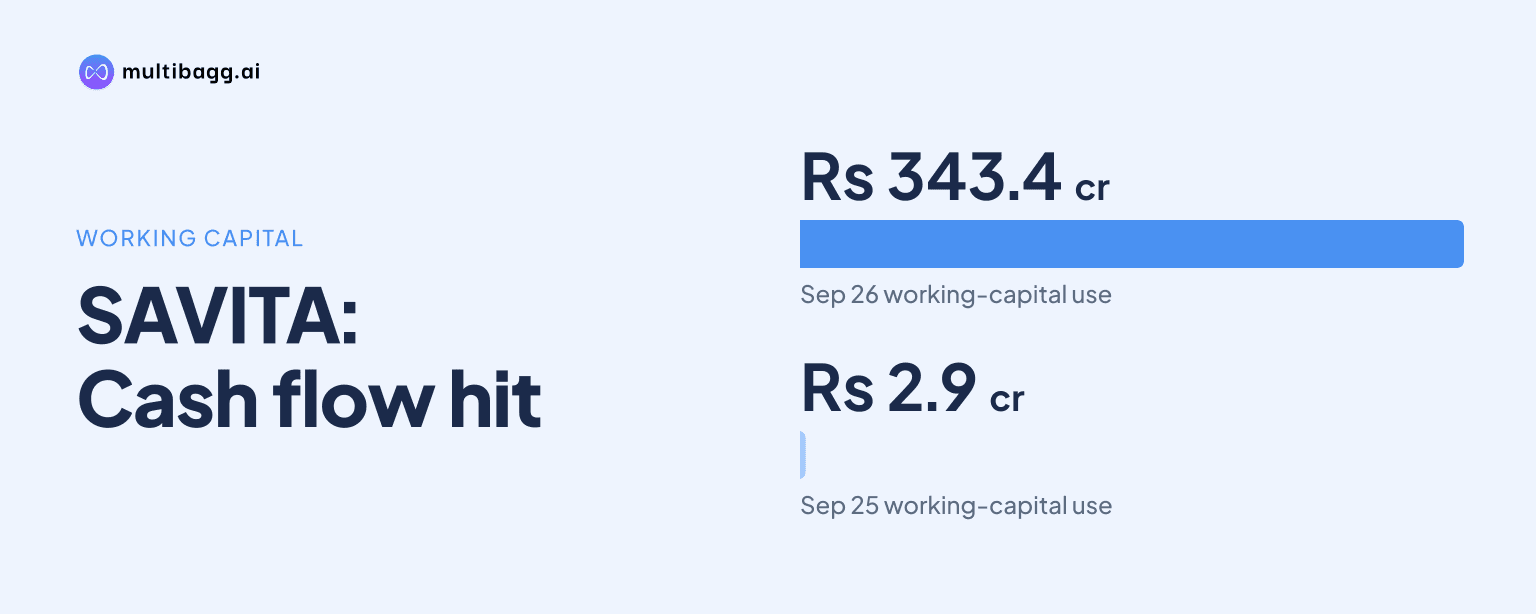
SAVITA’s H1 FY27 operating cash flow was reduced by a Rs 343.4 crore working-capital outflow, leaving Rs 225.6 crore of net cash from operating activities despite Rs 669.7 crore of consolidated profit before tax. Inventories and trade receivables both increased between March 2026 and September 2026.
Know Savita Oil Technologies inside out
Results, valuation, peers and who's buying, in one view.
How much operating cash did SAVITA generate in H1 FY27?
SAVITA generated Rs 225.6 crore of net cash from operating activities in Sep-26, compared with Rs 92.6 crore in Sep-25. Cash generated from operations was Rs 323.1 crore after the Rs 343.4 crore working-capital outflow reduced operating profit before working-capital changes of Rs 666.5 crore.
Profit before tax rose to Rs 669.7 crore in H1 FY27 from Rs 127.8 crore in H1 FY26, while operating profit before working-capital changes increased to Rs 666.5 crore from Rs 119.3 crore. Non-cash items and other investment or financial items reduced the latter measure by Rs 3.2 crore, compared with a Rs 8.5 crore reduction in Sep-25.
Direct taxes paid, net of refund and adjusted for operating interest, were Rs 97.5 crore in Sep-26, versus Rs 23.8 crore in Sep-25. That Rs 73.7 crore increase further reduced the conversion of Rs 323.1 crore in cash generated from operations into Rs 225.6 crore of net operating cash.
What drove SAVITA’s Rs 343.4 crore working-capital outflow?
SAVITA’s working-capital change was a Rs 343.4 crore cash outflow in Sep-26, compared with Rs 2.9 crore in Sep-25. Inventories increased by Rs 224.3 crore to Rs 1,108.6 crore and trade receivables rose by Rs 269.2 crore to Rs 1,183.6 crore between March 2026 and September 2026.
Trade payables increased by Rs 120.3 crore to Rs 890.6 crore, partly offsetting the rise in inventories and receivables. The disclosed movements do not independently reconcile to the Rs 343.4 crore cash-flow line because the balance sheet also contains other current assets and liabilities, and SAVITA does not provide a detailed working-capital bridge.
Current assets rose by Rs 674.7 crore to Rs 2,886.0 crore, while current liabilities rose by Rs 215.1 crore to Rs 1,087.6 crore over the six-month period. Current investments also increased by Rs 198.7 crore to Rs 366.7 crore, while cash and cash equivalents declined by Rs 20.0 crore on the balance sheet to Rs 110.7 crore.
How did SAVITA’s profit growth compare with operating cash flow?
SAVITA’s H1 FY27 profit growth outpaced the rise in operating cash because working capital absorbed Rs 343.4 crore. Total income rose 53.3% year on year to Rs 3,224.8 crore, profit before tax increased 424.1% to Rs 669.7 crore, and net cash from operating activities rose to Rs 225.6 crore from Rs 92.6 crore.
Earnings before interest, tax, depreciation and amortisation, or EBITDA, increased to Rs 693.1 crore from Rs 150.1 crore, with the EBITDA margin rising to 21.5% from 7.1%. Profit after tax reached Rs 499.9 crore, compared with Rs 96.5 crore, and the profit-after-tax margin increased to 15.5% from 4.6%.
Q2 FY27 contributed Rs 283.1 crore of H1 FY27 profit before tax, compared with Rs 386.6 crore in Q1 FY27. Q2 FY27 total income was Rs 1,714.1 crore, up 57.2% year on year, while EBITDA of Rs 296.4 crore was 25.3% below the Rs 396.7 crore reported in Q1 FY27.
Got a follow-up? Ask IRIS
What affected SAVITA’s operating conditions during the period?
Management said volatility in crude oil and refined-product prices, together with tighter supply, increased input feedstock costs and prices across SAVITA’s product portfolio during Q2 FY27. The presentation also reported double-digit H1 FY27 volume growth in the Export and Lubricating Oil Divisions.
On a sequential-quarter basis, Transformer Oils, White Oils and Export volumes recorded double-digit growth, according to management. SAVITA’s Petroleum Specialty Oils accounted for 73% of FY26 sales, while Lubricating Oils accounted for 26%, making the disclosed growth in those product areas relevant to inventory and receivables movements.
Management said the Savsol Ester5 automotive lubricant range was growing at four times the industry growth rate. The presentation does not disclose Savsol Ester5 revenue, its contribution to H1 FY27 earnings, or its specific working-capital requirement.
How did investing and financing cash flows affect SAVITA’s cash balance?
SAVITA used Rs 199.4 crore in investing activities and Rs 46.1 crore in financing activities in Sep-26. Together with Rs 225.6 crore of operating cash inflow, those movements resulted in a Rs 19.9 crore net decrease in cash and cash equivalents, compared with a Rs 4.8 crore increase in Sep-25.
Cash and cash equivalents ended Sep-26 at Rs 110.7 crore, after an opening balance of Rs 130.7 crore and a Rs 0.1 crore negative foreign-exchange translation difference. The comparable Sep-25 closing balance was Rs 74.6 crore, following Rs 69.7 crore at the beginning of that period.
The balance sheet reported no current or non-current borrowings at September 2026 or March 2026. Total equity rose to Rs 2,280.7 crore from Rs 1,814.9 crore, while property, plant and equipment increased to Rs 276.5 crore from Rs 257.8 crore.
What plans could affect SAVITA’s future cash requirements?
Management said SAVITA plans a project to increase Lubricants capacity by 50% and double Diesel Exhaust Fluids capacity, following continuing double-digit lubricant growth. The presentation does not disclose the project cost, completion date, funding source or expected cash-flow effect.
Management also said research and development is focused on ester-based immersion coolants for electric-vehicle batteries and Battery Energy Storage Systems, or BESS. The work involves tailoring products for original equipment manufacturers, but the presentation gives no commercialisation timetable or revenue target.
Conclusion
SAVITA’s H1 FY27 results show that substantially higher profitability did not translate directly into operating cash. Profit before tax reached Rs 669.7 crore and EBITDA reached Rs 693.1 crore, but a Rs 343.4 crore working-capital outflow and Rs 97.5 crore of direct taxes paid limited net operating cash to Rs 225.6 crore.
The next reporting periods will indicate whether September 2026 inventories of Rs 1,108.6 crore and receivables of Rs 1,183.6 crore convert into cash. Investors can also watch for management disclosure on the timing, cost and funding of the planned 50% Lubricants capacity increase and doubling of Diesel Exhaust Fluids capacity.