










Seamec plans $200-250 million capex as DSV supply tight
Key highlights
- Seamec plans $200-250 million of fleet capex over the next two to three years.
- Seamec said only one DSV was under construction globally, compared with about 65-70 operating vessels.
- Seamec Anant began a roughly 1,225-day, $55 million charter on October 21, 2026.
- Seamec’s Q2 FY27 consolidated revenue rose 103% year on year to Rs 198.1 crore.
powered by IRIS
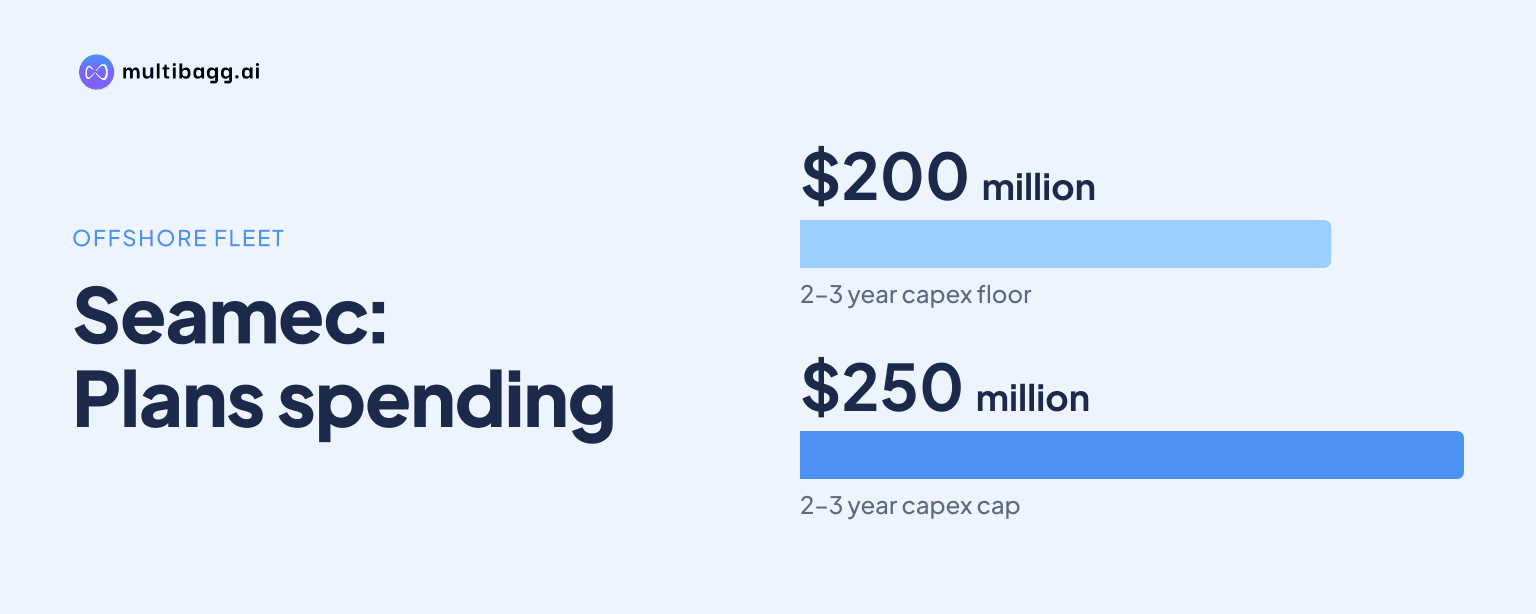
Seamec Limited plans $200 million to $250 million of fleet capital expenditure over the next two to three years, with a new diving support vessel, or DSV, among its expansion options as management said only one DSV was under construction globally against an estimated operating fleet of 65 to 70 vessels.
Know SEAMEC inside out
Results, valuation, peers and who's buying, in one view.
How much fleet capital expenditure is Seamec planning?
Seamec plans about $200 million to $250 million of fleet capital expenditure over the next two to three years. Management said it had spent $70 million to acquire Seamec Anant and described an ambition to deploy about $250 million over the next two to two-and-a-half years, without giving specific guidance for H2 FY27.
The stated investment focus is offshore vessels, particularly DSVs. Management said Seamec remains willing to consider other vessel categories, but currently sees its focus in offshore operations and DSVs. It sold Gallant after receiving what management called a good deal, while saying it had no present intention to fully exit other vessel types.
Seamec said it borrowed about Rs 350 crore for the Seamec Anant acquisition, taking its debt profile to roughly Rs 450 crore to Rs 470 crore. Management said future investments could use financing ratios of 60:40 or 70:30, but did not specify the debt and equity mix for any individual vessel purchase or a potential newbuild.
Why is Seamec considering a new DSV order?
Seamec is considering a new DSV because management said finding an acceptable second-hand vessel may be difficult in the current market. Asked whether it would explore a newbuild if it could not find a used DSV in the next six to 12 months, management said a newbuild was in the pipeline as one option for expanding the fleet.
Management said a DSV generally takes two to three years from order placement to delivery. A basic newbuild would cost more than $110 million to $120 million, with the price potentially rising to about $150 million depending on the capabilities added to the vessel.
Seamec said it was continuously evaluating available used-vessel opportunities but would not chase assets at what management described as abnormal prices. This leaves the company with two potential routes for its capex plan: a second-hand acquisition when terms meet its criteria, or a newbuild with a two-to-three-year delivery timeline.
How tight is the global DSV market?
The global DSV market is tight, according to Seamec management, which estimated that about 65 to 70 vessels with built-in diving systems operate worldwide and that only one was under production. Management described DSVs as specialised vessels made for long-term investment proposals rather than through factory-line production.
The limited construction pipeline means little new capacity may arrive during the two-to-three-year newbuild period, while older vessels could leave service. Management said that if DSV availability remains limited, end clients would need to consider higher charter rates to secure vessels, although it also said market forces determine pricing.
A newly built DSV could command an indicative charter rate of $70,000 to $80,000 a day or more, depending on contract terms, management said. It noted that contracts can be lump-sum or day-rate based, meaning the indicative range is not a uniform measure of existing fleet rates.
Seamec separately said Seamec Princess should receive a rate in line with Seamec II. Seamec II has been contracted to G R Infra at around $100,000 a day for the working season through May 2027, while Seamec Princess was in advanced discussions with L&T for the PRP-X project.
Got a follow-up? Ask IRIS
What contracted work supports Seamec’s expansion?
Seamec added contracted revenue visibility through Seamec Anant, which it formally took over at Kakinada on October 14, 2026. On October 21, 2026, Seamec signed a long-term charter with HAL Offshore for Oil and Natural Gas Corporation inspection, maintenance and repair assignments.
The Seamec Anant charter runs for about 1,225 days and has an approximate value of $55 million excluding goods and services tax. The vessel commenced operations on October 21, 2026, and management estimated that its acquisition could have a payback period of about five to six years.
Management said the existing charter covers about three years and that Seamec expects to bid Seamec Anant directly to Oil and Natural Gas Corporation after that contract ends. It also said a similar vessel in the open market would cost no less than $80 million to $90 million, compared with Seamec’s $70 million purchase price.
Four vessels are on seasonal spot-market work, generally from the beginning or middle of November to the middle of May, while the rest are on long-term charters, management said. Sevak and Prabha will complete their two-year charters at next year-end, and Swordfish will also come up for renewal next year.
How has fleet growth changed Seamec’s financial performance?
Seamec’s consolidated revenue rose 103% year on year to Rs 198.1 crore in Q2 FY27 from Rs 97.4 crore in Q2 FY26. Consolidated profit after tax was Rs 50 crore, compared with a loss of Rs 25.7 crore a year earlier.
Management attributed the operating improvement partly to the addition of Sevak, Prabha and Seamec Agastya, which were not contributing to Q2 FY26 in the same way. Swordfish also operated more during Q2 FY27 than in the comparable quarter, management said.
For H1 FY27, consolidated revenue increased about 61% to Rs 495 crore from Rs 308.3 crore in H1 FY26. Consolidated earnings before interest, tax, depreciation and amortisation, or EBITDA, rose 55% to Rs 162.2 crore from Rs 104 crore, while profit after tax increased to Rs 131.8 crore from Rs 50 crore.
Management said employee expense increases as DSV additions require more vessel crew, describing this as a direct cost. It expects depreciation of about Rs 200 crore to Rs 250 crore across the current and next financial year following the Seamec Anant addition, while depreciation on certain older vessels is expected to end within two to three years.
Conclusion
Seamec’s planned $200 million to $250 million fleet investment reflects management’s view that specialised DSV capacity is constrained and that additional offshore assets can support its contract pipeline. The October 2026 deployment of Seamec Anant under a roughly 1,225-day, $55 million charter adds visibility, while expanded vessel deployment coincided with consolidated revenue rising to Rs 198.1 crore in Q2 FY27.
The next developments to watch are whether Seamec secures a used DSV on acceptable terms or advances to a newbuild that would require two to three years for delivery. Management also expected a Seamec Princess contract decision shortly, while charter milestones for Sevak, Prabha and Swordfish next year could shape future deployment and rates.