










Seamec targets 15% revenue growth and 18-20% PAT growth
Key highlights
- Seamec targets around 15% revenue growth and 18% to 20% PAT growth over the next four to five years.
- Management expects around 40% stable-state EBITDA margin over the next three to four years.
- Seamec spent US$70 million on Seamec Anant in H1 FY28 and plans US$200 million to US$250 million of capital expenditure over two to three years.
- Seamec’s debt profile was about Rs 450 crore to Rs 470 crore after raising about Rs 350 crore for Seamec Anant.
powered by IRIS
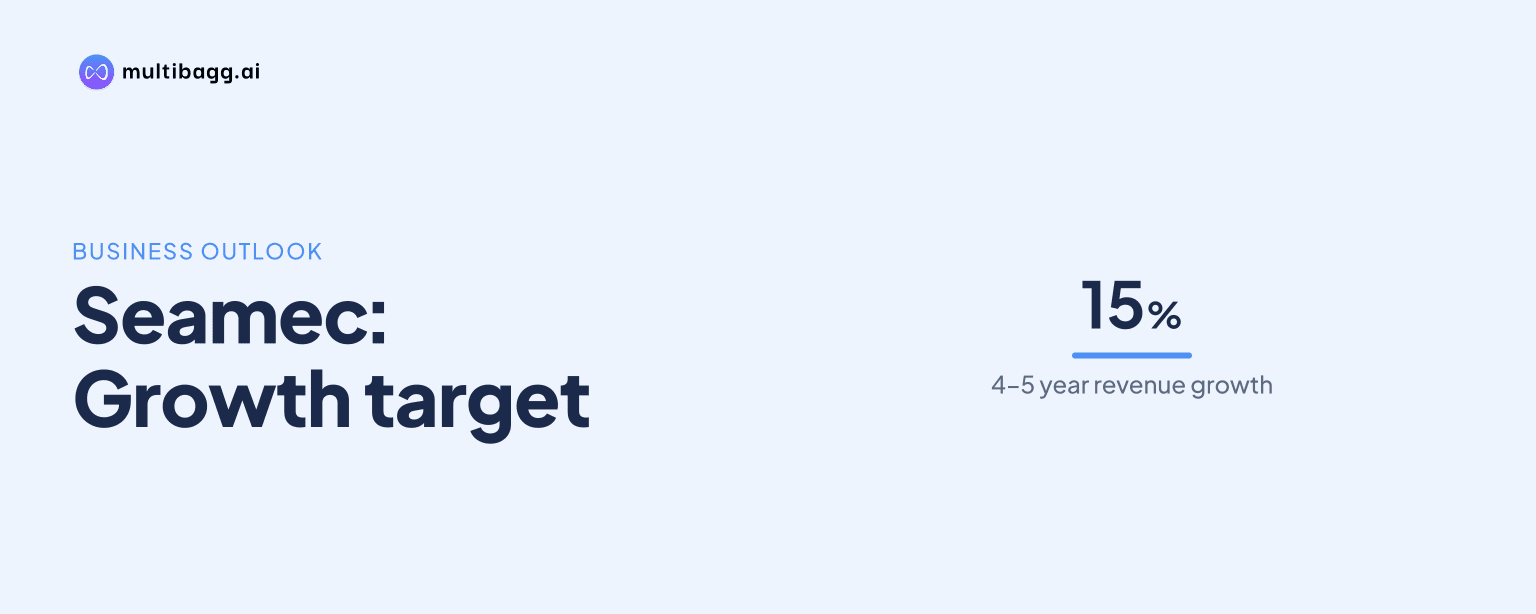
Seamec said in its FY28 earnings call that it aims to grow revenue by about 15% and profit after tax, or PAT, by about 18% to 20% over the next four to five years, supported by fleet expansion, long-term charters and management’s expectation of a 40% stable-state EBITDA margin.
Know SEAMEC inside out
Results, valuation, peers and who's buying, in one view.
What is Seamec’s four-to-five-year growth target?
Seamec’s stated target is revenue growth of around 15% and PAT growth of around 18% to 20% over the next four to five years. Management did not provide annual FY28 guidance, with Sunil Gupta saying the company does not give year-to-year guidance and instead frames its outlook over the longer period.
The profit target specifically refers to PAT rather than earnings before interest, tax, depreciation and amortisation, or EBITDA. That distinction matters because Seamec expects material depreciation as it adds vessels: management expects depreciation of Rs 200 crore to Rs 250 crore across this year and next year after the addition of Seamec Anant.
Management linked its 18% to 20% return on capital and return on equity target to vessel utilisation in a capital-intensive business. The company’s view is that higher utilisation improves performance, rather than that the ratio target is assured independently of deployment levels.
How does Seamec plan to grow its fleet?
Seamec plans to augment its fleet over the next two to three years, prioritising offshore vessels and particularly diving support vessels, or DSVs. It spent US$70 million in H1 FY28 to acquire Seamec Anant and said it would consider about US$200 million to US$250 million of capital expenditure over the next two to three years.
Management said the expansion could use second-hand vessels or new builds, depending on availability and economics. The second-hand DSV market was described as tight, while a new DSV would take around two to three years from order to delivery; management said a new-build order remained an option if a suitable used vessel is not found within six to 12 months.
Seamec said it raised about Rs 350 crore of debt for the Seamec Anant acquisition, taking its debt profile to about Rs 450 crore to Rs 470 crore at the time of the call. Management expects future investments to use loan-to-equity funding structures of either 60:40 or 70:30, which would add to borrowings.
What contract coverage supports Seamec’s target?
Seamec said all vessels were operating except one whose contract was expected within one to two weeks at the time of the call. Four vessels operate on seasonal spot-market contracts from around the middle or beginning of November to the middle of May, while the rest are on long-term charters.
The company expects three significant charter events next year: Prabha and Sevak will complete their two-year periods, and Swordfish will also come up for renewal. Prabha and Sevak are ONGC-owned vessels operated by Seamec under operations and maintenance contracts, and management said they work throughout the year rather than going off-hire during monsoon conditions.
Seamec Princess had just emerged from dry dock and was in advanced discussions with L&T for PRP-X work at the time of the call. Management said the expected charter rate would be in line with Seamec II, which had been contracted with G R Infra for the full working season through May 2027.
Seamec Anant provides another source of contracted work. Management said its existing charter would run for three years, after which Seamec intends to bid the vessel directly to ONGC; management estimated an overall payback period of roughly five to six years, including the expected subsequent three-year deployment.
Got a follow-up? Ask IRIS
What could affect Seamec’s margins and PAT growth?
Seamec expects quarterly volatility to remain because of monsoon exposure, even though management said it should taper over time. Its 40% EBITDA margin expectation applies to a stable state over the next three to four years, not to every quarter, particularly while four vessels retain seasonal spot-market exposure.
Unscheduled downtime is another operating variable. Management said it generally considers two to three off-hire days for every vessel, while Swordfish’s construction role in Saudi Aramco requires third-party verification before work resumes after even minor defects. The vessel is subject to a preventive maintenance schedule monitored by Saudi Aramco and the client team.
Depreciation will also affect the difference between EBITDA and PAT. Management said older vessels should see depreciation fall away over the next two to three years, but new assets such as Seamec Anant increase the charge in the nearer term; its Rs 200 crore to Rs 250 crore depreciation expectation covers this year and next year.
Fuel exposure varies by contract. Seamec said fuel is supplied by the charterer on long-term contracts for Swordfish, Seamec Paladin, Seamec Agastya and Seamec Anant, limiting direct fuel-cost impact on those vessels; on lump-sum work, management said fuel pricing is factored into bidding.
Which markets and assets are central to Seamec’s plan?
Seamec is concentrating on India, Southeast Asia and the Middle East over the next two to three years. Management identified DSVs as the key offshore focus, citing a worldwide fleet of roughly 65 to 70 DSVs with built-in diving systems and only one such vessel reported under production at the time of the call.
The company is not planning a complete withdrawal from non-DSV vessel categories. It sold Gallant after receiving what management described as a good deal, but said it would continue to consider other vessel opportunities; separately, it plans to liquidate some European subsidiary investments and bring money back to India over the next 12 to 15 months.
Rate renewals will be important for individual vessels. Seamec said Seamec Agastya’s contract through HAL, which in turn has an ONGC contract, runs until at least 2028-29 and will then be considered for a rate revision, while Seamec Diamond’s contract ends around March of the following year and is also being considered for a higher day rate.
Conclusion
Seamec’s framework combines a four-to-five-year target of around 15% revenue growth and 18% to 20% PAT growth with a plan to expand its DSV-led fleet, maintain deployment through long-term charters and pursue a 40% stable-state EBITDA margin. The trade-off is visible in the same plan: acquisition-led growth raises debt and depreciation, while seasonal work, vessel breakdowns and charter renewals can affect the quarterly path.
The next items to watch are the expected Seamec Princess contract notification, the company’s planned US$200 million to US$250 million capital expenditure over the next two to three years, and renewals for Prabha, Sevak and Swordfish next year. Management also plans to focus geographically on India, Southeast Asia and the Middle East while evaluating used vessels and possible new builds.