










Seamec Q2 profit hits Rs 50 crore on vessel deployment
Key highlights
- Seamec reported Rs 50 crore consolidated profit after tax in Q2 FY27, versus a Rs 25.7 crore loss in Q2 FY26.
- Seamec's Q2 FY27 consolidated revenue rose 103% to Rs 198.1 crore from Rs 97.4 crore.
- Seamec Anant began a 1,225-day HAL Offshore charter on October 21, 2026, valued at about USD 5.5 crore excluding goods and services tax.
- Seamec said debt was about Rs 450 crore to Rs 470 crore after borrowing about Rs 350 crore for Seamec Anant.
powered by IRIS
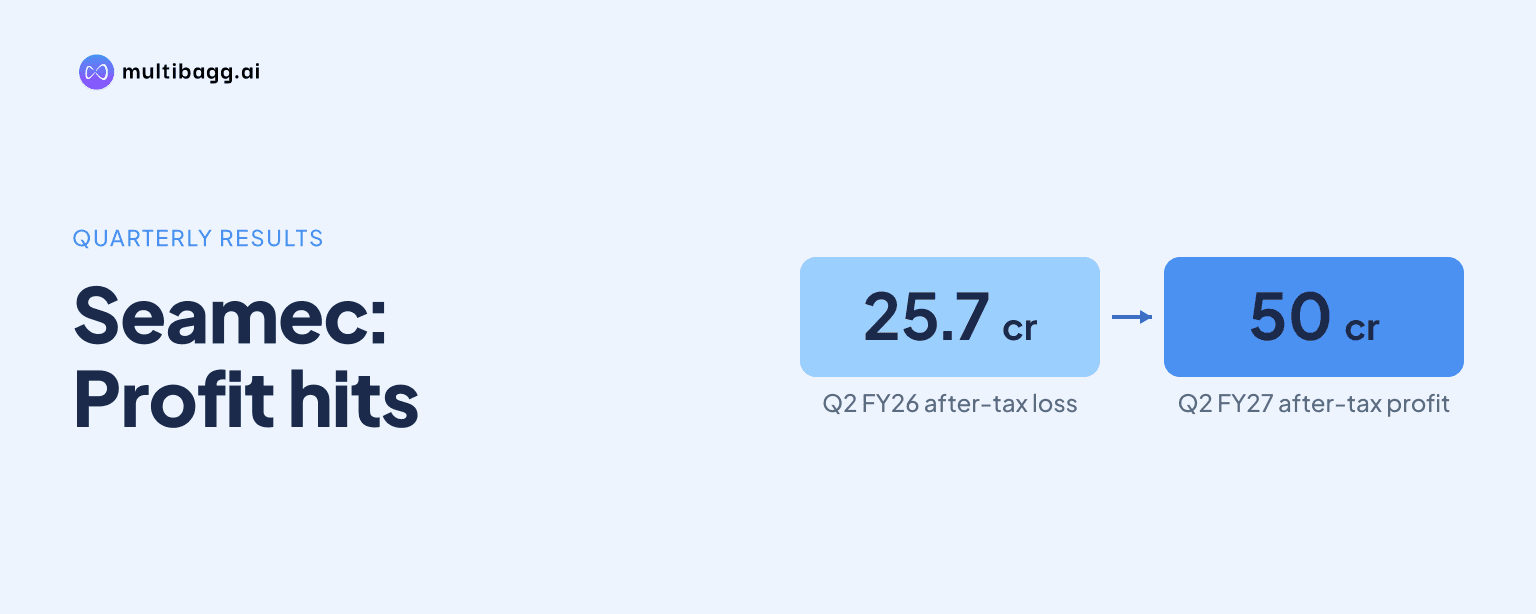
Seamec Limited reported consolidated profit after tax of Rs 50 crore in Q2 FY27, reversing a Rs 25.7 crore loss in Q2 FY26, as revenue rose 103% to Rs 198.1 crore. Management attributed the change principally to higher vessel deployment, including Sevak, Prabha and Agastya, plus greater Swordfish activity.
Know SEAMEC inside out
Results, valuation, peers and who's buying, in one view.
How did Seamec's Q2 FY27 financial results change?
Seamec's consolidated result turned profitable in Q2 FY27, with profit after tax reaching Rs 50 crore against a Rs 25.7 crore loss in Q2 FY26. Revenue increased by Rs 100.7 crore year on year to Rs 198.1 crore, while earnings before interest, tax, depreciation and amortisation, or EBITDA, rose to Rs 38.3 crore from Rs 7.8 crore.
The first-half comparison also showed growth, though the quarterly revenue increase was faster. H1 FY27 consolidated revenue was Rs 495 crore, up about 61% from Rs 308.3 crore in H1 FY26, while EBITDA rose 55% to Rs 162.2 crore from Rs 104 crore. Consolidated profit after tax for H1 FY27 was Rs 131.8 crore, compared with Rs 50 crore a year earlier.
Seamec's standalone result was substantially below the consolidated profit reported for Q2 FY27. Standalone profit after tax was Rs 4.2 crore, compared with a Rs 25.8 crore loss in Q2 FY26; standalone revenue increased to Rs 183.6 crore from Rs 82.4 crore, and standalone EBITDA rose to Rs 31.2 crore from Rs 0.2 crore.
What drove Seamec's higher vessel operating performance?
Seamec said additional vessel deployment was the main reason for the improved operating performance in Q2 FY27. Management said the Sevak and Prabha contracts, which were absent in Q2 FY26, contributed during the reported quarter, while Agastya had also joined the fleet by Q2 FY27.
The overseas business also benefited because Swordfish operated more in Q2 FY27 than in Q2 FY26, management said. This utilisation change coincided with a Rs 30.5 crore year-on-year increase in consolidated EBITDA, from Rs 7.8 crore to Rs 38.3 crore, alongside the Rs 100.7 crore rise in revenue.
Employee costs rose alongside fleet additions because they are crew-related costs, according to management. The company said the expense is linked to the number of vessels operated, establishing a direct operating mechanism between fleet deployment and personnel expenditure rather than identifying a separate one-off cost factor.
Management said the Q2 FY27 financial outcome reflected fleet expansion, operations and maintenance contracts, and better vessel deployment. It did not disclose revenue or profit contribution by vessel, but cited Sevak, Prabha, Agastya and Swordfish when explaining why Q2 FY27 differed from the prior-year quarter.
Got a follow-up? Ask IRIS
What does Seamec Anant add to Seamec's contracted fleet?
Seamec Anant adds contracted inspection, maintenance and repair work after the Q2 FY27 reporting date. Seamec took over the vessel at Kakinada on October 14, 2026, signed a long-term charter with HAL Offshore on October 21, and said operations began under that charter on the same date.
The HAL Offshore charter is for Oil and Natural Gas Corporation inspection, maintenance and repair assignments, runs for about 1,225 days, and has a value of about USD 5.5 crore excluding goods and services tax. Because the vessel started operating on October 21, after the September 30 close of Q2 FY27, the charter was not part of the reported quarter's operating period.
Management said the contract provides revenue visibility over its contracted term and strengthens Seamec's offshore inspection, maintenance and repair capability. It also said that safe operations, reliable execution and vessel utilisation would remain priorities for Seamec Anant, alongside the company’s domestic and international fleet operations.
The company cited India's Samudra Manthan National Offshore Exploration Scheme as an industry backdrop, noting its Rs 84,084 crore outlay through 2030-31. Management also referred to Oil and Natural Gas Corporation's September gas discovery in the Mahanadi Offshore Basin and its outlined investment in deepwater and ultra-deepwater exploration over the next five years.
How is Seamec funding its fleet expansion plans?
Seamec intends to pursue fleet expansion selectively, with management indicating capital expenditure of about USD 20 crore to USD 25 crore over the next two to two-and-a-half years. It said it had spent USD 7 crore to acquire Seamec Anant, but did not provide specific capital-expenditure guidance for H2.
The chief financial officer said Seamec's debt was about Rs 450 crore to Rs 470 crore after borrowing about Rs 350 crore for the Seamec Anant acquisition. Management said future investments could use debt-equity mixes of 60:40 or 70:30, describing a possible funding framework rather than a committed financing plan.
Management said Seamec is particularly focused on diving support vessels, or DSVs, while continuing to assess other vessel opportunities. It estimated that about 65 to 70 DSVs with built-in diving systems operate worldwide and said only one such vessel was reported to be under production.
A new DSV typically takes two to three years from order to delivery, management said. It estimated a basic new DSV could cost more than USD 11 crore to USD 12 crore, potentially reaching about USD 15 crore depending on specifications; second-hand acquisitions and a newbuild are both being evaluated as fleet-expansion options.
Conclusion
Seamec's Q2 FY27 turnaround combined higher revenue, higher EBITDA and a swing to Rs 50 crore of consolidated profit after tax. Management linked the improvement to operating deployment, specifically contracts for Sevak and Prabha, the addition of Agastya, and more Swordfish activity than in Q2 FY26, rather than identifying an accounting gain.
The next operating item to watch is execution of Seamec Anant's 1,225-day charter, which began on October 21, 2026. Management also said Seamec Princess was in advanced discussions with L&T for the PRP-X contract, and disclosed that Swordfish is scheduled for dry docking in FY27-28 while fleet expansion is evaluated over the next two to two-and-a-half years.