










SEAMEC sees ₹84,084 crore plan driving India offshore demand
Key highlights
- Samudra Manthan has a ₹84,084 crore outlay through FY2030-31 after approval on 31 July 2026.
- SEAMEC cites 25 offshore installations and more than 1,000 km of subsea pipelines planned over the next three years.
- OALP Round IX awarded 28 blocks, including 12 ultra-deepwater blocks, while Round X launched 25 blocks across about 1.92 lakh square km.
- SEAMEC’s standalone H1 FY27 revenue rose 65% year on year to ₹467 crore.
powered by IRIS
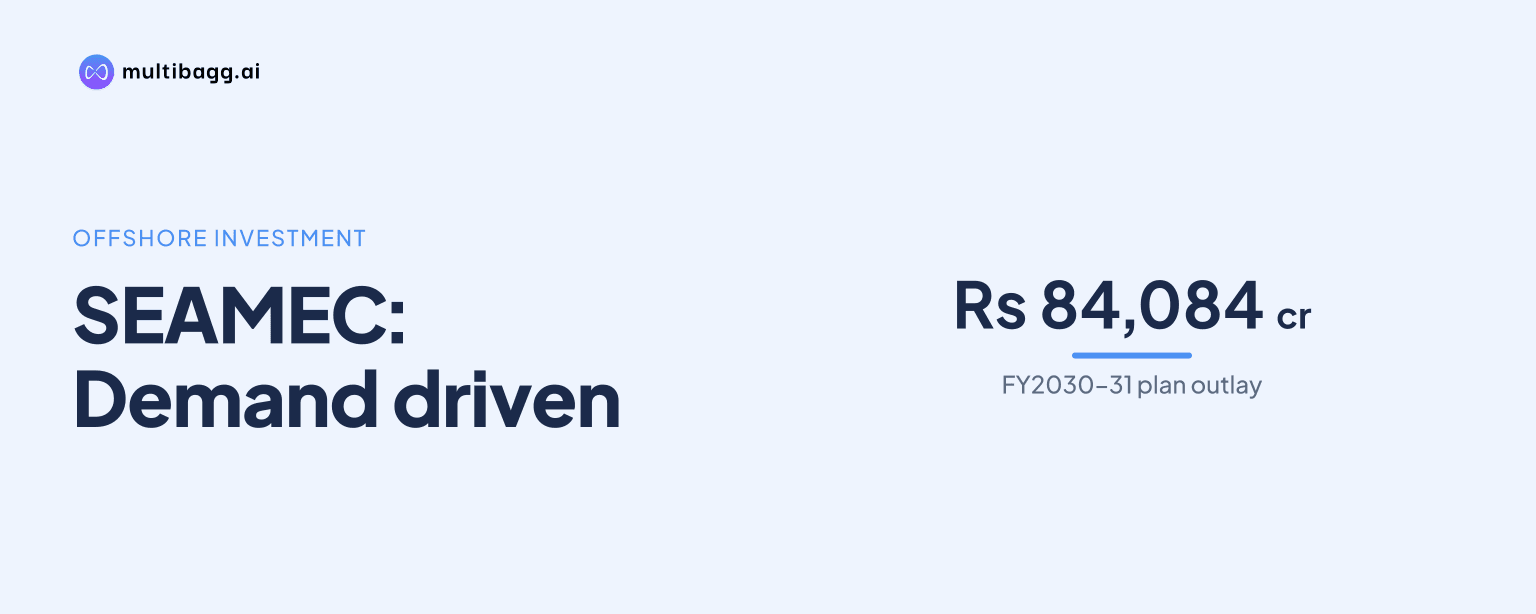
SEAMEC Limited says the ₹84,084 crore Samudra Manthan programme, approved on 31 July 2026 through FY2030-31, could support future demand for offshore vessels and subsea services. SEAMEC also identifies 25 offshore installations, more than 1,000 km of subsea pipelines and expanding exploration acreage as prospective activity drivers.
Know SEAMEC inside out
Results, valuation, peers and who's buying, in one view.
What is SEAMEC’s case for rising India offshore demand?
SEAMEC’s case is that exploration, field development and maintenance activity could widen the market for marine and subsea contractors, although it provides no revenue forecast from these developments. Its presentation identifies Samudra Manthan, mature-field redevelopment at Mumbai High, Andaman offshore discoveries, Open Acreage Licensing Programme, or OALP, rounds and National Oil Company capital expenditure as potential sources of work.
The opportunity is relevant to SEAMEC because domestic operations represented about 83% of FY26 geographical revenue, compared with about 17% from overseas business. The company lists seven Diving Support Vessels, or DSVs, one Offshore Support Vessel, or OSV, and one accommodation barge, serving subsea construction, inspection, maintenance and repair, or IMR, and offshore logistics requirements.
SEAMEC’s DSV scope includes single-buoy-mooring maintenance, removals and installations, platform, riser and pipeline repairs, subsea construction and remotely operated vehicle deployment. Its one OSV, SEAMEC Diamond, is designed to support offshore platforms and subsea installations throughout a field’s operating life, while SEAMEC Glorious provides accommodation and project-material capacity.
How large is the Samudra Manthan programme?
Samudra Manthan has a total outlay of ₹84,084 crore through FY2030-31, with financial assistance of up to 50% of eligible exploration costs. The Government of India approved the National Offshore Exploration Scheme on 31 July 2026 to accelerate offshore hydrocarbon exploration and support long-term energy security, according to SEAMEC’s presentation.
SEAMEC does not state how much of the programme’s outlay could reach vessel operators, DSV providers or IMR contractors. Its rationale is that exploration success can lead to appraisal, development, installation and maintenance work, which may require offshore support vessels and specialised subsea assets.
The presentation places the programme alongside spending by major oil companies. ONGC’s FY26 capital expenditure was ₹35,878 crore, while its FY27E capital expenditure is listed at ₹32,000 crore to ₹33,000 crore. Oil India’s capital expenditure is listed at ₹13,026 crore in FY26 and ₹7,585 crore in FY27E, a reduction between the two periods.
Which infrastructure projects could require offshore vessels?
SEAMEC identifies 25 offshore installations and more than 1,000 km of subsea pipelines planned over the next three years as indicators of potential offshore activity. The presentation does not identify contract values, tender dates or work awards for SEAMEC, but installation, replacement and maintenance can require logistics vessels, DSVs and subsea IMR capability.
The company also cites a ₹1,032 crore ONGC contract secured by GRSE for four Platform Supply Vessels, or PSVs. That order concerns vessel construction for ONGC rather than a SEAMEC contract, and it differs from SEAMEC’s fleet focus on diving support, subsea construction and repair work.
SEAMEC has expanded its own operating capacity during this period. SEAMEC Agastya commenced operations during FY26, while SEAMEC Anant commenced operations in October 2026. The presentation says these additions, together with fresh deployments of SEAMEC II and SEAMEC Glorious, support near-term revenue growth.
SEAMEC Anant was formally taken over at Kakinada on 14 October 2026 after a memorandum of agreement signed on 21 July 2026 for US$70 million. On 21 October 2026, it entered a long-term HAL Offshore charter for ONGC IMR work covering about 1,225 days and about US$55 million excluding goods and services tax.
Got a follow-up? Ask IRIS
How is India’s offshore exploration footprint expanding?
India’s offshore exploration footprint is expanding through OALP rounds and ONGC’s acreage plans, according to SEAMEC. OALP Round IX awarded 28 exploration blocks, including 12 ultra-deepwater blocks, while OALP Round X launched 25 blocks covering about 1.92 lakh square km.
ONGC is targeting exploration acreage of 5 lakh square km, which would enlarge the potential base for later appraisal and development activity. SEAMEC says every new offshore block can create future need for offshore support vessels, IMR services and subsea construction, but block awards do not establish work timing or contract allocation.
The presentation links this policy focus to India’s crude-oil import dependence of 88.7% in FY26. It also says ONGC contributes 66% of India’s oil production and 58% of gas production, making ONGC a central demand driver within SEAMEC’s predominantly domestic revenue mix.
SEAMEC estimates the Indian OSV market at about US$1.5 billion in 2025 and projects it at about US$2.06 billion by 2034, equivalent to a 3.07% compound annual growth rate, or CAGR. By comparison, the presentation projects 9.8% CAGR for the global subsea IMR market and 9.8% for offshore decommissioning, explaining SEAMEC’s emphasis on specialist subsea work as well as general marine support.
What operating evidence does SEAMEC report from its fleet expansion?
SEAMEC reported standalone H1 FY27 revenue of ₹467 crore, up 65% from ₹283.8 crore in H1 FY26. It attributed the increase to higher deployment of SEAMEC Swordfish, new contracts for Samudra Sevak and Samudra Prabha, and the addition of SEAMEC Agastya.
Standalone earnings before interest, tax, depreciation and amortisation, or EBITDA, rose 57% to ₹148 crore in H1 FY27 from ₹94.3 crore in H1 FY26. EBITDA margin declined to 31.7% from 33.2%, showing that EBITDA increased in absolute terms while the margin was lower than the preceding-year half.
In Q2 FY27, standalone revenue was ₹183.6 crore, up 123% from ₹82.4 crore in Q2 FY26 but below ₹283.3 crore in Q1 FY27. EBITDA was ₹31.2 crore, compared with ₹0.2 crore a year earlier and ₹116.8 crore in Q1 FY27; SEAMEC says repairs to Samudra Prabha cost ₹12.50 crore during the quarter.
SEAMEC describes its capital-allocation approach as demand-backed vessel acquisitions. Consolidated gross debt declined to ₹153 crore in H1 FY27 from ₹328 crore in FY26, while net debt was negative ₹227.4 crore compared with negative ₹227 crore in FY26. The presentation does not provide a company-wide revenue target for the new fleet additions.
Conclusion
SEAMEC’s outlook combines a ₹84,084 crore exploration programme with a three-year infrastructure pipeline of 25 offshore installations and more than 1,000 km of subsea pipelines. These are potential demand inputs for its seven DSVs, one OSV and one accommodation barge, particularly where offshore activity requires pipeline repair, IMR, subsea construction or marine support.
The next disclosed markers are delivery under the approximately 1,225-day SEAMEC Anant charter for ONGC IMR work, fresh deployments of SEAMEC II and SEAMEC Glorious, and implementation of Samudra Manthan through FY2030-31. The unresolved issue is whether exploration blocks and infrastructure plans progress into tenders and vessel contracts accessible to SEAMEC.