










Seamec H1 FY27 consolidated profit rose 163% to Rs 131.8 crore
Key highlights
- Seamec reported H1 FY27 consolidated profit after tax of Rs 131.8 crore, up 163% from Rs 50.0 crore.
- H1 FY27 consolidated net revenue rose 61% to Rs 495.0 crore and EBITDA excluding other income increased 55% to Rs 162.2 crore.
- The sale of Seamec Gallant generated a Rs 42.4 crore exceptional gain in H1 FY27.
- Seamec's gross debt declined to Rs 153 crore at H1 FY27 from Rs 328 crore at FY26.
powered by IRIS
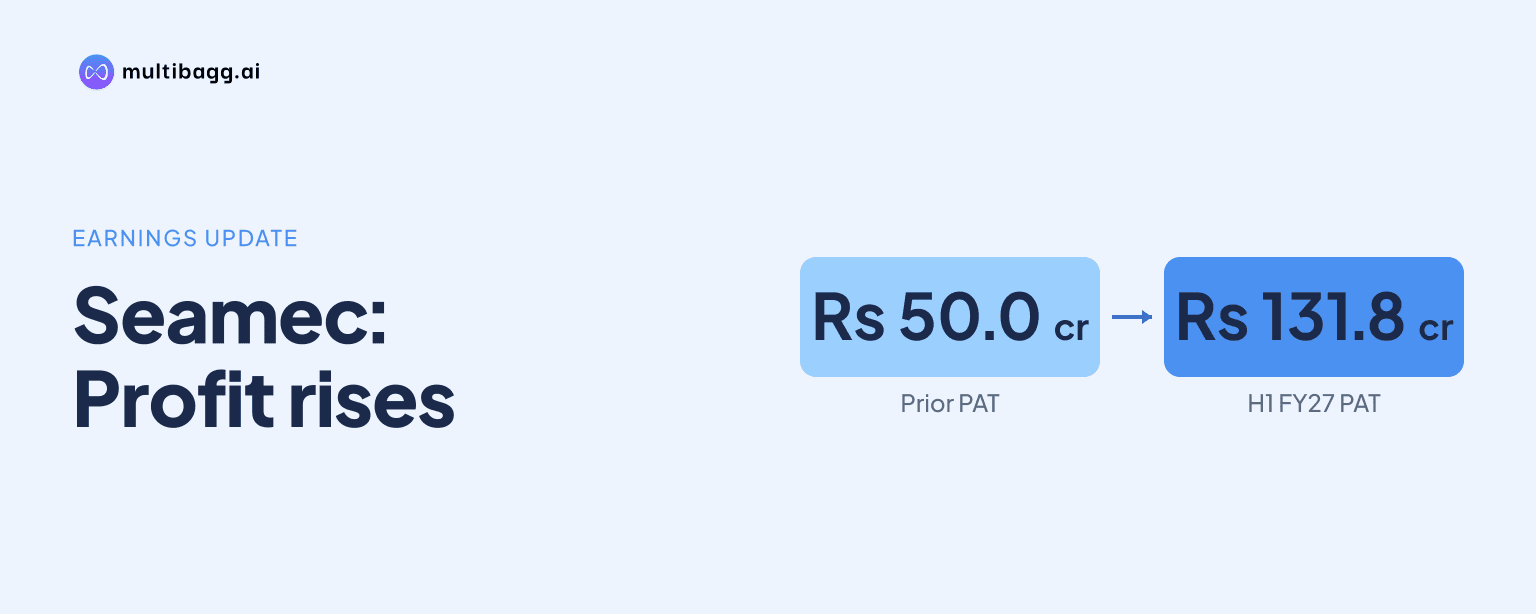
SEAMEC LIMITED reported H1 FY27 consolidated profit after tax of Rs 131.8 crore, up 163% from Rs 50.0 crore in H1 FY26, as revenue rose 61% to Rs 495.0 crore and the sale of Seamec Gallant generated a Rs 42.4 crore exceptional gain.
Know SEAMEC inside out
Results, valuation, peers and who's buying, in one view.
Why did Seamec's H1 FY27 profit rise?
Seamec's reported H1 FY27 profit rose because vessel deployments increased operating earnings and the Seamec Gallant sale added a Rs 42.4 crore exceptional gain. Profit before tax increased 156% to Rs 138.1 crore from Rs 53.9 crore, while profit after tax rose by Rs 81.8 crore to Rs 131.8 crore. The profit-after-tax margin increased to 26.6% from 16.2%.
Operating performance also increased before the exceptional item. Earnings before interest, tax, depreciation and amortisation, or EBITDA, excluding other income rose 55% to Rs 162.2 crore from Rs 104.7 crore. However, the EBITDA margin declined to 32.8% from 34.0%, while total expenditure increased 63% to Rs 332.9 crore against a 61% rise in net revenue.
What drove Seamec's H1 FY27 revenue growth?
The presentation attributes Seamec's H1 FY27 revenue growth to higher deployment of Swordfish, new contracts for Samudra Sevak and Samudra Prabha, and the newly acquired Seamec Agastya. These operating additions lifted consolidated net revenue by Rs 186.7 crore to Rs 495.0 crore from Rs 308.3 crore in H1 FY26.
Q2 FY27 showed that activity was lower than in the preceding quarter but ahead of the prior year. Consolidated Q2 revenue was Rs 198.1 crore, up 103% from Rs 97.4 crore in Q2 FY26 but below Rs 296.9 crore in Q1 FY27. Q2 EBITDA was Rs 38.3 crore, compared with Rs 7.8 crore a year earlier and Rs 123.9 crore in Q1 FY27.
The presentation described Q2 FY27 revenue as the highest for that quarter and also cited higher deployment of Seamec II. It said Q2 EBITDA benefited from Samudra Sevak, Samudra Prabha and Seamec Agastya despite Rs 12.50 crore of repair work on Samudra Prabha. The Q2 EBITDA margin was 19.3%, versus 8.0% in Q2 FY26 and 41.7% in Q1 FY27.
How much did the Seamec Gallant sale contribute?
The sale of Seamec Gallant created a Rs 42.4 crore exceptional gain in both Q2 FY27 and H1 FY27 consolidated results. Seamec identified the vessel as owned by Seamec International FZE, a wholly owned subsidiary engaged in bulk transportation services. The gain was recorded below finance cost and above profit before tax.
The reported H1 FY27 profit therefore includes an item outside EBITDA. The presentation does not provide an after-tax profit measure excluding the Rs 42.4 crore gain, so it does not establish a precise recurring post-tax profit. It does show EBITDA excluding other income increased by Rs 57.5 crore to Rs 162.2 crore before depreciation of Rs 102.1 crore, finance cost of Rs 8.1 crore and the exceptional item.
The quarterly figures further show the effect of the gain on reported earnings. Q2 FY27 profit after tax was Rs 50.5 crore, compared with a Rs 25.7 crore loss in Q2 FY26, while Q2 profit before tax was Rs 48.6 crore against a Rs 25.1 crore loss. Q2 depreciation was Rs 52.2 crore and finance cost was Rs 3.6 crore.
Got a follow-up? Ask IRIS
What changed in Seamec's costs and margins?
Seamec's H1 FY27 operating expenses rose 83% to Rs 219.1 crore from Rs 119.9 crore, exceeding the 61% growth in revenue. Employee cost increased 43% to Rs 82.8 crore, while other expenses rose 19% to Rs 31.0 crore. These changes coincided with a 1.2 percentage-point decline in EBITDA margin to 32.8%.
Below EBITDA, depreciation increased 41% to Rs 102.1 crore from Rs 72.2 crore, whereas interest and finance cost declined 4% to Rs 8.1 crore from Rs 8.5 crore. Other income rose 46% to Rs 43.7 crore. Together with the Rs 42.4 crore exceptional gain, these movements lifted profit before tax by Rs 84.2 crore.
Standalone results were lower than consolidated results in H1 FY27. Seamec reported standalone revenue of Rs 467.0 crore and profit after tax of Rs 85.3 crore, compared with Rs 283.8 crore and Rs 53.8 crore in H1 FY26. The standalone statement reported no exceptional item, while the consolidated statement recorded the Seamec Gallant gain.
What does Seamec's H1 FY27 balance sheet show?
Seamec reported gross debt of Rs 153 crore at H1 FY27, down from Rs 328 crore at FY26 and Rs 212 crore at FY25. Reported net debt was negative Rs 227.40 crore at H1 FY27, compared with negative Rs 227.00 crore at FY26. The presentation does not disclose the cash and borrowing components underlying net debt.
Net debt to equity was negative 0.16 times at H1 FY27, compared with negative 0.17 times at FY26 and negative 0.26 times at FY25. Net debt to EBITDA was negative 0.50 times, compared with negative 0.51 times at FY26. Return on capital employed was 20%, up from 18%, and return on equity was 23%, up from 19%.
The disclosed asset portfolio includes seven diving support vessels, including Swordfish, Seamec Agastya, Seamec II and Seamec Paladin, alongside Seamec Diamond, an offshore support vessel, and Seamec Glorious, an accommodation barge. Seamec also lists ASEAN Pearl as a bulk carrier, while Seamec International FZE is described as operating two bulk carriers.
Conclusion
Seamec's H1 FY27 result combined a larger operating base with a non-recurring vessel-sale gain. Revenue increased 61% and EBITDA excluding other income rose 55%, reflecting deployments and contracts involving Swordfish, Samudra Sevak, Samudra Prabha and Seamec Agastya. The Rs 42.4 crore gain on Seamec Gallant helped lift reported profit after tax to Rs 131.8 crore, while EBITDA margin fell to 32.8% from 34.0%.
Next, investors can watch the revenue and EBITDA contribution from Samudra Sevak, Samudra Prabha, Seamec Agastya and Swordfish, which the presentation identifies as operating drivers. Other disclosed matters to monitor are repair-related costs after Rs 12.50 crore of work on Samudra Prabha, the impact on Seamec Paladin due to the State of Hormuz, and changes in gross debt following its decline to Rs 153 crore at H1 FY27.