










SJS raises FY27 EBITDA margin guidance after Q2 expansion
Key highlights
- SJS raised FY27 EBITDA-margin guidance to 29-30% from 27-28%.
- SJS reported Q2FY27 operating revenue of Rs 282.73 crore, up 16.9% year on year.
- SJS's Q2FY27 EBITDA margin increased to 31.0% from 29.6% in Q2FY26.
- SJS ended Q2FY27 with net cash of Rs 331.87 crore.
powered by IRIS
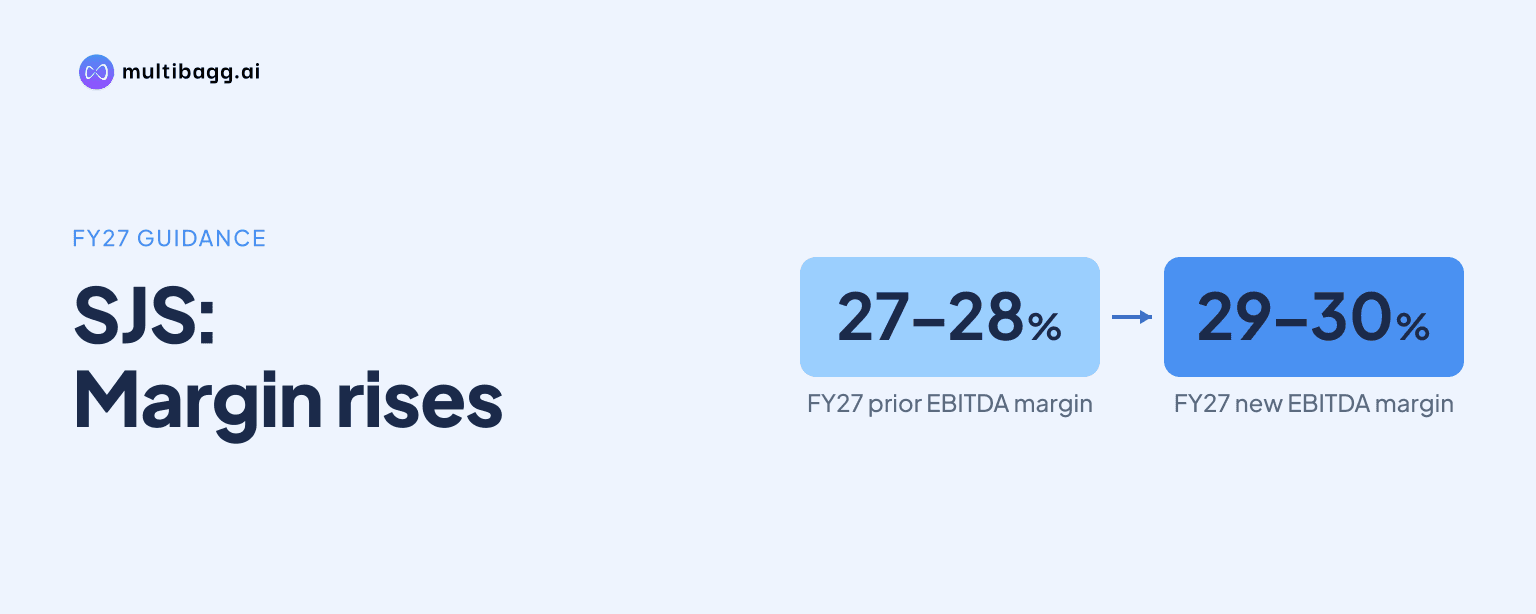
SJS Enterprises Limited raised its FY27 EBITDA margin guidance to 29-30% from 27-28% after reporting a 31.0% margin in Q2FY27, when operating revenue rose 16.9% year on year to Rs 282.73 crore. SJS also recalibrated revenue-growth expectations to 1.2-1.5 times passenger-vehicle and motorcycle industry growth.
Know S J S Enterprises inside out
Results, valuation, peers and who's buying, in one view.
What changed in SJS's FY27 guidance?
SJS raised its FY27 earnings before interest, tax, depreciation and amortisation, or EBITDA, margin guidance by 2 percentage points to 29-30%, from 27-28% previously. Management attributed the higher range to continued cost efficiencies and an improving product mix, following EBITDA margins of 31.0% in Q2FY27 and 30.5% in H1FY27.
SJS simultaneously reset its FY27 revenue-growth outlook to 1.2-1.5 times growth in the passenger-vehicle and motorcycle industry. Management said the recalibration reflected the evolving global macroeconomic environment, and the November 4, 2026 announcement did not give an absolute FY27 revenue-growth percentage or an industry-volume forecast.
The revised framework sets a lower relative growth expectation alongside a higher profitability target. SJS reported automotive-business growth of 21.7% year on year in Q2FY27, compared with 17.8% growth in automotive industry production volumes, although management cited subdued global consumer original equipment manufacturer demand, planned stock-keeping unit rationalisation at WPI and slower motorcycle growth relative to scooters as offsets.
How did SJS perform in Q2FY27 and H1FY27?
SJS reported record quarterly operating revenue of Rs 282.73 crore in Q2FY27, up 16.9% from Rs 241.76 crore in Q2FY26. EBITDA rose 23.1% to Rs 89.64 crore, outpacing revenue growth and lifting the EBITDA margin by 1.4 percentage points from 29.6% a year earlier.
SJS's reported profit after tax increased 34.8% to Rs 58.33 crore in Q2FY27, with the reported profit-after-tax margin reaching 20.6%. Management described that as its highest quarterly normalised profit-after-tax margin since listing, while September 2026 was also the first month in which SJS crossed Rs 100 crore of revenue.
For H1FY27, SJS recorded operating revenue of Rs 543.73 crore, up 20.4% year on year, and EBITDA of Rs 169.6 crore, up 28.9%. The H1 EBITDA margin rose to 30.5% from 28.7%, while reported profit after tax rose 70.4% to Rs 132.75 crore and included a Rs 24.17 crore post-tax exceptional gain from selling an old Bangalore facility in Q1FY27.
Got a follow-up? Ask IRIS
Which segments supported SJS's margin outlook?
Passenger vehicles and exports were the reported growth drivers in Q2FY27, with passenger-vehicle revenue up 33.4% year on year and export revenue up 23.1% to Rs 28.25 crore. Exports accounted for 10.0% of quarterly revenue, while domestic business increased 16.3% in the same period.
The H1FY27 comparison showed faster expansion in these areas, as passenger-vehicle revenue rose 39.0% and exports increased 45.8%. SJS's automotive business grew 26.6% in H1FY27, exceeding the 19.7% increase in combined passenger-vehicle and two-wheeler production volumes cited by management.
Management linked the revised 29-30% margin range to favourable product mix, higher export share and cost optimisation. SJS supplies decals, 3D lux badges, overlays, aluminium badges, chrome-plated parts and optical plastics, and said higher content per vehicle, particularly in passenger vehicles, supported Q2FY27 revenue.
SJS also disclosed new export orders from Stellantis and Whirlpool in North America during Q2FY27, followed by an order from TADME, Toyota Middle East, in October 2026. The announcement did not disclose the order values, delivery schedules or expected revenue contribution, but management said the wins strengthened its order pipeline and visibility.
What projects and risks should SJS investors monitor?
SJS has completed its Bangalore capacity expansion, with commercial production scheduled to start in Q3FY27. SDPL's new chrome-plating facility has commenced commercial production, while SJS said WPI's three Ranjangaon facilities are being consolidated into one integrated plant to support operational efficiencies and future growth.
SJS Display Electronics is setting up an automotive-display plant in Pune that is planned to become operational by Q2FY28. SJS said its technology partnership with BOE Varitronix is strengthening domestic capabilities in optical bonding and assembly of automotive displays, providing the stated technological basis for the Pune project.
SJS ended Q2FY27 with net cash of Rs 331.87 crore and said its capital expenditure was funded entirely through internal cash generation. Management said the balance-sheet position gives SJS capacity to incubate technologies and pursue strategic acquisitions, but it did not identify an acquisition target, investment amount or transaction timeline.
The disclosed constraints remain demand and execution-related. Management pointed to subdued global consumer original equipment manufacturer demand, WPI's planned stock-keeping unit rationalisation and slower motorcycle growth than scooters, while the global macroeconomic environment was the stated reason for resetting the FY27 revenue-growth outlook.
Conclusion
SJS's FY27 update combines a reset revenue-growth framework of 1.2-1.5 times passenger-vehicle and motorcycle industry growth with a higher EBITDA-margin target of 29-30%. Its Q2FY27 results provide the reported basis for that change: revenue grew 16.9%, EBITDA rose 23.1%, and EBITDA margin expanded to 31.0% from 29.6%.
The next disclosed milestones are commercial production at the expanded Bangalore facility in Q3FY27, the planned Q2FY28 opening of the Pune display plant and the November 5, 2026 earnings conference call. Investors can also monitor whether passenger-vehicle demand, export growth, new customer orders and WPI consolidation offset the demand factors management identified.