










SJS sees PV kit value rise five to eight times through new products
Key highlights
- SJS states a future PV kit-value opportunity of five to eight times per vehicle.
- SJS's current post-WPI PV kit value is Rs 3,500-Rs 5,000 per vehicle, versus Rs 1,200-Rs 1,500 for legacy products.
- New-generation products contributed about 24% of SJS consolidated H1FY27 revenue.
- PV represented 43.9% of SJS H1FY27 revenue, and Q2FY27 PV business grew 37.3% year on year.
powered by IRIS
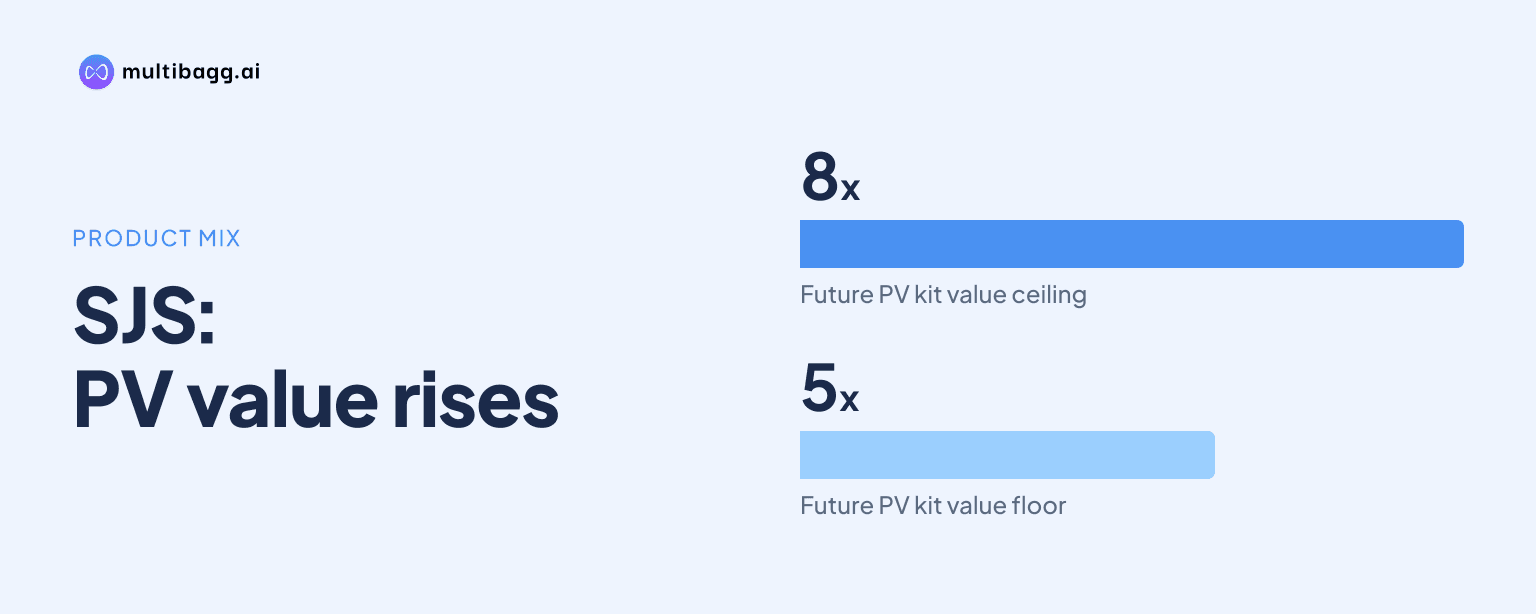
SJS says future passenger-vehicle (PV) kit value could grow five to eight times per vehicle, following a current post-WPI range of Rs 3,500-Rs 5,000 versus a legacy range of Rs 1,200-Rs 1,500. Its November 2026 presentation links the opportunity to new aesthetic products including optical plastics, display systems and illuminated logos.
Know S J S Enterprises inside out
Results, valuation, peers and who's buying, in one view.
How can SJS increase PV kit value five to eight times?
SJS says a broader range of new-age and future products could lift PV kit value by five to eight times per vehicle. The presentation does not state the rupee value, base year, vehicle volumes or timetable behind that future range. It instead presents the figure as a premiumisation-led opportunity from adding more aesthetic, illuminated and display-related applications across a vehicle.
The starting kit-value range has already increased after acquisition-led portfolio expansion. SJS places legacy PV kit value at Rs 1,200-Rs 1,500 per vehicle and current post-WPI kit value at Rs 3,500-Rs 5,000 per vehicle. SJS says the SJS DecoPlast and WPI acquisitions added chrome parts and in-mould decoration (IMD), in-mould labelling (IML) and in-mould forming (IMF) parts used in modern PV design.
The difference between the legacy and current ranges shows the larger content base that SJS says it has built before its future product pipeline is commercialised. The current range is more than double the upper end of the Rs 1,200-Rs 1,500 legacy range, although SJS does not disclose an average realised kit value or the contribution of each acquired product category.
Which products support SJS's PV premiumisation plan?
SJS identifies optical plastics, touch-screen cover glass and display systems as selected PV products that can raise its content per vehicle. The product list also includes wheel caps, aluminium badges, IML interiors, illuminated logos or emblems, three-dimensional ink or aluminium emblems, and heating, ventilation and air-conditioning overlays. These applications extend across exterior branding, interior surfaces and display-related vehicle components.
The legacy PV range includes illuminated logos, three-dimensional air vents, front-side-plate IMD, bumper guards, rear badges, chrome plating, mirror inserts, body graphics, blackout tape, door guards, side cladding, wheel-rim decals and wheel caps. Newer listed technologies include optical plastics, cover glass, smart surfaces and illuminated scuff plates. SJS therefore describes the opportunity as adding higher-value surfaces and illuminated or electronic-related components alongside established decals, badges and plated parts.
The same approach is presented for two-wheelers and consumer durables. SJS gives two-wheelers a legacy kit value of Rs 300-Rs 500 per vehicle and future growth potential of 1.5-2 times, citing optical plastics, touch screens, aluminium logos and WPI illuminated logos. For consumer durables, it states a legacy range of Rs 50-Rs 150 per product and a future potential of three-four times, supported by optical glass, touch screens, IMD or IML overlays and printed electronics.
Got a follow-up? Ask IRIS
How much of SJS revenue comes from PV and new-generation products?
PV accounted for 43.9% of SJS consolidated revenue in H1FY27, while new-generation products contributed about 24% of consolidated revenue in the same six-month period. PV was the largest reported end segment, ahead of two-wheelers at 37.8%, consumer products at 14.2% and others at 4.1%. The figures show that PV is the largest end-market exposure while newer products represented nearly one-quarter of revenue.
In Q2FY27, PV represented 43.3% of revenue, 0.6 percentage points below its H1FY27 share of 43.9%. Two-wheelers accounted for 38.9% in the quarter, consumer products 13.8% and others 4.0%. By business, SJS represented 54.3% of both Q2FY27 and H1FY27 revenue, SJS Decoplast 28.1% and WPI 17.6%, meaning the two acquired businesses represented a combined 45.7% in each period.
SJS reported Q2FY27 operating revenue of Rs 282.73 crore, up 16.9% from Rs 241.76 crore in Q2FY26. EBITDA, or earnings before interest, tax, depreciation and amortisation, rose 23.1% to Rs 89.64 crore, and the EBITDA margin increased to 31.0% from 29.6%. SJS attributed the 1.4-percentage-point margin increase to export contribution, product mix and operating-efficiency improvements.
Domestic sales rose 16.3% year on year to Rs 254.48 crore in Q2FY27, while exports increased 23.1% to Rs 28.25 crore and represented 10.0% of consolidated quarterly revenue. SJS said PV business grew 37.3% year on year in Q2FY27. That segment growth exceeded the 16.9% increase in consolidated operating revenue, although the presentation does not provide PV revenue in rupees.
What must SJS deliver to realise the higher kit-value opportunity?
SJS must develop, qualify and commercialise its product pipeline while expanding applications with vehicle makers to realise the stated kit-value potential. Its plan includes a tie-up with BOE Varitronix to develop optical cover glass and display systems in India. SJS also intends to introduce illuminated logos, in-moulded electronic (IME) parts and other new-generation technologies, but it gives no product-level revenue forecast.
Manufacturing milestones provide the disclosed timetable for the plan. SJS says the SJS Decoplast chrome-plating facility has commenced commercial production, while its Bangalore capacity expansion was completed and was due to begin commercial production in Q3FY27. SJS Display Electronics Pvt. Ltd. is setting up a Pune display-electronics plant targeted to be operational in September 2027, and SJS plans to consolidate three Ranjangaon plants into one by May 2027.
WPI remains part of the expansion mechanism. SJS acquired WPI in July 2023 and says it is in the performance-improvement phase; WPI revenue in FY26 grew about 1.5 times from acquisition. SJS says it will continue to explore value-accretive acquisitions in adjacent areas including IMD, IML, IME and plastic injection moulding, as well as consumer industries and new geographies.
For FY27, management expects SJS to grow at 1.2-1.5 times the underlying PV-plus-motorcycle industry growth, citing premiumisation, deeper original-equipment-manufacturer engagement, exports, new customer wins and wider geographic reach. Management also said the order book to be executed in FY27 was more than 90% of forecast FY27 revenue and raised EBITDA-margin guidance to 29-30% from 27-28%.
Conclusion
SJS presents the five-to-eight-times PV kit-value figure as a future content-per-vehicle opportunity rather than reported revenue or a dated target. Its current Rs 3,500-Rs 5,000 PV kit range is above the Rs 1,200-Rs 1,500 legacy range, while PV supplied 43.9% of H1FY27 revenue and new-generation products supplied about 24%. The strategy combines established decorative products with optical, display, touch and illumination applications.
The next disclosed milestones are Bangalore commercial production in Q3FY27, Ranjangaon consolidation by May 2027 and the Pune display-electronics plant target of September 2027. Investors can also monitor execution of the FY27 order book, which exceeds 90% of forecast FY27 revenue, and management's 29-30% EBITDA-margin guidance as SJS commercialises its product pipeline.