










SMT targets about 20% EBITDA margin by FY29, keeps capex at Rs 70 crore
Key highlights
- SMT targets about 20% EBITDA margin by FY29, compared with 14.1% in FY26.
- SMT has guided for capex of around Rs 70 crore in both FY27 and FY28.
- Q2 FY27 EBITDA margin rose to 17.6% from 16.0% a year earlier.
- SMT spent about Rs 44 crore on capex in H1 FY27.
powered by IRIS
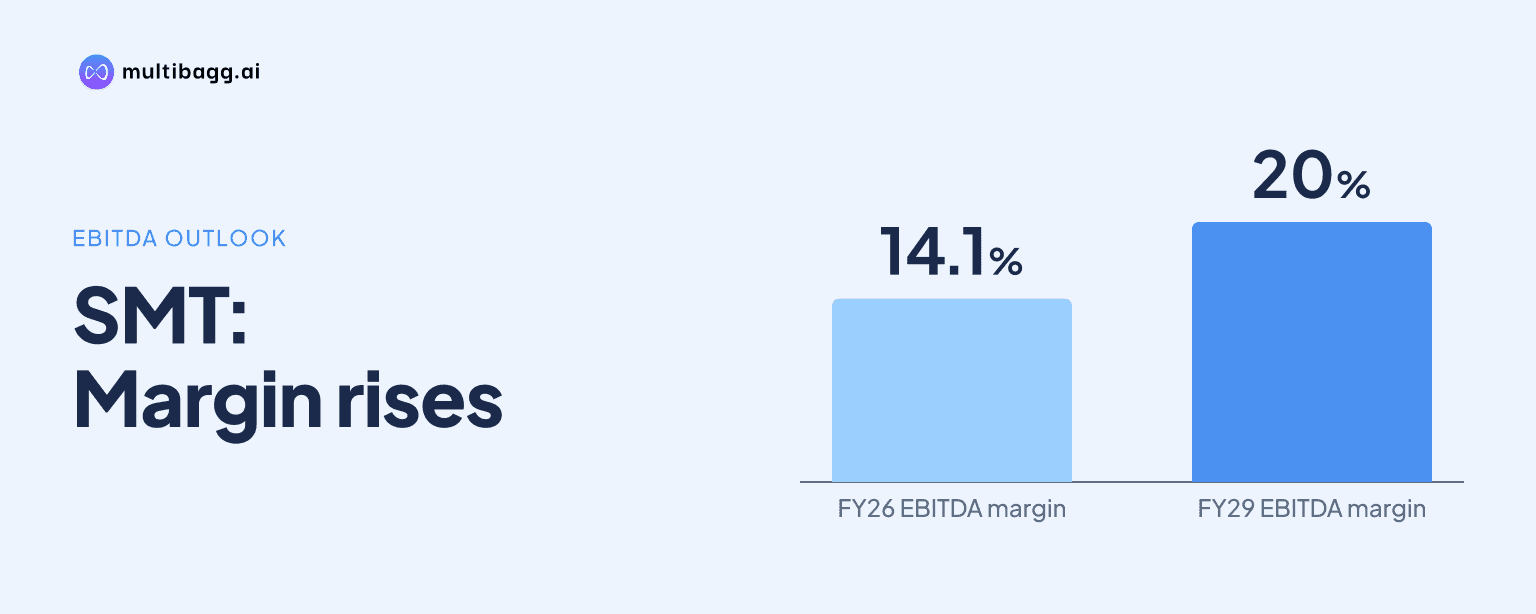
Sahajanand Medical Technologies is targeting an EBITDA margin of about 20% by FY29 while maintaining capex guidance of around Rs 70 crore each in FY27 and FY28. Management expects 150-200 basis points of annual margin expansion from FY26's 14.1%, mainly as revenue grows faster than costs at its established overseas sales operations.
Know Sahajanand Medical Technologies inside out
Results, valuation, peers and who's buying, in one view.
How does SMT plan to reach a 20% EBITDA margin by FY29?
SMT plans to expand EBITDA margin by 150-200 basis points annually in FY27, FY28 and FY29, taking it from 14.1% in FY26 to about 20% by FY29, management said. EBITDA means earnings before interest, tax, depreciation and amortisation. Management attributed the planned increase primarily to operating leverage rather than to a quantified improvement in gross margin.
The company has already built direct sales teams in Spain, Poland, Germany and France, management said. SMT does not expect to add many employees in these markets, while salaries are expected to increase broadly with 3%-5% inflation and revenue is expected to grow faster. This cost structure is the stated basis for employee-cost leverage.
Q2 FY27 provided evidence of that trend. Revenue rose 24.7% year on year to Rs 373 crore, while EBITDA increased 36.6% to Rs 65 crore and EBITDA margin reached 17.6%, versus 16.0% a year earlier. In H1 FY27, revenue grew 24.9% to Rs 725 crore and EBITDA grew 43.4% to Rs 114 crore, resulting in a 15.7% margin.
The Q2 margin expansion occurred despite lower gross margin in H1 FY27. Gross margin was 74.3%, down 170 basis points from 76.0% a year earlier, including about 150 basis points from mix. Management said traded products with lower gross margins grew faster than SMT's own products, while regional mix also shifted; pricing remained broadly stable across product segments.
What is SMT's capex plan through FY28?
SMT has guided for capex of around Rs 70 crore in FY27 and again in FY28, with no meaningful increase expected over the next two to three years. It spent about Rs 44 crore in H1 FY27, leaving roughly Rs 26 crore under its full-year FY27 guidance. Management said additional balloon or stent lines should not require a major increase in annual spending.
The FY27 and FY28 programme covers vertical integration of processes currently outsourced, automation and maintenance capex at the legacy Sachin plant. A smaller portion is intended for capacity enhancement. Management did not disclose the allocation among these three areas or give a peak revenue figure supported by the planned capex.
Management said vertical integration should improve gross margin but declined to quantify the likely benefit because the processes are complex and still being established. SMT said it may provide guidance after completing the processes and running several cycles. Therefore, the disclosed FY29 margin path relies mainly on sales and operating-cost leverage in the near term.
Existing capacity also supports the Rs 70 crore annual capex plan. In H1 FY27, drug-eluting stent utilisation was 79% at Surat and 20% at Telangana, while balloon utilisation was 72% at Surat and 57% at Telangana. The newer drug-coated balloon line at Surat was at 40% utilisation, indicating capacity headroom without a major new plant investment.
Got a follow-up? Ask IRIS
What operating evidence supports SMT's margin target?
SMT's Q2 FY27 expense ratios show the operating leverage cited by management. Employee cost declined to 27.1% of revenue from 28.8%, while other expenses fell to 29.7% from 31.5%. Management calculated the combined reduction as about 350 basis points of cost efficiency, helping EBITDA outpace revenue growth.
Product growth gives SMT more revenue to sell through its existing commercial infrastructure. Vascular intervention, its largest category, represented 58% of H1 FY27 revenue and grew 16% year on year. Structural heart grew about 40% in Q2 FY27, with both transcatheter aortic valve implantation, or TAVI, and occluders increasing by about 40%.
Other products increased 52% in H1 FY27, largely because of intravascular ultrasound, or IVUS, in Europe. Regionally, rest of world grew 37% and became SMT's largest region at 40% of H1 revenue, while Europe grew 23% and accounted for 36%. India improved from 6% growth in Q1 FY27 to 15% in Q2 FY27.
Currency also affected reported growth in the half, particularly in Europe. On a constant-currency basis, SMT said revenue grew about 16% in Q2 FY27 and about 15% in H1 FY27, below reported growth of 24.7% and 24.9%, respectively. Management guided to mid-teens constant-currency revenue growth in FY27, while declining to forecast currency gains.
What could determine whether SMT reaches its FY29 margin goal?
The FY29 target depends on revenue continuing to grow against the overseas cost base, fuller use of Telangana capacity and progress in vertical integration. Management expects structural heart to grow faster than vascular intervention because it is a newer and smaller business with a larger, faster-growing market. It nevertheless expects both segments to contribute to growth.
Product launches and regulatory work are part of the revenue plan. Sironity, SMT's sirolimus drug-coated balloon, is commercialised in India, while its next-generation Hydra valve was scheduled for launch soon. Supraflex Cruz has European Union Medical Device Regulation certification, and four product families remain in process ahead of the end-2027 transition deadline.
Pipit NC and Pipit SC have completed stage-one and stage-two audits, while Hydra and Cocoon have submitted technical files and await audit timelines. Management said newer products can be introduced into countries where SMT already sells stents, allowing the company to use established sales and distribution channels rather than build a new country operation.
Working capital and cash generation may influence funding of the capex programme. Cash from operations was Rs 47 crore in H1 FY27, equal to 41% of EBITDA, after a first-half working-capital build. Free cash flow after capex and lease payments, before interest, was negative Rs 1.8 crore after Rs 41 crore of capex, while net debt was about Rs 223 crore at the end of September.
Conclusion
SMT has provided a defined framework of about 20% EBITDA margin by FY29 and annual capex of around Rs 70 crore in FY27 and FY28. Its Q2 FY27 margin of 17.6%, up 154 basis points year on year, supports management's argument that revenue growth can be converted into higher profitability even while H1 gross margin declined because of product and regional mix.
The next measures to watch are whether FY27 constant-currency revenue growth stays in the mid-teens, whether employee and other-expense ratios keep declining, and how utilisation develops at Telangana. Management has not quantified vertical integration's gross-margin benefit or the revenue capacity of its asset base, while regulatory work on Pipit NC, Pipit SC, Hydra and Cocoon remains unfinished before the end-2027 transition deadline.