










SMT Expects Q4 Hydra TAVI and AVDC Launches for European Growth
Key highlights
- SMT expects Hydra TAVI and AVDC launches as early as Q3 and no later than Q4 of the current financial year.
- SMT said its European TAVI market share is about 1.5%, below 2%.
- SMT expects structural heart to grow faster than vascular intervention because it has a smaller base and serves a larger, faster-growing market.
- SMT said current capacity is sufficient for at least 1.5 years, with annual capital expenditure expected to remain no higher than Rs 70 crore for two to three years.
powered by IRIS
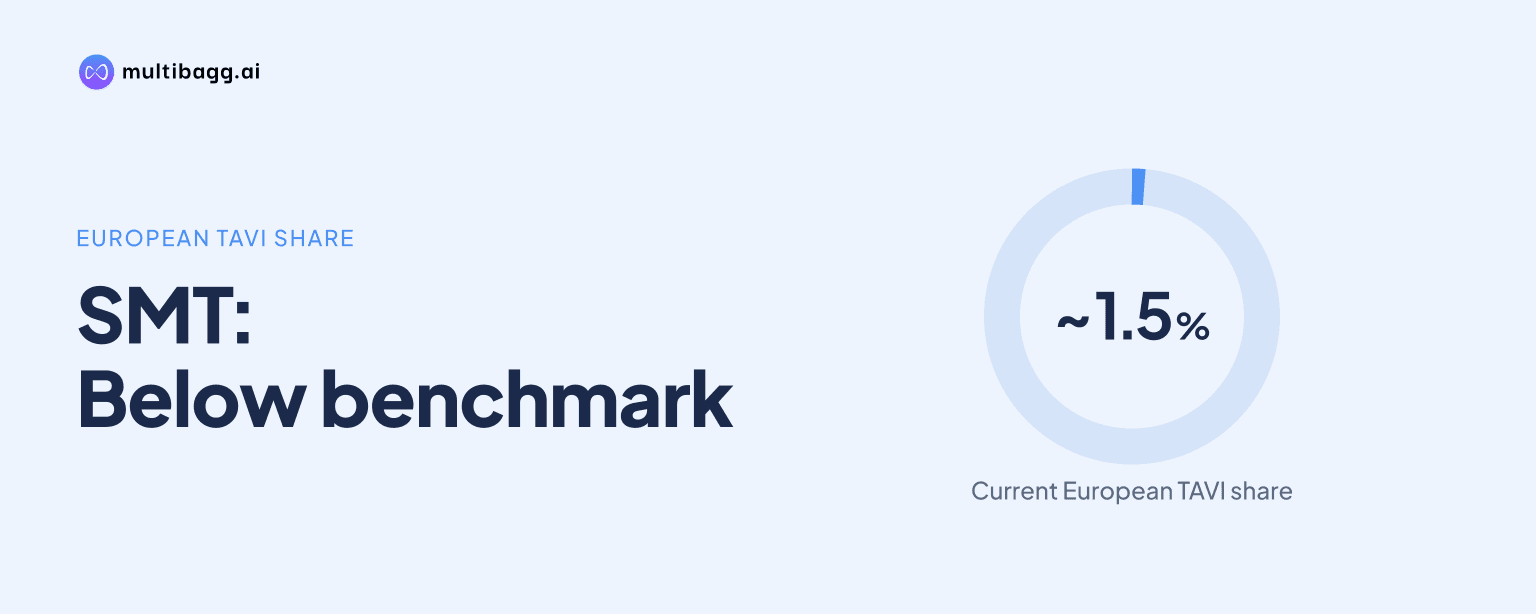
SMT expects its Hydra transcatheter aortic valve implantation (TAVI) valve and AVDC delivery system to launch by Q4 of the current financial year, with management seeking to lift a European TAVI share of about 1.5% using its existing sales, clinical-specialist and proctorship network.
Know Sahajanand Medical Technologies inside out
Results, valuation, peers and who's buying, in one view.
When will SMT launch Hydra TAVI and AVDC?
SMT expects the Hydra TAVI valve and AVDC delivery system to launch within the current financial year, potentially as early as Q3 and, in management's expectation, no later than Q4. Management provided that timing in response to a question on the next-generation TAVI platform and AVDC, after confirming the commercial launch of Sironity, SMT's drug-coated balloon for vascular intervention.
Management said products scheduled for launch within the next six months are in technology transfer, meaning manufacturing lines are being set up. It said these products have moved beyond product development and regulatory approvals, while products scheduled for the next financial year have completed development and are undergoing regulatory approval processes.
SMT also expects to launch a portfolio of percutaneous transluminal coronary angioplasty, or PTCA, catheters in FY 2028. Other major products, including structural-heart products, are about two to three years away and remain in development and testing, creating a pipeline that extends beyond the Hydra TAVI and AVDC launch window.
How much European TAVI share does SMT have?
SMT's European TAVI market share is about 1.5%, remaining below 2%, according to management. Management said SMT is a newer product and brand in the segment than established peers, and it expects traction to accelerate after the introduction of the newer Hydra TAVI valve and AVDC delivery system.
Europe is a high-focus region for SMT because management described it as the largest market it serves for structural heart and TAVI. Its commercial model uses the same hospital and physician call points for coronary stents and TAVI, with management saying the implanting physician for both procedures is the same doctor.
SMT already has a clinical-specialist force and proctorship network in Europe because it sells an existing TAVI product there. Management said clinical specialists support high-touch products such as TAVI and intravascular ultrasound, or IVUS, and that one specialist may cover four or five sales personnel rather than matching the size of the overall sales force.
Why does SMT expect structural heart to grow faster than vascular intervention?
SMT expects structural heart to grow faster than vascular intervention because structural heart starts from a smaller base, serves a substantially larger market and is in a faster-growing category, management said. Management added that neither structural heart nor vascular intervention is close to peak or plateau market share, so it still expects growth from the more established vascular business.
The distinction is reflected in the product portfolio. Vascular intervention includes Sironity and the planned FY 2028 PTCA catheter launches, while structural heart includes the existing TAVI platform, the Hydra TAVI valve, AVDC and additional products under development for a two-to-three-year horizon.
SMT said its existing country network could reduce the time needed to commercialize newer products. Its mature stent portfolio is broadly present in more than 70 countries, while TAVI, occluders and drug-coated balloons still need approvals in some markets where SMT already has sales and distribution operations.
Management said each approval for a newer product can effectively reopen an existing country from a product perspective while retaining the established local sales and distribution base. SMT recently received approval and commercially launched in Australia, and it has received approval in Canada, although its TAVI product has not yet been approved in Brazil.
Got a follow-up? Ask IRIS
What supports SMT's European rollout and regulatory plans?
SMT's existing European sales, clinical-specialist and proctorship infrastructure is intended to support the Hydra TAVI and AVDC rollout without a separate full-size sales force. Management said its sales and distribution team already sells vascular intervention and structural-heart products, while clinical specialists provide support for complex procedures such as TAVI.
Regulatory progress remains relevant to the wider product portfolio. SMT has received European Union Medical Device Regulation, or EU MDR, certification for Supraflex Cruz, while certification remains in process for four product families: Pipit NC, Pipit SC, Hydra and Cocoon.
Management said Pipit NC and Pipit SC have completed both stage-one and stage-two audits. Hydra and Cocoon applications have been filed and are awaiting audit timelines, making the timing of those audits a remaining regulatory item for products that SMT plans to expand in Europe.
SMT said manufacturing capacity is not expected to be its near-term constraint, with current capacity sufficient for at least one-and-a-half years. Management expects annual capital expenditure to remain no higher than Rs 70 crore for at least the next two to three years, with spending directed mainly toward vertical integration and additional capabilities rather than straightforward revenue capacity.
How does SMT view TAVI capacity and revenue potential?
SMT said expanding TAVI or occluder capacity within its Hyderabad plant would not be capital-expenditure intensive. Management distinguished the 9,000 TAVI technical sterilization capacity disclosed in its RHP from the 3,000 commercialized capacity in its presentation, explaining that the larger technical capacity was not yet commercialized.
Management declined to provide a peak-revenue figure for the existing manufacturing set-up because capital expenditure is being used for capabilities and vertical integration as well as output. It said a TAVI capacity expansion can generate greater revenue from the same plant than expansion of stent or catheter lines because TAVI has a higher per-unit realization.
The capacity position therefore supports the launch plan without providing a quantified sales target for Hydra TAVI or AVDC. Management's disclosed plan is to make annual additions to balloon or stent lines as needed while keeping annual capital expenditure at or below Rs 70 crore for the next two to three years.
Conclusion
SMT's planned Q3-to-Q4 launch window for Hydra TAVI and AVDC is central to its effort to grow structural heart in Europe, where its current TAVI share is about 1.5%. Management expects structural heart to outgrow vascular intervention because of its smaller base, larger market and faster category growth, while relying on an established European sales and clinical network for commercialization.
The next developments to watch are whether Hydra TAVI and AVDC launch by Q4, the EU MDR audit timing for Hydra and Cocoon, and the FY 2028 PTCA catheter launch plan. Management also identified product approvals in markets where SMT already sells stents, including a potential future TAVI approval in Brazil, as a route to expand the newer portfolio.