










Tamboli Casting Limited wins ₹20 crore+ OEM programme
Key highlights
- TCL’s programme covers 50+ precision-engineered components for a Fortune 100 global OEM.
- The programme has potential recurring annual revenue of ₹20 crore+ on full transition.
- TCL expects the portfolio to transition into commercial production over the next 2-3 years.
- Q2FY27 total income rose 20% year on year to ₹23.87 crore.
powered by IRIS
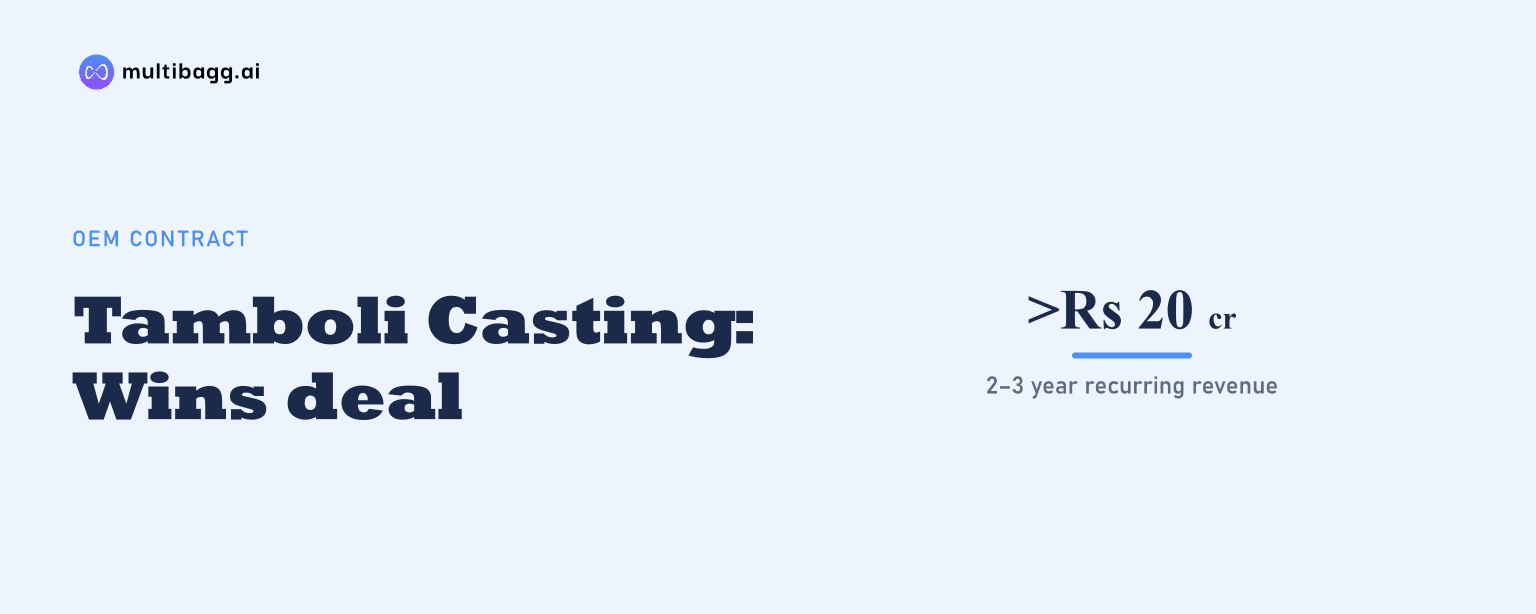
Tamboli Casting Limited has secured a long-term Fortune 100 global original equipment manufacturer programme with potential recurring annual revenue of ₹20 crore+ once more than 50 components complete phased development, approvals and transition to commercial production over the next two to three years.
Know Tamboli Industries inside out
Results, valuation, peers and who's buying, in one view.
What does TCL’s Fortune 100 programme include?
TCL’s programme covers development and long-term supply of more than 50 precision-engineered components for the Fortune 100 customer’s global manufacturing operations. The customer is described as a multibillion-dollar global OEM and a leader in off-highway equipment and advanced mobility solutions, but the presentation does not identify it by name. TCL said it was selected and qualified for direct supply to the OEM’s global operations after an extensive evaluation of precision-component manufacturers from emerging markets.
The award followed more than three years of engagement, during which the OEM assessed TCL’s engineering and manufacturing capabilities, quality systems, supply-chain performance and experience supporting global OEM programmes. The programme combines development work with a supply relationship rather than representing only a one-time component order. TCL says very few companies globally could qualify, although it does not provide a number of qualifying suppliers or competitors.
The ₹20 crore+ amount is potential recurring annual revenue on full transition of the portfolio, not reported annual sales in the November 2026 update. Its realisation depends on moving more than 50 parts through the customer’s development, approval and sourcing stages. TCL characterises the resulting relationship as sustained and long term.
When can TCL recognise the programme’s ₹20 crore+ potential?
TCL says the entire component portfolio is expected to transition over the next two to three years, with development activities commencing immediately. Initial development orders have already been received, while subsequent orders are expected in successive phases over the coming months. These orders are the first disclosed commercial step, but they do not establish that the full ₹20 crore+ annual potential has entered production.
Customer approvals are the key condition before commercial production expands. TCL says the phased move into production will follow the OEM’s global sourcing plans, and that realisation is subject to the pace of customer approvals, business transition and customer requirements. The two-to-three-year timetable is therefore an execution path rather than a fixed annual revenue schedule.
The phased structure separates the award from TCL’s current-period performance. In Q2FY27, TCL reported total income of ₹23.87 crore, so the programme’s annual potential cannot be compared directly with one quarter of income without information on part-level approvals or the production ramp. The source does not disclose component prices, order quantities, annual volumes, contract tenure or revenue by programme phase.
Got a follow-up? Ask IRIS
How does the OEM award fit TCL’s FY27 and FY28 outlook?
TCL said it is optimistic about its FY27 and FY28 business outlook, citing demand traction from key European accounts, large projects in the United States and medium-sized projects in India. The Fortune 100 award is presented as a structural, long-term growth driver within that outlook. Management said global customers are building alternate supply chains and qualifying suppliers such as TCL, but it did not quantify revenue expected from Europe, the United States or India.
TCL links its capacity plan to the expected ramp in opportunities. It anticipates reaching optimum capacity utilisation by FY28 and says it is strengthening its machining facility while adding computer numerical control, or CNC, machining capacity. The presentation does not disclose capital expenditure, additional machine count, capacity volumes or the operational date for the added CNC capacity.
TCL’s reported earnings rose before the new programme reaches full transition. Total income increased 20% year on year to ₹23.87 crore in Q2FY27 from ₹19.88 crore in Q2FY26, while earnings before interest, tax, depreciation and amortisation, or EBITDA, rose 49% to ₹6.00 crore. Profit after tax, or PAT, increased 76% to ₹3.41 crore. In H1FY27, total income was ₹42.55 crore, 14% above H1FY26, while EBITDA rose 43% to ₹10.00 crore and PAT increased 71% to ₹5.51 crore.
Margins also changed across the reported periods. EBITDA margin increased to 25% in Q2FY27 from 20% in Q2FY26 and 21% in Q1FY27, while PAT margin reached 14%, compared with 10% and 11%, respectively. In H1FY27, EBITDA margin was 24% versus 19% a year earlier and PAT margin was 13% versus 9%. TCL says operating leverage should improve margin outcomes as revenue builds, which is management’s expectation rather than a programme-specific forecast.
Conclusion
TCL has added a Fortune 100 OEM programme with stated potential recurring annual revenue of ₹20 crore+ at full transition, alongside Q2FY27 total income of ₹23.87 crore. The award spans more than 50 components and follows a qualification process lasting over three years, but its value depends on development work, customer approvals and the customer’s sourcing requirements.
The next disclosed milestones are successive development orders over the coming months, customer approvals and commercial production transition during the stated two-to-three-year period. Management’s plans to strengthen machining operations, add CNC capacity and reach optimum capacity utilisation by FY28 are the operational measures disclosed for the anticipated demand ramp.