










Tamboli Casting Limited targets optimum capacity utilisation by FY28
Key highlights
- TCL anticipates optimum capacity utilisation by FY28 as Europe, US and Indian opportunities ramp up.
- The Fortune 100 OEM programme covers more than 50 components and has potential recurring annual revenue of more than Rs 20 crore.
- Q2FY27 total income rose 20% year on year to Rs 23.87 crore, while EBITDA rose 49% to Rs 6 crore.
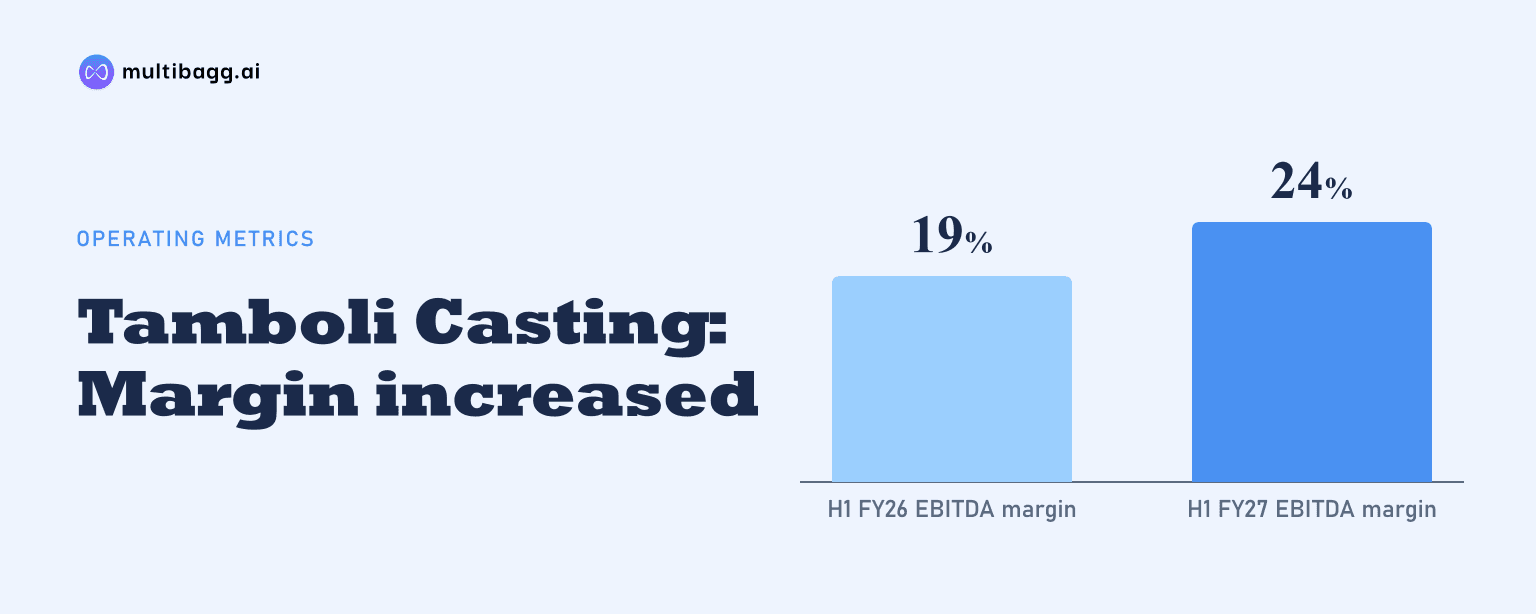
- H1FY27 EBITDA margin increased to 24% from 19% in H1FY26.
powered by IRIS
TCL anticipates optimum capacity utilisation by FY28 as Europe, US and Indian opportunities ramp up, and is adding computer numerical control machining capacity; its Fortune 100 original equipment manufacturer programme covers more than 50 components and carries potential recurring annual revenue of more than Rs 20 crore on full transition.
Know Tamboli Industries inside out
Results, valuation, peers and who's buying, in one view.
Why does TCL expect optimum capacity utilisation by FY28?
TCL expects the business opportunities under development to ramp up sufficiently for optimum capacity utilisation by FY28, according to its November 2026 earnings update. Management cited demand traction from key European accounts, large projects in the US and medium-sized Indian projects as the basis for its FY27 and FY28 outlook. The presentation does not disclose current utilisation, installed capacity or the revenue level associated with optimum utilisation.
The expected utilisation outcome depends on projects progressing from opportunity to production. The new Fortune 100 original equipment manufacturer, or OEM, programme is intended to transition over two to three years, a timetable that overlaps with the FY28 objective. TCL said the programme was secured after more than three years of engagement and global evaluation, but stated that commercial realisation depends on customer approvals, business transition and customer requirements.
What new business could support TCL's FY28 capacity plan?
TCL's largest quantified opportunity is a programme covering more than 50 precision-engineered components for a Fortune 100 global OEM in off-highway equipment and advanced mobility solutions. On full transition, the component portfolio has potential recurring annual revenue of more than Rs 20 crore. Initial development orders have already been received, while subsequent orders are expected in phases over the coming months.
The programme's execution schedule gives context to the capacity target. Development begins immediately, followed by customer approvals and phased commercial production, with the entire portfolio expected to transition over the next two to three years. The disclosed Rs 20 crore-plus annual potential is therefore not presented as immediate revenue, because it remains subject to the OEM's global sourcing plan and the pace of approvals.
TCL also identified demand beyond the named OEM award. Management referred to key accounts in Europe, large US projects and medium-sized projects in India, without assigning values to those opportunities. The geographical mix is relevant because management's utilisation expectation rests on the combined ramp-up of these channels rather than on the Fortune 100 programme alone.
How is TCL expanding machining capacity?
TCL says it is strengthening its machining facility and adding further computer numerical control, or CNC, machining capacity to stay ahead of anticipated demand. The November 2026 disclosure does not specify the number of CNC machines, investment amount, commissioning date or incremental machining output. It establishes the direction of capacity investment but not its financial scale or completion milestones.
The added machining capacity is linked to the programme mix disclosed in November 2026. The Fortune 100 award involves more than 50 precision-engineered components, and TCL's chairman, chief executive officer and managing director presented a technical paper, “Smart Planning for Complex CNC Machining: A Digital Framework to Boost Capacity”, at the Investment Casting Institute's 73rd Technical Conference in Michigan from October 25 to 28, 2026. The presentation says the framework draws on systems at TCL's Bhavnagar facility.
Management's stated sequence is to expand machining capability before demand reaches the targeted utilisation level. This is intended to support the two-to-three-year OEM transition and European, US and Indian work as orders move through development and approval stages. However, the update provides no separate forecast for machining revenue, annual capacity utilisation or output from the CNC addition.
Got a follow-up? Ask IRIS
What evidence supports TCL's operating-leverage outlook?
TCL's Q2FY27 results provide the reported evidence cited alongside the scale narrative: total income rose 20% year on year to Rs 23.87 crore, while EBITDA increased 49% to Rs 6.00 crore. EBITDA margin expanded to 25% from 20% in Q2FY26, a rise of 5 percentage points. Management says that as revenue builds, operating leverage will translate into improved margin outcomes.
The sequential comparison also changed from Q1FY27. Total income increased from Rs 18.68 crore in Q1FY27 to Rs 23.87 crore in Q2FY27, EBITDA rose from Rs 4.00 crore to Rs 6.00 crore, and EBITDA margin moved from 21% to 25%. PAT increased from Rs 2.09 crore to Rs 3.41 crore over the same comparison, with PAT margin rising from 11% to 14%.
For H1FY27, total income was Rs 42.55 crore, up 14% from Rs 37.35 crore in H1FY26. EBITDA grew 43% to Rs 10 crore and margin reached 24%, compared with Rs 6.99 crore and 19% a year earlier. PAT rose 71% to Rs 5.51 crore from Rs 3.21 crore, while margin increased to 13% from 9%; these changes preceded the planned full transition of the Rs 20 crore-plus OEM opportunity.
What could determine whether TCL reaches its FY28 target?
TCL's FY28 utilisation expectation will depend on customer approvals, phased business transfer and customer requirements, which the company identifies as conditions for the Fortune 100 programme's realisation. The OEM portfolio is scheduled for development, approvals and commercial transition over two to three years rather than a single production start. The presentation provides no quarterly order schedule or disclosed value for the Europe, US and India projects.
The extent of machining expansion also remains unresolved in the November 2026 update. TCL confirms that further CNC capacity is being added but does not disclose capital expenditure, funding, commissioning dates or expected utilisation of new equipment. Readers can distinguish a stated FY28 objective from a quantified capacity-expansion plan: the target is disclosed, while operating metrics to measure progress have not been provided.
Conclusion
TCL's capacity outlook combines a stated objective of optimum utilisation by FY28 with a long-cycle OEM programme, additional CNC machining investment and higher reported margins in Q2FY27 and H1FY27. The Fortune 100 award is the clearest quantified contributor, with more than 50 components and potential recurring annual revenue of more than Rs 20 crore after full transition, but it is one part of the demand mix management describes.
The next point to watch is the programme's path from development orders to customer approvals and commercial production over the next two to three years. Management's FY28 expectation also depends on the pace of European, US and Indian projects and on when added CNC capacity becomes operational, neither of which has a disclosed monetary value or timetable in the update.