










Tarsons expansion ramp expected to contribute meaningfully from FY28
Key highlights
- Tarsons said most planned expansion capacity was commissioned and operational by November 13, 2026.
- Tarsons expects expansion benefits to become increasingly visible from FY28 over the next 2 to 3 years.
- Standalone revenue grew 25% year on year in Q2 FY27 and exceeded Rs 100 crore for the first time.
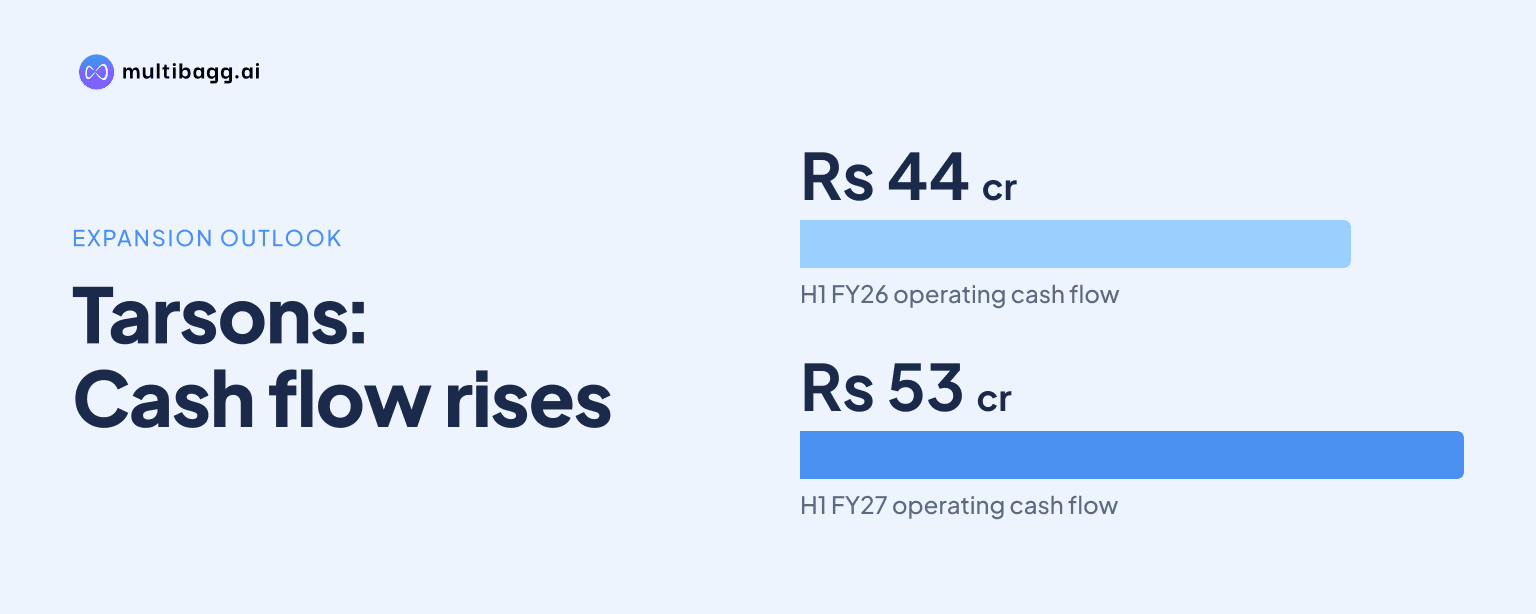
- Consolidated operating cash flow rose to Rs 53 crore in H1 FY27 from Rs 44 crore in H1 FY26.
powered by IRIS
Tarsons Products Limited expects its largely commissioned expansion to contribute meaningfully from FY28, after revenue, customer validations and utilisation build over the next two to three years. In Q2 FY27, Tarsons' standalone revenue grew 25% year on year and crossed Rs 100 crore, while costs, depreciation and interest from the new facilities were already affecting profitability.
Know Tarsons Products inside out
Results, valuation, peers and who's buying, in one view.
What stage is Tarsons' expansion programme at?
Tarsons is in the final phase of one of its largest capital-expenditure programmes, with most planned capacity commissioned and operational as of the November 13, 2026 earnings call. Management said the immediate focus has shifted from creating capacity to raising utilisation, obtaining customer validations and commercialising new products.
Selected existing product lines have begun operating at the new Panchla facility, while its radiation-line warehousing space is operational. Expanded manufacturing capacity at Amta is fully operational. These assets have completed the physical capacity-creation stage, but management said their revenue contribution is yet to ramp up meaningfully.
Cell culture remains the key incomplete part of the programme. Management said more than 50% of the planned cell-culture products had been launched and internally tested for quality and packaging, but customers generally seek a complete solution of more than 100 stock-keeping units, or SKUs. Tarsons expects to complete the remaining SKUs over the next few months after attributing the delay to stabilising multiple products.
Why are Tarsons' new facilities affecting profit before revenue ramps?
Tarsons' new facilities are affecting reported profit because their operating expenses are already included in the profit and loss account before they generate meaningful revenue. Management also said profit after tax remained affected by accelerated depreciation and interest costs associated with the new sites in H1 FY27.
Standalone revenue increased 25% year on year in Q2 FY27, but standalone gross profit rose 15% to Rs 67.4 crore and earnings before interest, tax, depreciation and amortisation, or EBITDA, grew 16.9% to Rs 30.6 crore. The slower growth in gross profit than revenue reflected higher raw-material costs as well as the early cost base of the expanded operations.
Crude-linked input prices have added to the margin pressure. Management said prices for these raw materials had risen 30% to 50% after the West Asia conflict began in March 2026 and remained 25% to 35% above original levels at the time of the call. Tarsons said it had implemented calibrated price increases where feasible, while seeking to protect customer relationships and competitiveness.
Got a follow-up? Ask IRIS
When will Tarsons' expanded capacity lift revenue and margins?
Tarsons expects the expansion to translate into meaningful revenue growth over the next two to three years, with benefits becoming increasingly visible from FY28. Management presented this as a ramp-up expectation dependent on product adoption, customer validation and higher utilisation, rather than as a numerical revenue or margin forecast.
The stated mechanism for margin improvement is fixed-cost absorption. As production volumes rise, the operating costs already incurred at the new facilities can be spread across a larger sales base. Management said higher utilisation and operating leverage should support better margins, profitability and return on invested capital, but disclosed no utilisation or margin target.
The cell-culture range will be an important near-term commercial milestone because Tarsons said customers prefer the full offering of more than 100 SKUs. More than half of the products had been launched by November 2026, while the balance was expected to be completed in the following months. The pace at which those products obtain customer acceptance will determine how quickly this part of the capacity begins contributing.
Raw-material prices are a separate variable in the margin outlook. Management said margins could return to the early-70s range if raw-material prices settle back to pre-crisis levels, but reported no correction from Q2 FY27 levels after further price spikes in the preceding month and a half. Utilisation can improve fixed-cost absorption, while commodity-cost normalisation would affect gross margins.
What is driving Tarsons' growth before the new capacity ramps?
Tarsons said FY27 growth was largely driven by its existing product portfolio, with minimal contribution from new product categories. Standalone revenue rose 25% year on year in Q2 FY27 and 23% in H1 FY27, while consolidated H1 FY27 revenue reached Rs 233.9 crore, up 21% year on year.
Domestic growth was led by private-sector life-science customers, according to management. It identified contract research organisations, contract development and manufacturing organisations, pharmaceutical and biopharmaceutical customers, and vaccine-related businesses as areas of stronger demand. Management said demand from government and semi-government research institutes had yet to recover.
Exports also supported current growth, with standalone export revenue rising 37% year on year in Q2 FY27 and 33% in H1 FY27. Management cited larger customer restocking and higher wallet share with some global customers, but said container shortages had held up shipments to Europe and the United States before several shipments could move together.
Tarsons said export growth of 35% to 37% may be difficult to sustain every quarter. It is discussing new projects and products with customers in Europe and the United States and plans to increase sales through German subsidiary Nerbe. Nerbe revenue grew 7% in Q2 FY27 and 13% in H1 FY27, while Tarsons is pursuing both original equipment manufacturing and its branded business internationally.
Conclusion
Tarsons has largely moved beyond building facilities and into commercialising them. Existing products delivered 25% standalone revenue growth in Q2 FY27, but the facilities' operating costs, depreciation and interest are already in reported results before their revenue contribution has become material. The expansion's financial benefit therefore depends on volumes catching up with the installed capacity.
The next disclosed milestones are completion of the remaining cell-culture SKUs over the next few months, customer validations and commercialisation at Panchla and Amta. Management expects the benefits to become increasingly visible from FY28, while raw-material prices, still 25% to 35% above original levels, remain an unresolved influence on gross margins.