










Tarsons export growth hit 37% as containers delayed shipments
Key highlights
- Tarsons’ standalone export revenue grew 37% year on year in Q2 FY27 and 33% in H1 FY27.
- Standalone domestic revenue grew 19% in Q2 FY27, compared with 37% export growth.
- Management said container availability for Europe and the US had been a major issue for five to six months.
- Tarsons aims to keep any one customer below 15% to 20% of international business.
powered by IRIS
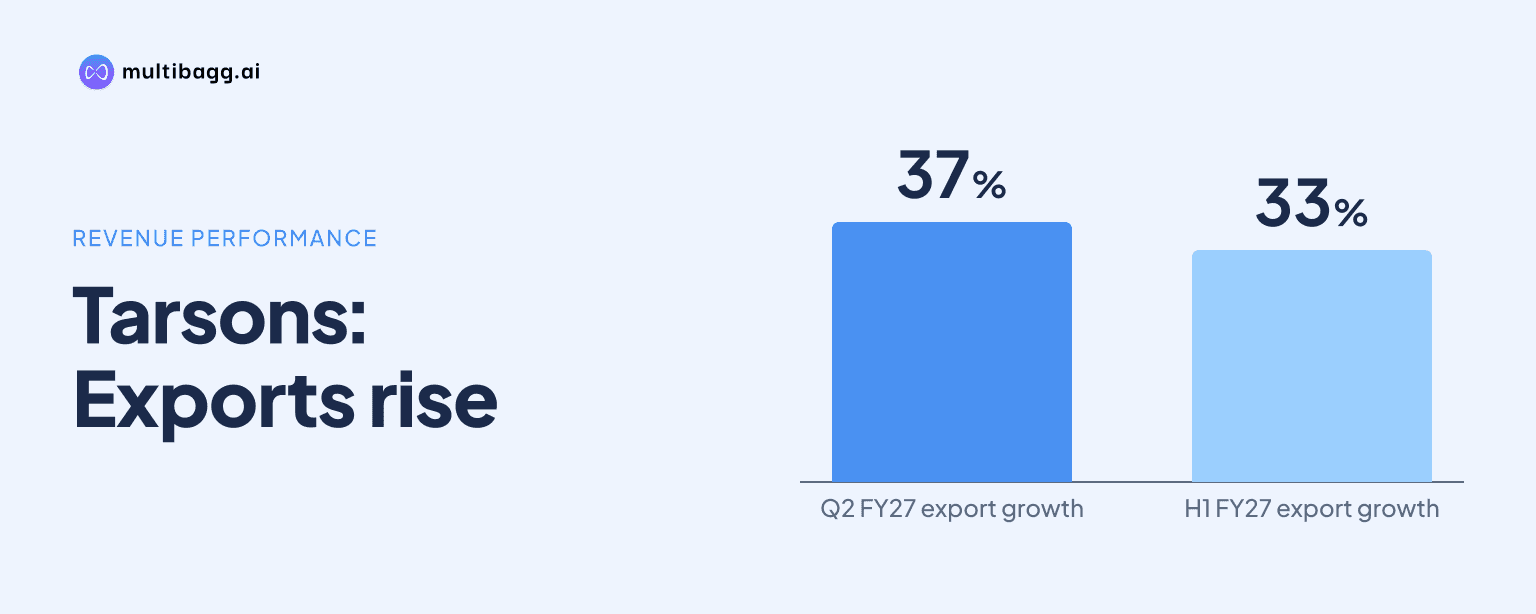
Tarsons Products Limited reported 37% year-on-year standalone export growth in Q2 FY27, ended September 30, 2026, but management said container shortages had delayed paid or transacted shipments to Europe and the US for five to six months, affecting when export revenue was recorded.
Know Tarsons Products inside out
Results, valuation, peers and who's buying, in one view.
Why did Tarsons export sales grow 37% in Q2 FY27?
Tarsons said its 37% export growth in Q2 FY27 reflected a larger wallet share with certain global customers, lower customer inventory levels and subsequent restocking. Management also cited more customer inquiries and improved order conversion after international trade fairs and exhibitions featuring its life-science product portfolio. It did not disclose export revenue in rupees or identify specific customer contracts.
Export growth exceeded Tarsons’ 19% domestic revenue growth and 25% standalone revenue growth in Q2 FY27. In H1 FY27, standalone export revenue rose 33% year on year, against 23% growth in total standalone revenue. The comparison shows exports grew faster than domestic sales in the reported quarter, although Tarsons did not disclose the export share of overall revenue.
Tarsons reported its second consecutive quarter of export growth above 30%, based on the analyst’s observation during the call and management’s discussion of the 37% Q2 rate. Management linked the improvement to restocking, customer traction and wider commercial activity rather than attributing it to a single export contract or product category.
How have container shortages affected Tarsons shipments?
Tarsons said the West Asia crisis had made container availability and transportation to Europe and the US a major concern over the previous five to six months. Management said multiple containers had at times remained in its warehouse even after customers had paid or completed their transactions, because containers were unavailable for shipment.
The constraint means reported quarterly export sales can be affected by logistics timing as well as underlying demand. Management said pending shipments may move in a particular period when containers become available, concentrating revenue that could otherwise have been recognised across different quarters. Tarsons did not quantify delayed containers, the value of unshipped orders or the share of Q2 FY27 export growth caused by this timing effect.
The outbound-logistics issue occurred alongside input-cost pressure. Tarsons said crude-linked raw-material prices had risen by 30% to 50% since the West Asia conflict began in March 2026, while it continued to focus on raw-material availability and customer deliveries. The company’s comments distinguish the ability to manufacture products from the separate challenge of securing containers to export them.
Can Tarsons sustain export growth above 30%?
Management said Tarsons expects healthy international growth but does not expect growth in the late-30% range to continue over the long term. Aryan Sehgal said maintaining 35% to 37% growth every quarter would be an uphill task, even with new projects, new products and discussions with customers in Europe and the US. This was management commentary rather than formal guidance.
Tarsons plans to increase supplies from its Indian operations to its German subsidiary, Nerbe. Management said supplies had already started, should ramp up by the end of the current year and were expected to increase significantly in the following year. Tarsons did not provide an export-sales target or a revenue contribution forecast for sales to Nerbe.
Management also described an international customer-diversification approach, seeking to keep any one customer below 15% to 20% of total international business. Tarsons said it does not want a large share of overseas revenue to depend on one or two isolated customers because contracts can be lost or transferred to another supplier. That approach makes growth dependent on activity across several accounts rather than one large order.
Got a follow-up? Ask IRIS
Where is Tarsons seeking its next overseas growth?
Tarsons said recent inquiries covered both new and existing products, but all were from its existing geographies. Management identified parts of Europe, Asia and the US as markets where Tarsons already operates and sees further room for growth. It did not disclose country-level export revenue for Q2 FY27 or H1 FY27.
The company is also building teams for Latin America, the Middle East and Africa, where management said Tarsons is relatively less established. Its international strategy includes expanding in stronger markets, developing weaker territories, using Nerbe as a channel, and pursuing both original equipment manufacturing and Tarsons-branded business. Management said international business is where it expects the company’s biggest growth to come from moving forward.
Product additions may support that strategy over time. Tarsons said more than 50% of its planned 100-plus cell-culture stock-keeping units had been launched and internally tested for quality and packaging by the call date, with the remaining products expected over the next few months. Management did not say these cell-culture products had made a material contribution to the 37% export growth in Q2 FY27.
How does export growth compare with Tarsons’ wider business?
Tarsons’ export expansion occurred during a quarter when standalone revenue grew 25% year on year and consolidated revenue grew 21%. Standalone revenue crossed Rs 100 crore in Q2 FY27 for the first time, while consolidated H1 FY27 revenue was Rs 233.9 crore, up 21% year on year. These figures show export growth was part of a broader increase in sales rather than the company’s only source of growth.
Nerbe’s revenue grew 7% in Q2 FY27 and 13% in H1 FY27, below Tarsons’ 37% quarterly export growth. Management said Germany remained a difficult market and that Nerbe’s top-line expansion would depend on an improvement in Germany or expansion beyond the country. It also said additional hiring and related costs for future expansion had reduced Nerbe’s earnings before interest, tax, depreciation and amortisation margin.
Conclusion
Tarsons’ 37% standalone export growth in Q2 FY27 and 33% growth in H1 FY27 reflect customer restocking, increased wallet share and improving commercial traction. However, management’s account of paid shipments awaiting containers means the quarterly result also contains a logistics-timing element, making period-to-period export growth less comparable until shipping availability normalises.
The next measures to watch are container availability for Europe and the US, the planned ramp-up of supplies to Nerbe by the end of the current year, and completion of the remaining cell-culture stock-keeping units over the next few months. Management also plans to build teams in Latin America, the Middle East and Africa, while cautioning that 35% to 37% export growth should not be treated as a long-term expectation.