










Tarsons says raw-material inflation cannot be fully passed on
Key highlights
- Tarsons said material margins have returned to the late 60% range from close to the late 70% range during COVID.
- Tarsons said material margin has ranged between about 68% and 78% to 79% over the last 10 years.
- Tarsons disclosed revenue potential of about Rs 800 crore, split equally between older and newer facilities.
- Tarsons said more than 50% of its planned 100-plus cell-culture SKUs have been launched and internally tested.
powered by IRIS
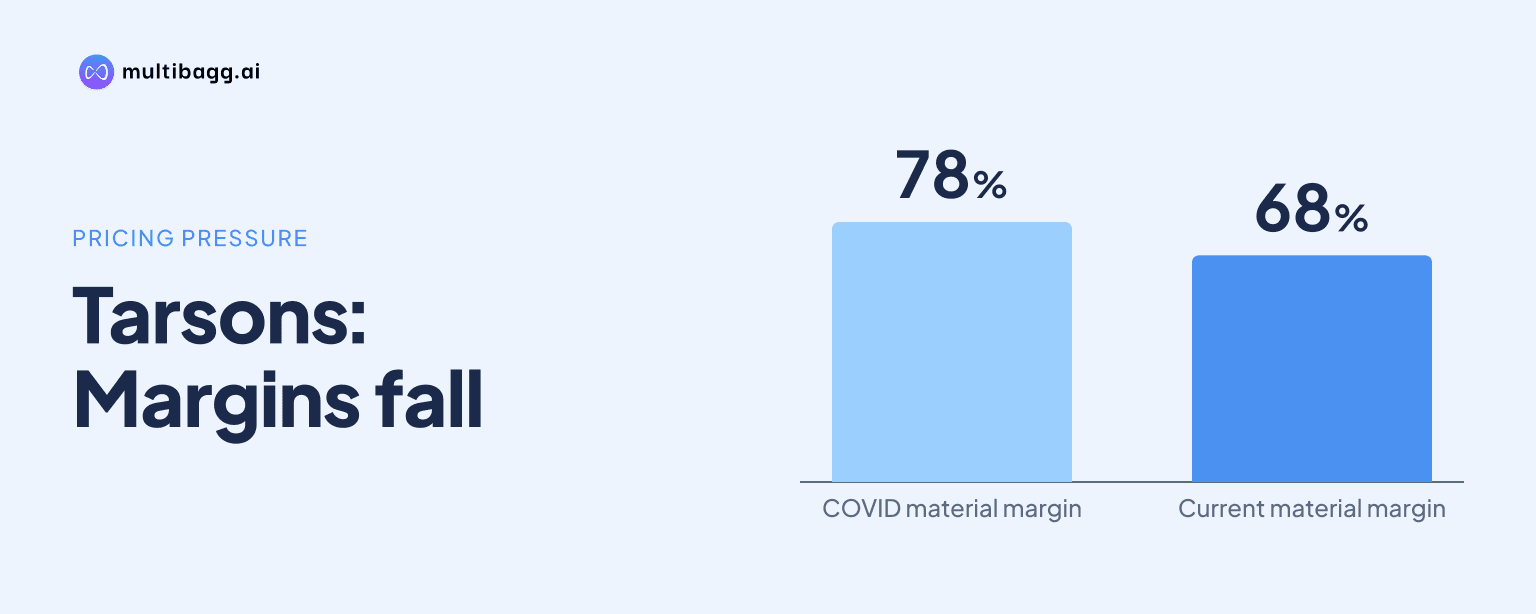
Tarsons said in the first half (H1) that it cannot fully pass volatile raw-material, packaging and other input-cost inflation to customers because competition is intense in India and internationally, leaving material margins in the late 60% range after they had reached the late 70% range during the coronavirus disease 2019 (COVID) period.
Know Tarsons Products inside out
Results, valuation, peers and who's buying, in one view.
Why cannot Tarsons fully pass raw-material inflation to customers?
Tarsons cannot fully pass raw-material inflation to customers because price increases in its industry are nominal and do not move in line with the company’s actual input-cost increases. Management said the constraint applies not only to raw materials but also to packaging and other inputs. It attributed the limit to competition from Indian and international rivals, saying a larger price increase could allow competitors to offer their product lines to accounts Tarsons has developed over years.
Tarsons had implemented certain price increases during H1, but management said it did not know whether those increases would remain unchanged, rise further or decline in the second half (H2). The company therefore expects H2 growth rates to be similar to H1 rather than assuming a sales acceleration from pricing. This means reported revenue growth and price realisation may be influenced by volatile material costs as well as customer demand in the second half.
How have input costs changed Tarsons material margins?
Tarsons said the current West Asia crisis had moved its material margin back to the late 60% range, from the early 70% range through last year. Management framed this as a return to the range the company had operated in around 2017 or 2018, rather than a new level for the business. It said material margin had varied with market conditions and crises over the past decade.
Tarsons said its material margin has moved between about 68% and 78% to 79% over the last 10 years. Management presented this measure, rather than earnings before interest, tax, depreciation and amortisation (EBITDA), as the more relevant indicator of price realisation and competitive positioning. The comparison shows that the COVID-era expansion towards the late 70% range has reversed as higher raw-material costs have emerged, even though Tarsons said its selling-price realisation had been robust over the full decade.
Why does Tarsons separate EBITDA pressure from material-margin pressure?
Tarsons said external competition is more directly reflected in material margin than in EBITDA. Management said EBITDA also reflects the company’s internal cost structure, which has changed materially over the last three to four years. It has added overheads ahead of revenue from newer facilities and product lines, and management described those embedded costs as part of the effort to scale the business over the next two to three years.
The company disclosed revenue potential of about Rs 400 crore from older facilities and another Rs 400 crore from newer facilities, or close to Rs 800 crore in total. Management said it believes a significant part of that potential could be realised without costs rising proportionately from their existing base. However, it also acknowledged that facility delays were expensive operationally and in cost terms, saying the facilities would have been financially better placed had they been ready 12 to 14 months earlier.
Got a follow-up? Ask IRIS
What is Tarsons doing to support future volume and revenue growth?
Tarsons is completing a cell-culture portfolio intended to offer customers a complete solution of more than 100 stock-keeping units (SKUs). Management said more than 50% of these products had been launched and internally tested for quality and packaging, while the remaining SKUs were expected to be completed over the next few months. It said customers prefer suppliers able to provide the complete portfolio rather than a limited set of products.
The company has also begun supplies from its India operations to Nerbe, its Germany-focused business, and expects a ramp-up by the end of the year followed by a significant increase next year. Tarsons said Nerbe’s selling prices in Germany had remained constant and that it had secured higher prices, supporting gross or material margins there. Yet it expects lower earnings before interest and tax (EBIT) and EBITDA margins at Nerbe because it is hiring sales personnel, including beyond Germany, and incurring additional employee and travel costs for a planned three-to-five-year scale-up.
Which demand segments matter most for Tarsons?
Tarsons said private-sector customers in contract research organisations (CROs), contract development and manufacturing organisations (CDMOs), pharma and biopharma were showing strong demand, particularly in life-science and vaccine production. Management contrasted this with government and semi-government research institutions, where demand had yet to recover. It estimated that private pharma, biopharma and CRO/CDMO customers account for about 60% of the industry, diagnostics and healthcare about 20%, and government business about 15% to 20%.
Consumables, which management said account for about 60% of Tarsons’ business, are its main measure of underlying customer activity because they are repeatedly ordered. Tarsons said consumables lead or match overall quarterly and annual growth, while re-usables and benchtop equipment grow at slightly lower rates. Management also said it believes the post-COVID demand slump is behind the industry and that growth could be strong and sustainable for the next two to three years, while declining to give a numerical forecast.
Conclusion
Tarsons’ central message is that price increases have not insulated it from input-cost inflation: intense competition limits full pass-through, and material margins have returned to the late 60% range from COVID-era late 70% levels. Management distinguishes this commercial pressure from EBITDA pressure, which it links to a larger overhead base built during the past three to four years for future capacity and product expansion.
The next items to watch are the completion of the remaining cell-culture SKUs over the next few months, the expected Nerbe supply ramp by year-end and next year, and whether H1 price increases hold in H2 amid raw-material volatility. Tarsons also plans only Rs 30 crore to Rs 40 crore of commercial and maintenance capital expenditure going forward, while management expects total debt to remain in a Rs 370 crore to Rs 390 crore range.