










Tata Chemicals Kenya unit stays suspended before court hearing
Key highlights
- Tata Chemicals said its Kenya lease rights extend until 2053 while operations remained suspended in Q2 FY27.
- The Environment and Land Court was scheduled to hear Tata Chemicals’ Kenya matter during November.
- Consolidated EBITDA fell to Rs 381 crore in Q2 FY27 from Rs 537 crore in Q2 FY26, with the Kenya suspension cited as one factor.
- Tata Chemicals said its Kenyan unit is debt-free and remains positive-margin.
powered by IRIS
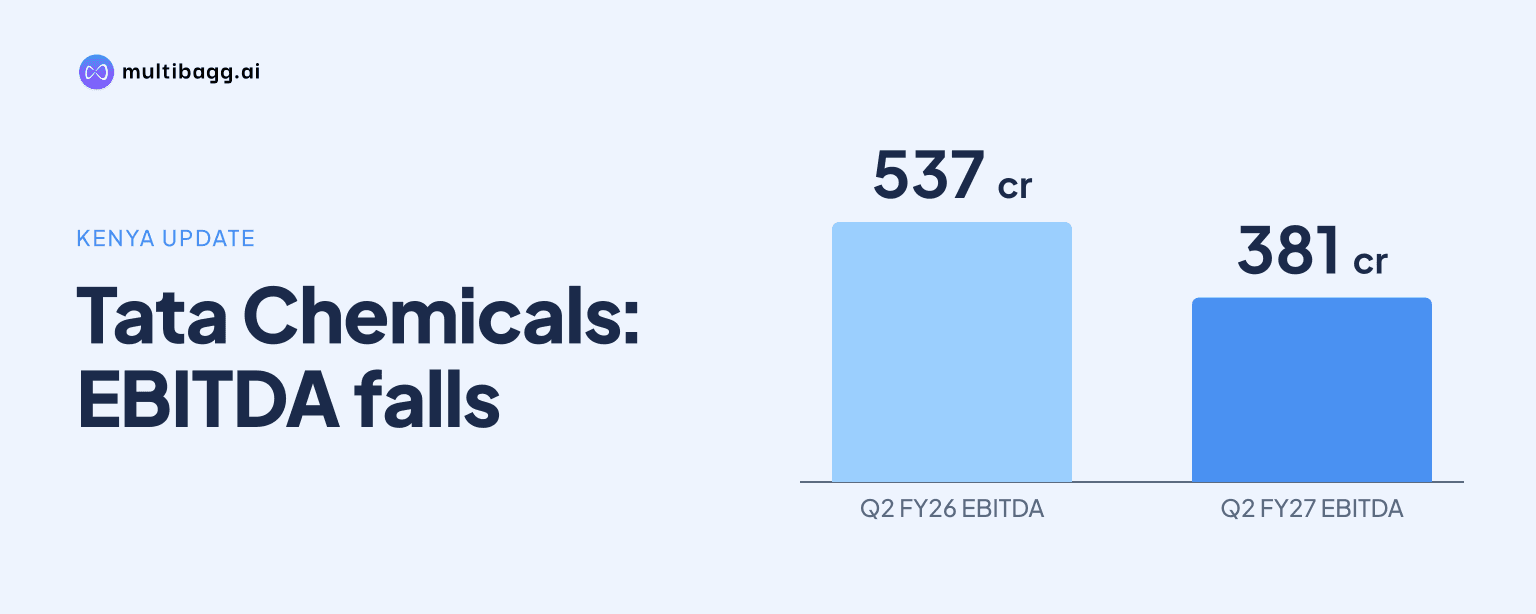
In Q2 FY27, Tata Chemicals Limited kept its Kenya operations suspended ahead of a November Environment and Land Court hearing, while management said its lease rights extend until 2053 and the debt-free unit remains positive-margin. The suspension was among the factors behind consolidated earnings before interest, tax, depreciation and amortisation falling to Rs 381 crore.
Know Tata Chemicals inside out
Results, valuation, peers and who's buying, in one view.
Why are Tata Chemicals’ Kenya operations suspended?
Tata Chemicals’ Kenya operations were suspended after a notice from Kenya’s Ministry of Mining, according to Managing Director and Chief Executive Officer R. Mukundan. He said Tata Chemicals is engaging with the ministry and officials through administrative channels while using legal mechanisms to protect its rights.
The suspension contributed to pressure on Tata Chemicals’ consolidated Q2 FY27 performance. Consolidated EBITDA was Rs 381 crore, compared with Rs 537 crore in Q2 FY26, as lower overseas realisations, higher UK energy and logistics costs, and the Kenya suspension affected results. Tata Chemicals did not disclose Kenya-specific revenue, output, profit or the direct financial cost of the stoppage.
Management described the Kenyan operation as debt-free and positive-margin despite the difficult soda ash market. Global soda ash pricing has faced pressure from oversupply, elevated Chinese exports and subdued industrial demand, but Mukundan said the Kenyan unit has remained resilient. Tata Chemicals’ decision to pursue administrative and legal remedies reflects management’s stated commitment to the business rather than a disclosed plan to leave Kenya.
What lease rights is Tata Chemicals asserting in Kenya?
Tata Chemicals says its lease rights in Kenya run until 2053 and are inalienable. Management said the lease is the central legal right underpinning its Kenyan operation, while mining licences are an additional legal layer introduced under mining law after the lease arrangement.
Mukundan said Tata Chemicals has approved mining licences for which fees have been paid, although the licences have not been issued. The company is relying on its lease position and the status of these licence approvals in its efforts to resolve the suspension. The call did not specify the contents of the Ministry of Mining notice or explain why the licences remain unissued.
Tata Chemicals’ immediate court route is the Environment and Land Court. Management said the court initially approached directed Tata Chemicals to the specialist court that hears such matters, where the company has filed its case and other participants have been notified. Proceedings were scheduled to be heard during November.
How is Tata Chemicals pursuing the Kenya case?
Tata Chemicals is pursuing administrative engagement and legal action in parallel, and management gave no timetable for either a court outcome or an operational restart. Mukundan said discussions with a technical committee are continuing and Tata Chemicals has presented options on how to progress the matter.
Management described the November hearing as one stage in a potentially longer judicial and administrative process. Mukundan said Tata Chemicals remains committed to Kenya and intends to conduct business ethically and sustainably, but declined to say whether a restart could take one quarter, two quarters or any other defined period.
The company said remedies could potentially extend beyond Kenya, but it has not decided on its next legal step. Mukundan told an analyst that a business can seek compensation in courts beyond Kenya after available remedies, while clarifying that Tata Chemicals is currently seeking justice in Kenyan courts. Tata Chemicals did not disclose a compensation claim or any formal action outside Kenya.
Got a follow-up? Ask IRIS
How could treaty protection affect Tata Chemicals’ options?
Management said Tata Chemicals’ Kenyan operation is covered by the UK-Kenya Bilateral Investment Treaty because it is a UK investment into Kenya. Mukundan said the treaty protects the investment, while noting that Tata Chemicals’ legal teams are still evaluating the next course of action.
The treaty reference identifies a possible additional protection beyond the Kenyan court process. However, Tata Chemicals did not say it has begun a treaty claim, started international arbitration, sought damages or received a ruling on treaty coverage. The active disclosed proceeding remains the Environment and Land Court hearing planned for November.
Tata Chemicals has also outlined investments connected with its long-term presence in Kenya. Mukundan said the company had been expanding capacity with an aim to double it, was adding a bicarbonate unit, and was seeking a partner to establish a container-glass plant because Tata Chemicals is not in that business. Management said these proposals formed part of its submission to authorities, not that they were approved or would proceed while operations are suspended.
What does Kenya mean for Tata Chemicals’ financial position?
Kenya was one of several overseas pressures in Q2 FY27, while Tata Chemicals’ India business recorded higher salt, fructo-oligosaccharides and silica volumes. Consolidated revenue from operations rose 8% to Rs 4,177 crore, but Tata Chemicals reported a consolidated loss after tax of Rs 50 crore, compared with a profit in Q2 FY26, amid lower realisations, higher energy costs, lower other income and lower joint-venture income.
The comparison shows a divergence between Tata Chemicals’ standalone and consolidated performance during Q2 FY27. Standalone EBITDA increased 22% to Rs 292 crore, supported by higher sales and production volumes, operating efficiencies and cost management. Consolidated EBITDA declined because overseas subsidiaries faced lower export realisations, UK gas and logistics costs, and the Kenya suspension.
Tata Chemicals said capital expenditure should be about Rs 1,000 crore in FY27 and at roughly the same level in the following year, including growth projects. Management’s wider priorities include cost competitiveness, supply-chain resilience, working-capital optimisation and increasing the contribution of non-cyclical specialty and value-added businesses.
Conclusion
Tata Chemicals’ Kenya suspension has both operational and legal implications: management says the unit is debt-free and positive-margin, holds lease rights until 2053, and is seeking an administrative or judicial resolution. The disruption also coincided with a Rs 156 crore year-on-year decline in consolidated Q2 FY27 EBITDA to Rs 381 crore, alongside broader overseas pricing, energy and logistics pressures.
The next disclosed event is the Environment and Land Court hearing during November. Investors will watch whether technical-committee discussions provide a path to restart, whether Tata Chemicals specifies any action under the UK-Kenya Bilateral Investment Treaty, and whether its proposed capacity doubling, bicarbonate unit and container-glass partnership can proceed.