










Tata Chemicals shifts US soda ash away from Southeast Asia
Key highlights
- Tata Chemicals curtailed largely unremunerative US soda-ash exports to Southeast Asia in Q2 FY27.
- Chinese soda-ash producer inventory reached nearly 1.89 million metric tons at September-end 2026.
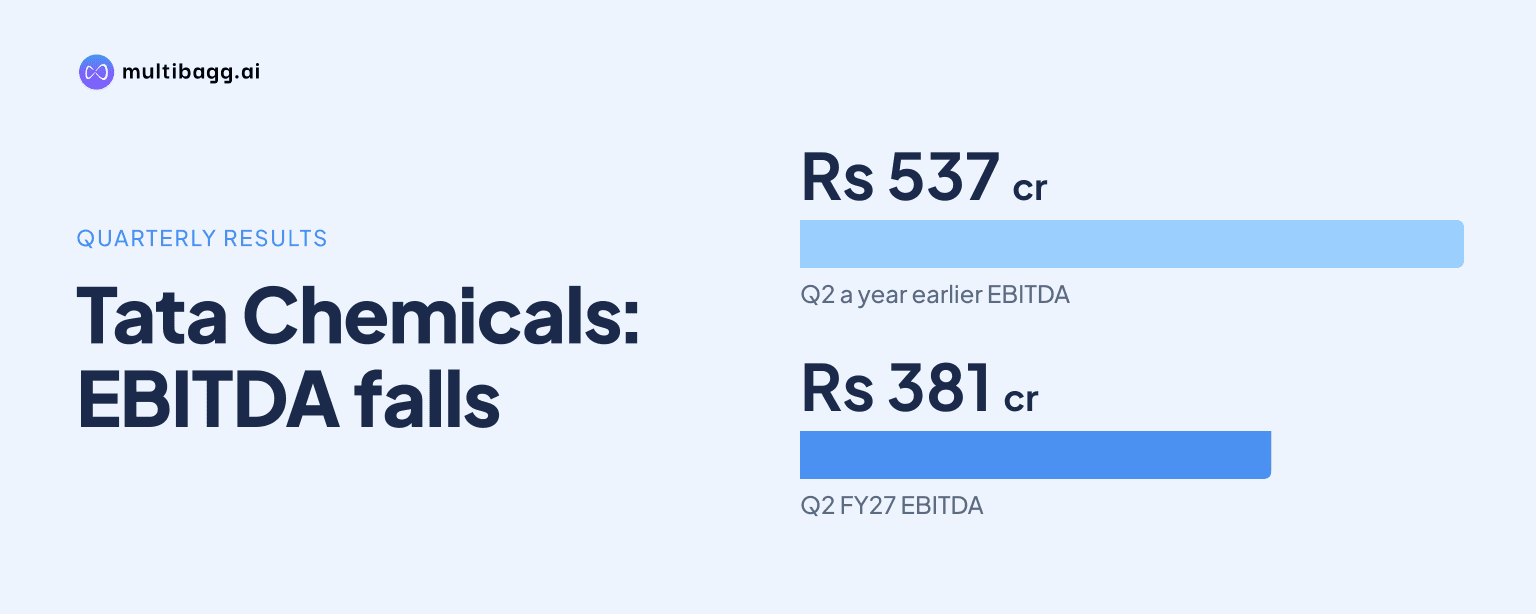
- Tata Chemicals’ consolidated EBITDA fell to Rs 381 crore in Q2 FY27 from Rs 537 crore a year earlier.
- Searles Valley Minerals customer contracts represent 0.5 million tonnes over two years.
powered by IRIS
Tata Chemicals Limited curtailed largely unremunerative US soda-ash exports to Southeast Asia in Q2 FY27 and is focusing on the Americas and other markets that management said make a positive contribution. The change followed lower export realisations as Chinese producer inventory reached nearly 1.89 million metric tons at September-end 2026.
Know Tata Chemicals inside out
Results, valuation, peers and who's buying, in one view.
Why did Tata Chemicals reduce Southeast Asia soda-ash exports?
Tata Chemicals reduced Southeast Asia exposure because Chinese exports have made the region highly competitive and lowered realisations for US soda-ash shipments. Management said Chinese suppliers continued to gain market share in Southeast Asia, even as the region grew, and identified lower realisation in US exports to Southeast Asian markets as a factor in Q2 FY27 consolidated performance.
The company had already curtailed the low-return volumes and said it would concentrate its US business on the Americas and other markets delivering a positive contribution. Tata Chemicals did not disclose the tonnes withdrawn from Southeast Asia, revenue associated with those sales, or a target geographic mix during the November 7, 2026 earnings call. The disclosed strategy is a destination-by-destination response to returns rather than a stated exit from all export markets.
Higher volume is not, by itself, the objective of the revised approach. Tata Chemicals said its US revenue increased year on year because of higher volumes from contracts acquired during the year, but lower export-market pricing partly offset that benefit in Q2 FY27. The focus on contribution therefore distinguishes the company’s commercial priorities from a strategy based solely on maximising soda-ash tonnes sold.
How is Chinese oversupply changing Tata Chemicals’ soda-ash markets?
Chinese capacity additions, high operating rates and continued exports are pressuring global soda-ash prices and redirecting trade flows, according to Tata Chemicals. Management described China as the key determinant of market conditions because weak demand from its real-estate and construction sectors has left additional supply available for export markets, including Southeast Asia.
Chinese producer inventory reached nearly 1.89 million metric tons at the end of September 2026. Tata Chemicals linked the inventory build to capacity additions during the preceding two years and slower-than-expected demand recovery in end-use sectors. It said the resulting export availability and competitive pricing were weighing on global producer margins and export realisations.
Supply changes announced for October did not establish a clear basis for a price recovery. Inner Mongolia Berun’s phase-one 5 million-ton facility underwent maintenance and was expected to return to full operating rates at month-end, while Qinghai Salt Lake was due to reduce operating rates at the end of October. Management said the magnitude and duration of those production effects remained uncertain.
Tata Chemicals also cited a US producer’s announcement that it would reduce Wyoming production by 1.5 million tons and exit uneconomic export volumes. Management said that announcement underlined the low-realisation environment and structural demand-supply imbalance. Its decision to limit Southeast Asian exposure fits this broader market response to Chinese export competition rather than reflecting a disclosed fall in demand in every soda-ash application.
How did export and overseas pressures affect Tata Chemicals’ results?
Overseas pricing and costs lowered Tata Chemicals’ consolidated EBITDA in Q2 FY27 even as consolidated revenue increased 8% year on year. Earnings before interest, tax, depreciation and amortisation, or EBITDA, fell to Rs 381 crore from Rs 537 crore, with management citing lower overseas realisation, UK energy and logistics costs, and the suspension of Kenya operations.
The contrast between standalone and consolidated results indicates where the pressure was concentrated in Q2 FY27. Standalone EBITDA rose 22% to Rs 292 crore, supported by higher sales and production volumes, operating efficiencies and cost management. Consolidated EBITDA fell Rs 156 crore as lower overseas soda-ash realisation and costs in overseas operations outweighed those gains.
The first-half comparison showed the same pattern. Consolidated revenue rose 11% to Rs 8,432 crore in H1 FY27, while EBITDA declined to Rs 936 crore from Rs 1,186 crore in H1 FY26. Profit after tax before exceptional items and non-controlling interest was Rs 10 crore, compared with Rs 535 crore in H1 FY26, reflecting lower overseas realisation and higher logistics and energy costs.
UK conditions added a separate operational constraint. Tata Chemicals said UK revenue was lower year on year because of lower salt realisation, while variable costs increased sharply with natural-gas costs. Supply-chain conditions also reduced realisation on sales to Middle East markets, showing that the US export shift is occurring alongside freight, energy and route-related pressures in other regions.
Got a follow-up? Ask IRIS
What supports Tata Chemicals’ US volumes after the export shift?
Tata Chemicals has acquired customer contracts representing 0.5 million tonnes to be supplied over two years through the Searles Valley Minerals Chapter 11 process. Its US unit was declared the successful bidder during Q2 FY27, and management said these contracts contributed to higher US volumes compared with the prior year.
The contracts provide committed volume, but the call did not disclose their pricing, margins, customer locations or annual delivery split. Management said higher US revenue from acquired contracts was partly offset by lower pricing in export markets during Q2 FY27. That disclosure makes the destination and contribution of the contracted tonnes relevant to the company’s stated decision to prioritise the Americas and other positive-contribution markets.
Tata Chemicals said near-term soda-ash pricing was expected to remain range-bound because inventories remained elevated and export activity continued. Management did not provide a numerical FY27 price outlook or a specific estimate of US export realisation. It said sustained price improvement would require both supply rationalisation and stronger demand growth in applications and geographies.
Management identified solar glass, lithium, food and pharmaceutical applications as demand supports. India was comparatively supportive, with demand growth helped by activity across segments, solar-glass capacity expansion and infrastructure investment, although domestic pricing softened later in the year as import availability and domestic supply increased. These demand areas provide the context for its effort to place available soda ash in markets with better contribution.
How is Tata Chemicals managing soda-ash pressure in India and overseas?
Tata Chemicals is pursuing cost competitiveness, supply-chain resilience, working-capital optimisation and disciplined capital allocation while soda-ash markets remain oversupplied. Management said these measures are intended to protect cash flows and retain financial flexibility during a period of geopolitical uncertainty, evolving trade flows and continued Chinese export activity.
Import pressure remains relevant to the India business. The Directorate General of Trade Remedies recommended quantity restrictions on soda-ash imports for two years after finding serious injury to domestic industry, Tata Chemicals said. Imports increased 89% in FY2024 and remained elevated as global oversupply, new capacity in exporting countries and redirected export volumes added supply to India.
The company is also increasing the role of less cyclical specialty and value-added businesses under its LIFE framework. Living Essentials includes bicarbonate, salt and fructo-oligosaccharides, or FOS, while Industrial Essentials includes soda ash and silica. Management said premiumisation and consumption across food, feed, pharmaceutical and beverage uses supported the outlook for bicarbonate and salt.
This portfolio strategy does not remove the effects of soda-ash pricing on consolidated results. Instead, it sets out the operating mechanisms management plans to use while supply exceeds demand in export markets. The Q2 FY27 outcome, with standalone EBITDA up 22% but consolidated EBITDA down Rs 156 crore, illustrates why overseas realisation, energy costs and logistics remain material to execution.
Conclusion
Tata Chemicals’ curtailment of largely unremunerative Southeast Asia soda-ash exports marks a shift toward contribution-led US sales allocation. Chinese inventory of nearly 1.89 million metric tons at September-end, continued export activity and lower realisations explain the move, while the Q2 FY27 difference between rising standalone EBITDA and lower consolidated EBITDA shows the effect of overseas conditions.
Next, management’s delivery of the 0.5 million tonnes of Searles Valley Minerals customer contracts over two years will indicate how US volumes are placed across higher-contribution destinations. Investors can also watch whether Chinese operating-rate changes after October maintenance, supply rationalisation and demand in solar glass, lithium, food and pharmaceutical applications alter the range-bound pricing outlook management described.