










Tata Chemicals wins Searles contracts at higher pricing
Key highlights
- Tata Chemicals won Searles Valley customer contracts covering 0.5 million tonnes over two years.
- Tata Chemicals paid $22 million for the contracts and will amortise the amount over five years.
- Management said Searles contract pricing is substantially better than Tata Chemicals’ export option.
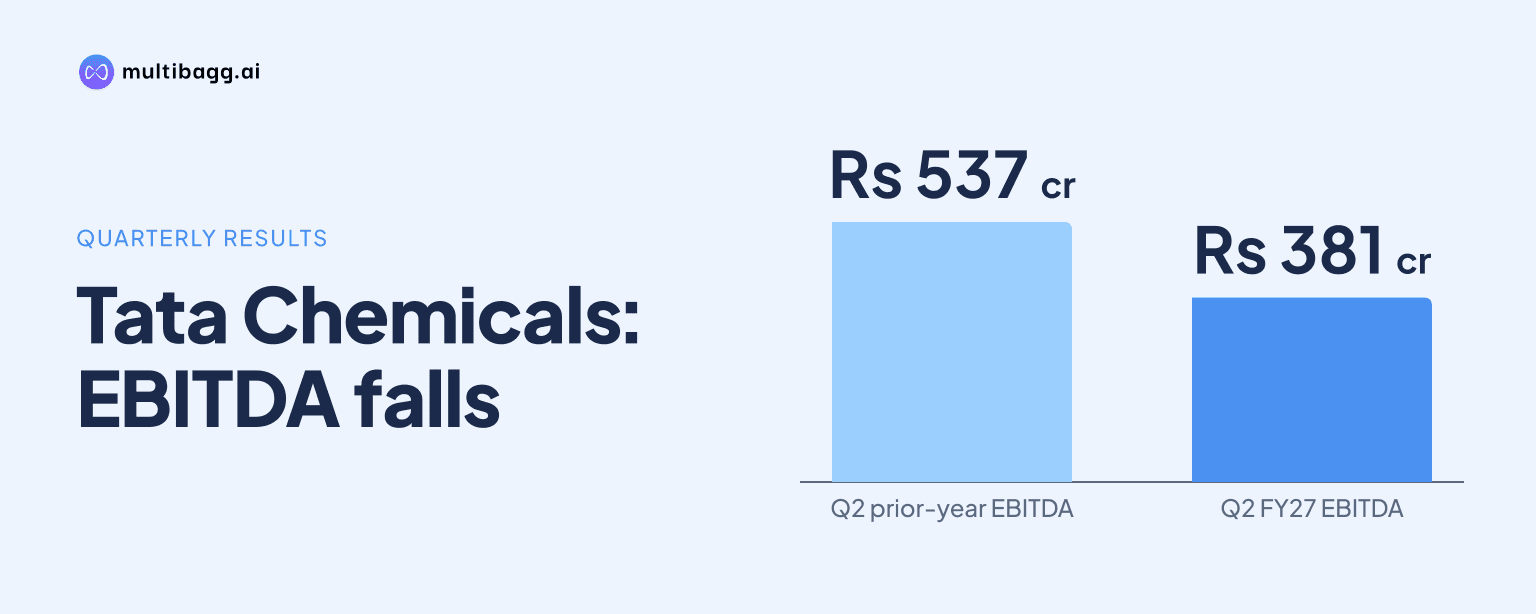
- Q2 FY27 consolidated EBITDA was Rs 381 crore, down from Rs 537 crore a year earlier.
powered by IRIS
In Q2 FY27, Tata Chemicals Limited (Tata Chemicals) won Searles Valley customer contracts for 0.5 million tonnes over two years, paying $22 million that will be amortised over five years; management said nearby California and Mexico deliveries provide substantially better pricing than its export alternative.
Know Tata Chemicals inside out
Results, valuation, peers and who's buying, in one view.
What did Tata Chemicals acquire from Searles Valley?
Tata Chemicals acquired customer contracts rather than Searles Valley Minerals operating assets. Its U.S. subsidiary was declared the successful bidder in Searles Valley Minerals’ Chapter 11 bankruptcy proceedings during Q2 FY27, securing contracts covering 0.5 million tonnes to be supplied over two years to customers in California and the neighbouring Mexican market.
The contracts add demand in markets that management said are geographically close to Tata Chemicals’ U.S. operations. Tata Chemicals reported higher U.S. revenue than a year earlier, mainly from higher volumes linked to contracts acquired during the year, although lower pricing in export markets partly offset that volume effect during Q2 FY27.
Why are the Searles contracts priced above exports?
The Searles contracts are priced substantially above Tata Chemicals’ export option, according to Chief Financial Officer Nandakumar Tirumalai. Management attributed the difference to overland service for nearby California and Mexico customers, which gives the U.S. business more control over logistics costs and supports plant-level netbacks, or revenue after directly associated costs.
The comparison comes as Tata Chemicals faces higher diesel costs, shipping freight and intermittent shipping connections on export routes. Managing Director and Chief Executive Officer R. Mukundan said shipping companies have taken longer routes to avoid conflict zones, while the local Searles routes reduce exposure to those ocean-freight and availability pressures.
Tata Chemicals is also completing residual soda ash export contracts in Southeast Asia, which management described as fairly unremunerative. Its stated U.S. strategy is to focus on North and South America, as well as Asian markets that provide positive netbacks after contribution costs, rather than serving large parts of Asia with lower returns.
How will Tata Chemicals account for the $22 million payment?
Tata Chemicals will treat the $22 million Searles payment as an intangible asset and amortise it over five years. Mr. Tirumalai said on the November 7, 2026 earnings call that the payment would not be netted against revenue, establishing an accounting period longer than the two-year initial customer-contract term.
Tata Chemicals did not disclose an annual amortisation charge, contract-level contribution margin or the individual customer prices. The two-year period therefore provides the disclosed duration for supplying 0.5 million tonnes, while the five-year intangible amortisation will continue to affect reported costs beyond that initial term.
The contracts do not include an automatic continuation after two years, according to management. Mr. Mukundan said Tata Chemicals will need to undertake a renewal process, while management hopes that serving these customers well could support renewals and help the company add further customers in the same nearby markets.
Got a follow-up? Ask IRIS
How do the contracts fit Tata Chemicals’ FY27 U.S. results?
The Searles contracts fit Tata Chemicals’ attempt to shift U.S. volumes toward local markets while global soda ash remains oversupplied. In Q2 FY27, consolidated revenue rose 8% year on year to Rs 4,177 crore, driven by higher volumes in India and the U.S., but lower overseas realisations and higher costs reduced consolidated EBITDA.
Consolidated EBITDA fell because of lower realisation at overseas subsidiaries, including U.S. exports to Southeast Asia, higher energy and logistics costs in the United Kingdom, and suspended Kenya operations. In contrast, standalone EBITDA rose 22% to Rs 292 crore in Q2 FY27, while standalone profit after tax declined 31% to Rs 122 crore.
The first-half comparison shows the wider group pressure beyond the U.S. contract win. H1 FY27 consolidated revenue increased 11% to Rs 8,432 crore, but EBITDA declined to Rs 936 crore from Rs 1,186 crore in H1 FY26, while profit after tax before exceptional items and non-controlling interest fell to Rs 10 crore from Rs 535 crore.
What should Tata Chemicals investors monitor next?
Investors should monitor whether Tata Chemicals converts the 0.5 million-tonne Searles volume into repeat demand when the two-year period ends. Management’s ability to renew these contracts, add customers in California and Mexico, and retain the local logistics advantage will determine whether the five-year intangible amortisation is supported by a longer customer relationship.
Tata Chemicals has set capital expenditure at around Rs 1,000 crore for FY27, including growth projects, and Mr. Tirumalai said the following year should remain at about the same level. The company reported net debt excluding leases of Rs 6,127 crore in Q2 FY27 and said proceeds from selling listed group-company investments were used to reduce debt in the U.S. and the United Kingdom.
Soda ash market conditions remain relevant to the U.S. strategy because management cited Chinese capacity additions, high inventories and sustained exports as sources of pricing pressure. Tata Chemicals said it would focus on cost competitiveness, logistics resilience, working-capital optimisation and disciplined capital allocation while global soda ash prices remain range-bound.
Conclusion
The Searles contracts give Tata Chemicals two years of local customer demand for 0.5 million tonnes and, according to management, substantially better pricing than export sales. The transaction addresses a specific U.S. logistics issue at a time when consolidated earnings remain affected by lower overseas realisations, U.K. energy and logistics costs, and suspended Kenya operations.
Next, investors should watch the renewal process after the initial two-year term, progress in shifting U.S. volumes away from low-return Southeast Asian exports, and the company’s around Rs 1,000 crore FY27 capital-expenditure plan. Management also said it expects to speak again when Tata Chemicals announces Q3 FY27 results.