










Tata Chemicals says UK cost surge drove overseas losses
Key highlights
- Tata Chemicals’ standalone Q2 FY27 EBITDA rose 22% year on year to Rs 292 crore.
- Consolidated Q2 FY27 EBITDA fell to Rs 381 crore from Rs 537 crore despite revenue rising 8% to Rs 4,177 crore.
- Management said UK salt and bicarbonate faced sharply higher gas, energy, logistics and soda-ash feedstock costs in Q2 FY27.
- Tata Chemicals acquired US customer contracts covering about 0.5 million tonnes to be serviced over two years.
powered by IRIS
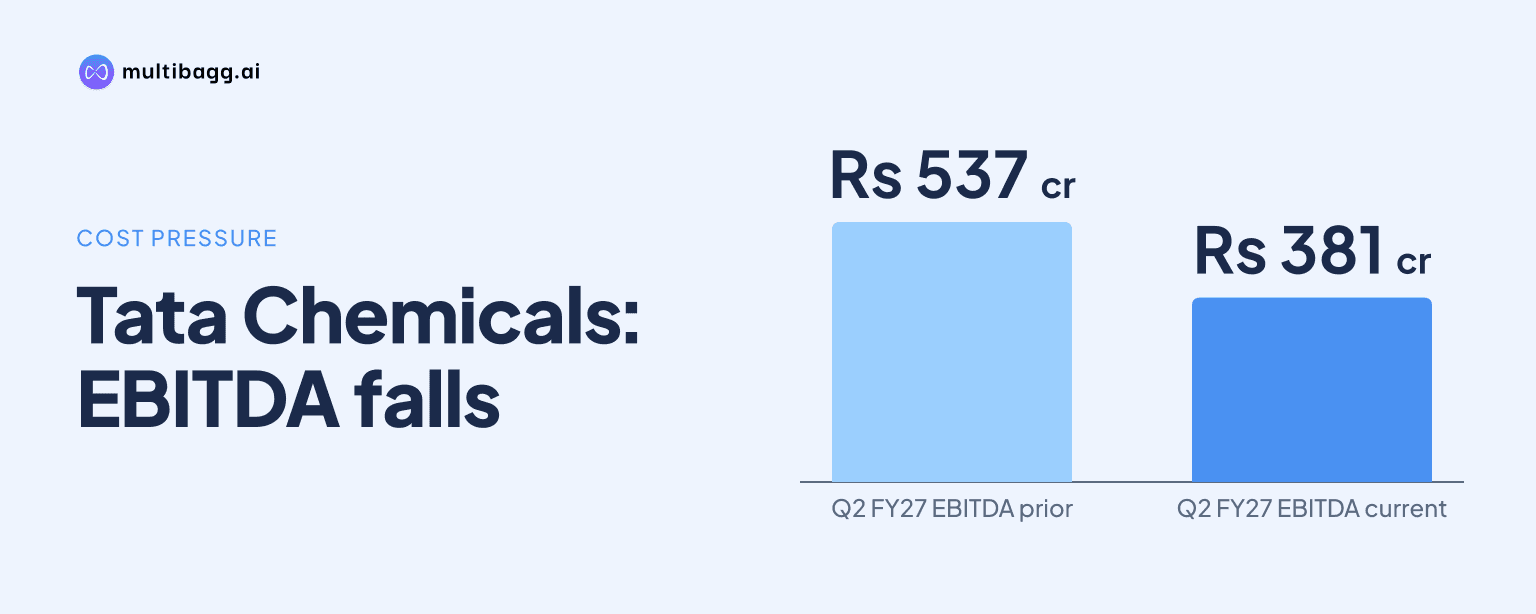
In Q2 FY27, Tata Chemicals Limited said a sharp UK increase in gas, energy, logistics and soda-ash feedstock costs made overseas Living Essentials operations loss-making, even as standalone EBITDA rose 22% year on year to Rs 292 crore. Consolidated EBITDA fell to Rs 381 crore from Rs 537 crore as UK costs, lower overseas realisations and Kenya’s suspension weighed on earnings.
Know Tata Chemicals inside out
Results, valuation, peers and who's buying, in one view.
How did UK costs make Tata Chemicals’ overseas Living Essentials business loss-making?
Tata Chemicals said the UK operation was the principal reason consolidated Living Essentials earnings before interest and tax, or EBIT, fell below standalone EBIT in Q2 FY27, indicating an EBIT loss at the subsidiaries. Management identified the combined UK bicarbonate and salt businesses as the main source of the pressure, rather than the India operations.
For salt, Tata Chemicals attributed the Q2 FY27 increase in variable costs mainly to higher gas and energy expenses. For bicarbonate, the pressure included energy costs and a higher cost of bringing soda ash feedstock into the business. Management described these as very recent Q2 FY27 spikes, with several costs escalating sharply during the quarter.
What changed between Tata Chemicals’ standalone and consolidated results?
Tata Chemicals’ India-led standalone business reported higher revenue and EBITDA in Q2 FY27, while consolidated results absorbed overseas cost and pricing pressure. Standalone revenue rose 8% year on year to Rs 1,303 crore and EBITDA rose 22% to Rs 292 crore, supported by higher sales and production volumes, operating efficiencies and cost management.
Consolidated revenue also increased 8% to Rs 4,177 crore in Q2 FY27, driven by higher volumes in India and the United States. However, consolidated EBITDA declined to Rs 381 crore from Rs 537 crore a year earlier, as lower realisations in overseas subsidiaries, UK energy and logistics costs, and the suspension of Kenya operations outweighed volume growth.
The difference extended below EBITDA in Q2 FY27. Tata Chemicals reported standalone profit after tax of Rs 122 crore, down 31% year on year, while consolidated results recorded a loss after tax of Rs 50 crore. Management cited lower realisations, higher energy costs, lower other income and lower joint-venture income for the consolidated loss.
Why did UK revenue and logistics conditions fail to offset higher costs?
Tata Chemicals said UK revenue in Q2 FY27 was lower than the previous year because salt realisations declined while variable costs rose sharply with gas prices. Supply-chain conditions also lowered sales realisations, particularly for Middle East markets, where freight and logistics were affected by the prolonged regional conflict.
The company linked broader freight pressure to rerouted shipping, higher diesel costs and intermittent shipping-connection availability during Q2 FY27. Those factors affected the overseas portfolio, but the UK Living Essentials exposure had an added bicarbonate issue because delivered soda ash feedstock costs rose alongside gas and energy costs.
Tata Chemicals did not disclose a numerical UK gas-cost increase, the UK segment EBIT result, or the respective contribution of salt and bicarbonate to the loss in Q2 FY27. Management said the affected UK businesses would return to normal levels if energy and logistics costs moderated, but it did not provide a timetable, cost threshold or earnings target.
Got a follow-up? Ask IRIS
How did the UK issue compare with Tata Chemicals’ other overseas pressures?
The UK cost spike was one of three specified overseas drags on Tata Chemicals’ consolidated Q2 FY27 EBITDA, which declined by Rs 156 crore year on year. The other two were lower realisations in overseas subsidiaries, especially US exports to Southeast Asia, and the temporary suspension of Kenya operations.
In the US, Tata Chemicals said exports to much of Southeast Asia had become unremunerative and it was completing residual contracts rather than expanding this exposure. Management said it would focus on North and South America, and other markets that produce positive post-contribution netbacks, helped by shorter logistics routes and lower transport exposure.
The Kenya issue was different from the UK margin pressure because operations remained suspended after a Ministry of Mining notice. Tata Chemicals said the Kenya unit was debt-free and had continued to generate a positive margin in a challenging environment; legal and administrative processes were continuing, with court proceedings expected during November and no restart date provided.
What is Tata Chemicals doing to address overseas margin pressure?
Tata Chemicals said its near-term priorities include cost competitiveness, supply-chain resilience, operational excellence, working-capital optimisation and disciplined capital allocation. Net debt excluding leases stood at Rs 6,127 crore at the end of Q2 FY27, and management said it was focused on protecting cash flows and preserving financial flexibility amid geopolitical uncertainty and soda-ash oversupply.
For FY27, management indicated capital expenditure of about Rs 1,000 crore, including growth projects, and said spending in the following year should remain at roughly the same level. Tata Chemicals’ longer-term strategy is to increase the contribution of non-cyclical specialty and value-added businesses, including Living Essentials products such as salt, bicarbonate and fructo-oligosaccharides, or FOS, a prebiotic ingredient.
Tata Chemicals also highlighted US customer contracts acquired through Searles Valley Minerals’ Chapter 11 process. The contracts represent about 0.5 million tonnes to be serviced over two years, and management said California and Mexico proximity should improve logistics economics relative to distant export routes; renewals after the two-year period are not automatic.
Conclusion
Tata Chemicals’ Q2 FY27 results show that higher volumes and improved standalone operating performance did not protect consolidated earnings from overseas exposure. The UK salt and bicarbonate operations faced a concentrated combination of higher gas, energy, logistics and soda-ash feedstock costs, while lower export realisations and Kenya’s suspension contributed to consolidated EBITDA falling from Rs 537 crore to Rs 381 crore.
The next issue to watch is whether UK energy and logistics costs moderate enough for salt and bicarbonate margins to normalise, as management expects. Investors can also monitor the November Kenya court proceedings, progress in servicing the 0.5 million-tonne US contracts, and Tata Chemicals’ next scheduled update when it announces Q3 FY27 results.