










TCI Express targets 2030 owned centres after 40-50 bps cuts
Key highlights
- TCI Express targets 80%-85% of revenue through major owned sorting centres by 2030 or 2031.
- Two automated TCI Express sorting centres reduced annual overall direct costs by at least 40-50 basis points.
- TCI Express had completed six or seven centre conversions and expects three more projects to take the total to nine.
- Management affirmed roughly Rs 100 crore of annual capital expenditure from the next year onward.
powered by IRIS
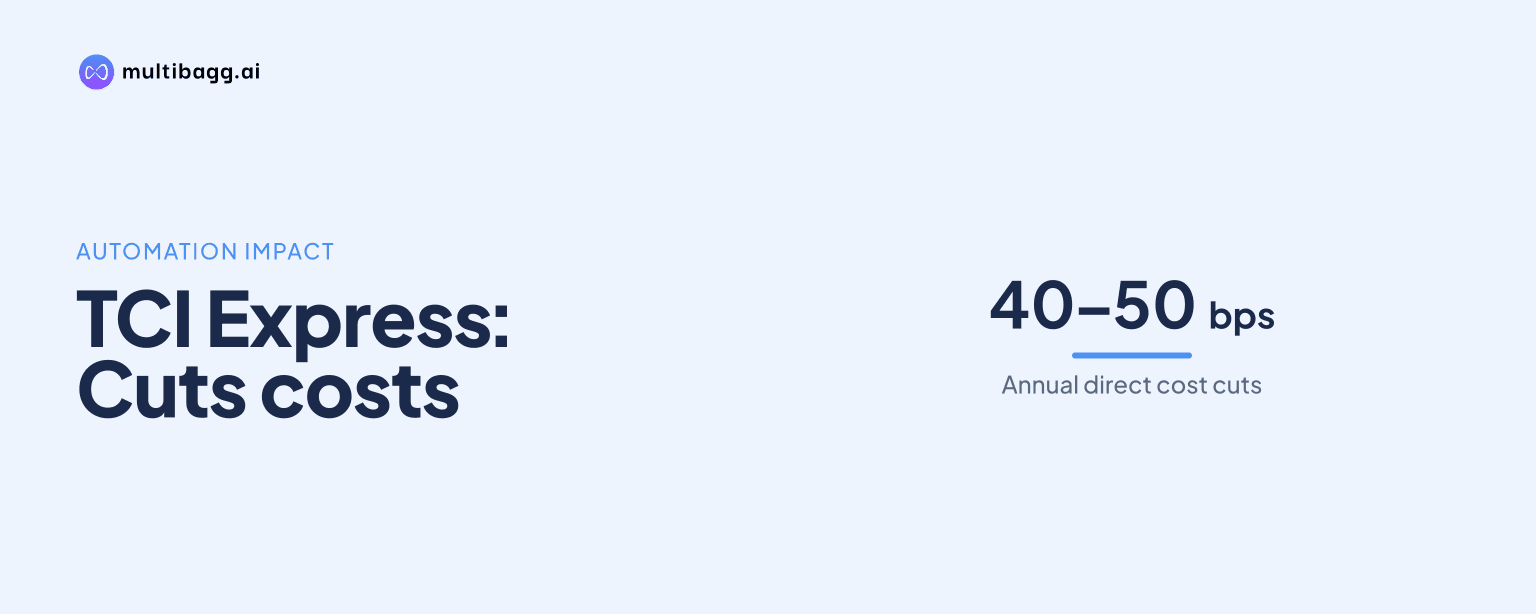
In Q2 FY 2027, TCI Express said two automated sorting centres had lowered annual overall direct costs by at least 40-50 basis points, while it planned to have 80%-85% of revenue move through owned major centres by the end of 2030 or, at the latest, 2031. The plan initially weighs on returns, management said.
Know TCI Express inside out
Results, valuation, peers and who's buying, in one view.
What is TCI Express's owned sorting-centre target?
TCI Express aims for its major owned sorting centres to handle 80%-85% of revenue by the end of 2030, or by 2031 at the latest. Management said the ownership programme is intended to give TCI Express long-term control of facilities that are vital to its India-wide operations, rather than being only a short-term cost-reduction exercise.
TCI Express said it wants to convert about 12 to 15 sorting centres under this strategy. It had already completed six or seven centres and was ramping up three more in Lucknow, Ahmedabad and Kolkata; management said this would take the total to nine. Mumbai, Chennai and Bengaluru were identified as the next three major locations being considered over the subsequent three to four years.
The 80%-85% revenue objective relates to major centres, not every TCI Express location. Management said that once roughly 15 centres are in place, the company expects the bulk of network revenue to pass through them, giving it more control over capacity and reducing the risk of disruption at critical sites.
How much has automation reduced TCI Express's direct costs?
TCI Express said its two automated sorting centres have reduced annual overall direct costs by at least 40-50 basis points. A basis point is one-hundredth of a percentage point, so the stated saving equals 0.40-0.50 percentage points of direct cost annually.
Management attributed the reduction to two operating changes: a lower labour component at automated centres and faster truck turnaround. The company did not give a rupee saving, a direct-cost base, or a separate cost figure for each of the two facilities, so the disclosed measure is the 40-50-basis-point annual impact on overall direct cost.
The savings are from facilities that have already been automated, while Ahmedabad and Kolkata were still awaiting automation. Management expected automation at those two centres to be completed in the first quarter of the next financial year or, at most, the second quarter, creating a further test of whether the existing cost effect can be extended.
What capital expenditure is TCI Express planning?
TCI Express said it expects roughly Rs 100 crore of capital expenditure a year from the next year onward as it pursues the ownership programme through 2030 or 2031. Management initially described a Rs 100 crore-plus capital plan over the next four to five years, then affirmed the analyst's characterisation of approximately Rs 100 crore per year.
The company’s previous five-year capital plan, made in 2023, was initially Rs 500 crore and was subsequently revised to Rs 400 crore. Management said TCI Express would complete around Rs 400 crore under that plan by FY 2027, marking a reduction of Rs 100 crore from the original programme.
In FY 2027, TCI Express had already spent Rs 80 crore, according to management, with another Rs 40 crore to Rs 50 crore remaining under the Rs 400 crore plan. The ongoing projects include the Lucknow, Ahmedabad and Kolkata sorting centres and corporate-office construction; management expected the three sorting centres, excluding the corporate office, to be completed by the financial year-end.
Got a follow-up? Ask IRIS
Why is TCI Express replacing leased sites with owned centres?
TCI Express is moving from leased to owned major sorting centres to gain long-term operating control over facilities that could carry 80%-85% of revenue by 2030 or 2031. Management said a leased facility does not by itself hurt operations, but ownership is intended to avoid disruption risk at sites that play a central role in the nationwide network.
Management also said larger owned properties can provide more space to accept customer business. It added that some customers prefer to visit company-owned facilities, allowing TCI Express to showcase capacity, although it did not disclose revenue won from owned sites, customer conversion rates, or utilisation levels for individual centres.
The planned conversion is largely not a shift away from promoter-linked premises. Management said only one existing centre was promoter-driven and the remaining centres were third-party sites. The programme therefore involves building control over key infrastructure while the company continues to identify locations such as Mumbai, Chennai and Bengaluru for the next phase.
What is the return trade-off in TCI Express's plan?
TCI Express acknowledged that initial investment in owned centres weighs on returns before volumes build. Management said the assets are being developed for the next 20 to 25 years and expects return on investment to improve as business increases, but it did not provide a numerical return target, payback period or utilisation threshold.
Management linked the capacity build to its growth outlook for the remaining two quarters of FY 2027. It said Surface Express had grown around 9%, broadly in line with overall growth of around 9%, and projected 14%-15% growth for the next two quarters, with volume growth of around 11%-12%; these are management expectations rather than reported full-year results.
The company also said it was achieving net price increases of around 1.5% after fuel-related pass-throughs. Management projected H2 FY 2027 margin above 13%, compared with 12.2% in H1 FY 2027, and earlier said it expected margin improvement of 50-100 basis points over the prior year. These targets depend on volume growth, pricing and execution of the centre programme.
Conclusion
TCI Express is combining owned infrastructure and automation in a plan that targets 80%-85% of revenue through major owned sorting centres by 2030 or 2031. The quantified operating result so far is at least a 40-50-basis-point annual reduction in overall direct costs from two automated facilities, driven by lower labour needs and quicker truck turnaround.
The next disclosed milestones are completion of the Lucknow, Ahmedabad and Kolkata centres by FY 2027 year-end and automation at Ahmedabad and Kolkata by the first or second quarter of the next financial year. Management’s plans for roughly Rs 100 crore of annual capital expenditure and five or six more centres by 2030 or 2031 will determine the pace at which the targeted network coverage is reached.