










TCI Express targets 15% margin in selective e-commerce
Key highlights
- TCI Express said E-Commerce Express grew 51.6% year-on-year in Q2 FY27.
- Management said selected D2C last-mile work must deliver at least a 15% EBITDA margin.
- TCI Express reported Q2 FY27 EBITDA of Rs 43 crore and a 12.7% margin, compared with 12.4% a year earlier.
- Management expects its digital wallet to be operational by the end of calendar 2026.
powered by IRIS
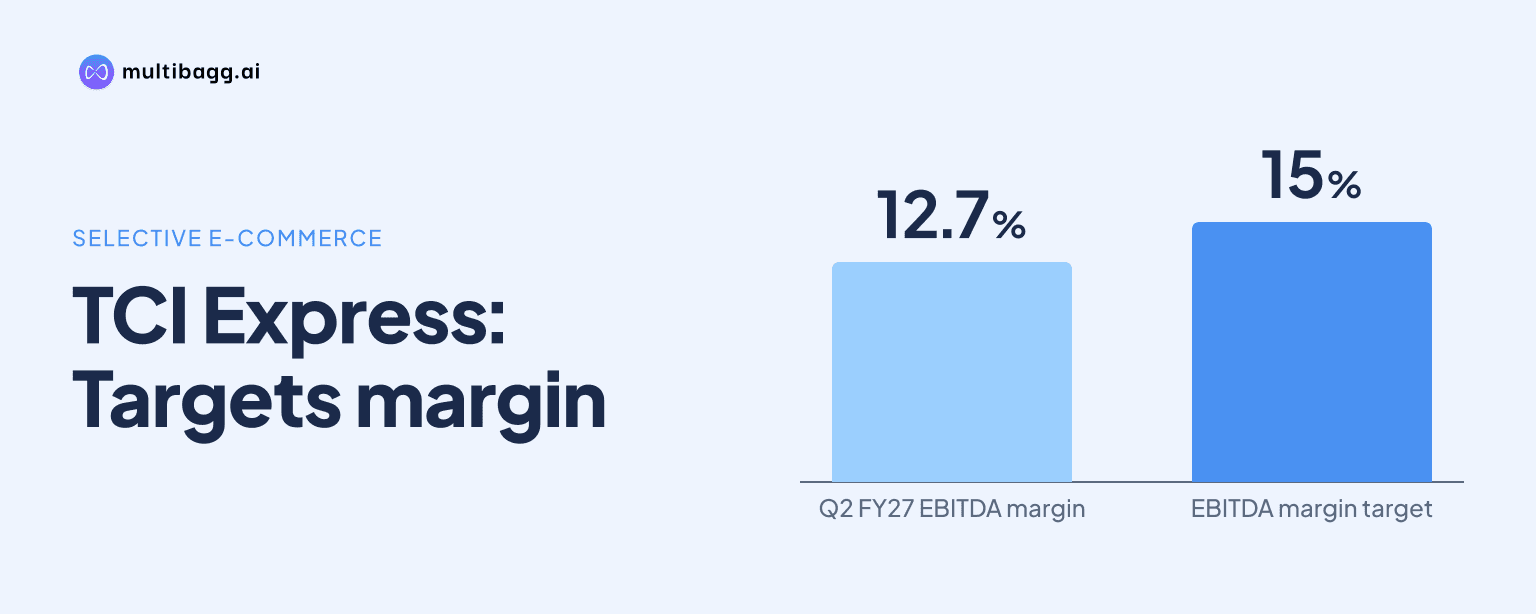
TCI Express Limited is rebuilding E-Commerce Express around direct-to-consumer, or D2C, brands and smaller merchants, with management targeting at least a 15% earnings before interest, tax, depreciation and amortisation, or EBITDA, margin on selected work after the segment grew 51.6% year-on-year in Q2 FY27.
Know TCI Express inside out
Results, valuation, peers and who's buying, in one view.
How is TCI Express changing its e-commerce strategy?
TCI Express is focusing on D2C sellers, merchants reached through e-commerce platforms and smaller e-commerce players rather than pursuing broad exposure to two or three large platforms. Management said D2C brands increasingly sell through their own websites and need direct delivery to consumers, making this a focus area for E-Commerce Express in Q2 FY27.
The company is registering with aggregators and marketplace platforms, including the Open Network for Digital Commerce, or ONDC, but management described this as a small business. The objective is to access merchants using those platforms and then approach them for wider delivery requirements across India. TCI Express said its current business-to-consumer, or B2C, E-Commerce Express activity is mainly last-mile delivery, while e-commerce-linked business-to-business, or B2B, shipments are also a focus.
The operating model is selective by city rather than nationwide from the outset. Management cited Surat, Bengaluru and Ludhiana, with Surat's textile market representing enterprises that send orders directly to consumers. It said the initial emphasis includes Tier 2 cities, where smaller merchants and enterprises are directly dispatching parcels to customers.
TCI Express said it is creating separate city-level teams instead of expanding into every city at once. The approach combines local customer preparation with the existing network, while management did not disclose E-Commerce Express tonnage. Total Q2 FY27 tonnage was 265,000 tonnes, up 7.5% year-on-year.
Why is TCI Express avoiding the largest e-commerce platforms?
TCI Express is avoiding an indiscriminate pursuit of large-platform volume because management wants business that meets its margin requirement. It said it would focus on smaller, second-line e-commerce platforms that it considers more profitable and would operate only where the business economics are acceptable.
Management said it was targeting D2C customers that are not engaged in a price war and gave Yes Madam as an example of a brand it serves. Such customers, management said, accept pricing that allows TCI Express to earn at least a 15% EBITDA margin. This is a management threshold for selected E-Commerce Express work, not the segment's reported profitability.
The target exceeds the company's reported standalone EBITDA margin of 12.7% in Q2 FY27, compared with 12.4% a year earlier. EBITDA rose about 11% year-on-year to Rs 43 crore, faster than the roughly 9% increase in income from operations to Rs 336 crore.
For H1 FY27, TCI Express reported EBITDA of Rs 80 crore, up 10.8% year-on-year from Rs 72 crore, and an EBITDA margin of 12.2%, compared with 12.0%. Management also said it seeks to return company-level margins to the 15%-16% range after two to three years, which is an aspiration rather than guidance for E-Commerce Express alone.
Got a follow-up? Ask IRIS
How will marketplace registrations and the digital wallet support TCI Express?
TCI Express is using platform registrations as a merchant-acquisition route rather than as the primary channel for mass marketplace volume. Management said registrations provide access to small and medium enterprise, or SME, merchants, allowing the company to seek other delivery assignments from businesses that operate across India.
A digital wallet is intended to enable online booking for domestic E-Commerce Express and International Air Express customers. Management said TCI Express had signed an agreement with a wallet company and integration was under way during the Q2 FY27 call. A D2C customer sending 20 or 50 packets would first load money into the wallet before the company transports the consignment.
Management expected the wallet to be operational by the end of calendar 2026 and said bookings through it could begin from the following year. This is an implementation expectation, not a confirmed launch date. The product is intended for customers that need online docket bookings rather than a conventional high-volume enterprise arrangement.
The platform and wallet initiatives sit alongside a customer mix that was 50% SME and 50% large customers in the quarter, according to management. It said maintaining a high SME share is important to margins, although the 50:50 split applies to the wider business and not specifically to E-Commerce Express.
Is E-Commerce Express changing TCI Express's core logistics business?
TCI Express said aggregators have no significant impact on its core B2B Surface Express operations because B2B customers generally contact logistics providers directly. Management said it does not use aggregators to sell Surface Express services, even though it registers with platforms as part of its E-Commerce Express activity.
Surface Express, the largest business, grew about 9% year-on-year in Q2 FY27, while E-Commerce Express grew 51.6%. Domestic Air Express grew 29% and International Air Express grew 26%, according to management. The comparison shows the newer businesses were growing faster, but their smaller revenue base meant Surface Express remained the main influence on overall growth.
Management said Air Express, International Air Express, rail, E-Commerce Express and C2C Express together accounted for about 17%-17.5% of revenue. Its target is more than 18% by the end of FY27 and more than 22% by 2030, based on higher growth in these services than in Surface Express.
For the remaining two quarters of FY27, management expects overall revenue growth of about 14%-15%, volume growth of about 11%-12% and EBITDA margin above 13%. It also said October had started well, but did not provide a separate revenue or margin forecast for E-Commerce Express.
Conclusion
TCI Express is returning to e-commerce through a narrower model centred on D2C brands, smaller merchants and selected platforms where pricing can support at least a 15% EBITDA margin. The strategy uses city-level teams, merchant access through platform registrations and last-mile delivery, while management says the company is avoiding dependence on the largest platforms.
The next development to watch is the planned digital-wallet rollout by the end of calendar 2026 and the expected start of wallet bookings in the following year. Management has also set targets of more than 18% revenue from newer services by FY27-end, 14%-15% overall growth in the second half and EBITDA margin above 13%, while separate E-Commerce Express financial disclosure remains unresolved.