










Timex Group India Limited expands Baddi capacity to 6 million
Key highlights
- TGIL raised Baddi single-shift assembly capacity to 6 million units from about 4 million units produced last year.
- TGIL reports 6,446 physical sales touchpoints, including 5,024 multi-brand locations.
- TGIL's after-sales network comprises 181 authorised locations supported by a Customer Care Call Centre.
- Baddi handles more than 150 movement types and assembles five stated watch formats.
powered by IRIS
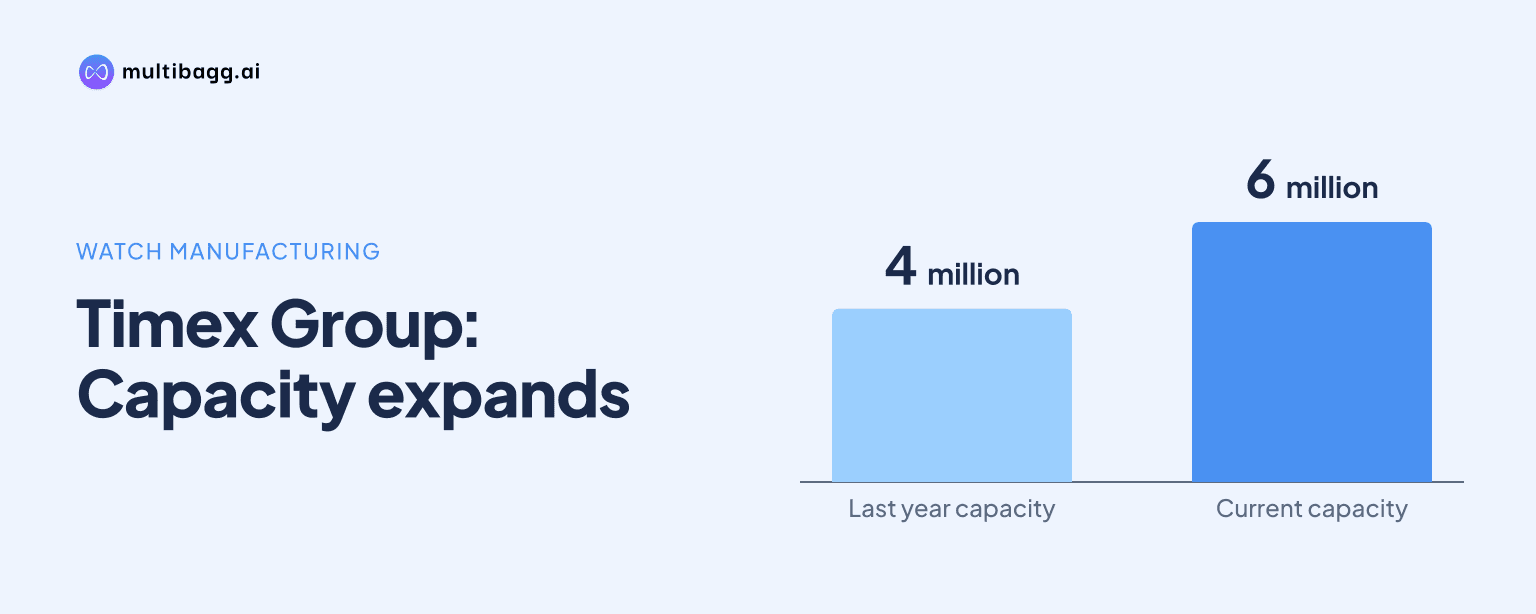
Timex Group India Limited (TGIL) increased Baddi watch-assembly capacity to 6 million units in a single-shift operation this year, after producing about 4 million units last year, and reports 6,446 physical sales touchpoints plus 181 authorised service locations in India. The disclosure combines a higher stated assembly ceiling with sales and after-sales coverage.
Know Timex Group India inside out
Results, valuation, peers and who's buying, in one view.
How large is TGIL's Baddi watch-assembly capacity?
TGIL says its Baddi plant has capacity to assemble 6 million watch units in a single-shift operation this year, compared with output of about 4 million units last year. The difference between those stated measures is about 2 million units, but they are not like-for-like production figures because one is output and the other is available capacity.
The 6 million-unit figure is a capacity measure rather than a sales, shipment or inventory target. TGIL describes the Baddi, Himachal Pradesh facility as an assembly unit that takes watch piece parts through to a completed watch, while its headquarters is in Noida and its registered office is in New Delhi.
TGIL identifies Baddi as an SA8000:2014 and ISO 45001:2018 certified watch-assembly unit. The presentation does not disclose the year of the capacity increase, capital expenditure, employee numbers, utilisation at 6 million units, or a production forecast for the current year.
What can TGIL assemble at the Baddi plant?
TGIL says Baddi assembles five stated watch formats: Analog Quartz, Mechanical, Digital, Ana-Digi and Connected watches. The plant handles more than 150 types of movements and a range of cases, dials and attachment types, giving it a stated capability across multiple component combinations.
The facility has online and offline assembly capability, which TGIL says can accommodate both high- and low-volume movements. The presentation does not provide a production split by format, movement type or brand, and it does not state how the 6 million-unit capacity is allocated among the five watch formats.
TGIL lists 13 brands in its portfolio: Timex, Versace, Guess, Philipp Plein, Ferragamo, Nautica, GC, Furla, Aston Martin, TMX Time Mode Xclusive, Helix, United Colors of Benetton and iConnect by Timex. The portfolio and plant capabilities are both disclosed, but the presentation does not connect a specific brand to Baddi output or capacity.
The presentation also says Timex is registered on the Government e-Marketplace, or GeM. TGIL does not disclose GeM order values, tender awards, or the proportion of Baddi's 6 million-unit capacity that may be associated with government procurement.
Got a follow-up? Ask IRIS
How broad is TGIL's physical sales network?
TGIL reports 6,446 physical sales touchpoints across five channels in India, led by 5,024 multi-brand locations. Defence canteens account for 845 touchpoints, followed by 351 large-format locations, 185 luxury-retail locations and 41 locations classified as retail.
Multi-brand outlets exceed defence-canteen locations by 4,179 touchpoints and are the largest disclosed channel. Luxury retail has 185 locations, fewer than the 351 large-format locations, while the 41 retail locations are the smallest of the five categories.
TGIL also lists six online platforms: Tata CLiQ Luxury, Amazon, Flipkart, Myntra, Nykaa Fashion and AJIO. The presentation does not report online sales, physical-channel sales, revenue per location, unit volumes, or the contribution of any of the five physical formats to revenue.
How is TGIL's after-sales service network organised?
TGIL reports 181 authorised after-sales locations across India, supported by a Customer Care Call Centre. The network comprises 5 authorised service workshops, 12 lead authorised service centres and 164 authorised service centres.
The 164 authorised service centres are the largest component of the 181-location network, followed by 12 lead authorised service centres and 5 authorised workshops. The presentation does not define the responsibilities of the three categories or disclose repair turnaround times, warranty claims, spare-parts availability or service revenue.
The service footprint is disclosed alongside Baddi's more than 150 movement types and the 6,446 sales touchpoints. TGIL does not state whether every one of its 13 listed brands uses the same authorised network, or how service centres receive parts from the Baddi operation.
Conclusion
TGIL's disclosure describes an India operating platform with 6 million units of single-shift Baddi assembly capacity, 6,446 physical sales touchpoints and 181 authorised after-sales locations. The stated increase from about 4 million units produced last year to 6 million units of capacity adds assembly headroom, while the retail network is concentrated in 5,024 multi-brand locations.
The key unresolved operating measure is utilisation of the 6 million-unit Baddi capacity, which the presentation does not provide. Future disclosures of production, output by the five watch formats, and sales by physical and online channel would show how TGIL's stated manufacturing, distribution and service footprint is being used.