










Thomas Scott India Limited's licensed business rises 52%
Key highlights
- Thomas Scott signed exclusive Forever 21 and Dockers licences for India, Nepal and Bangladesh.
- Licensed-and-other-brands revenue rose 52% year on year to Rs 49 crore in Q2 FY27.
- Q2 FY27 revenue from operations increased 39% year on year to Rs 79 crore.
- Fulfilment cost per unit fell 25%, from Rs 24 in FY24 to Rs 18 in H1 FY27.
powered by IRIS
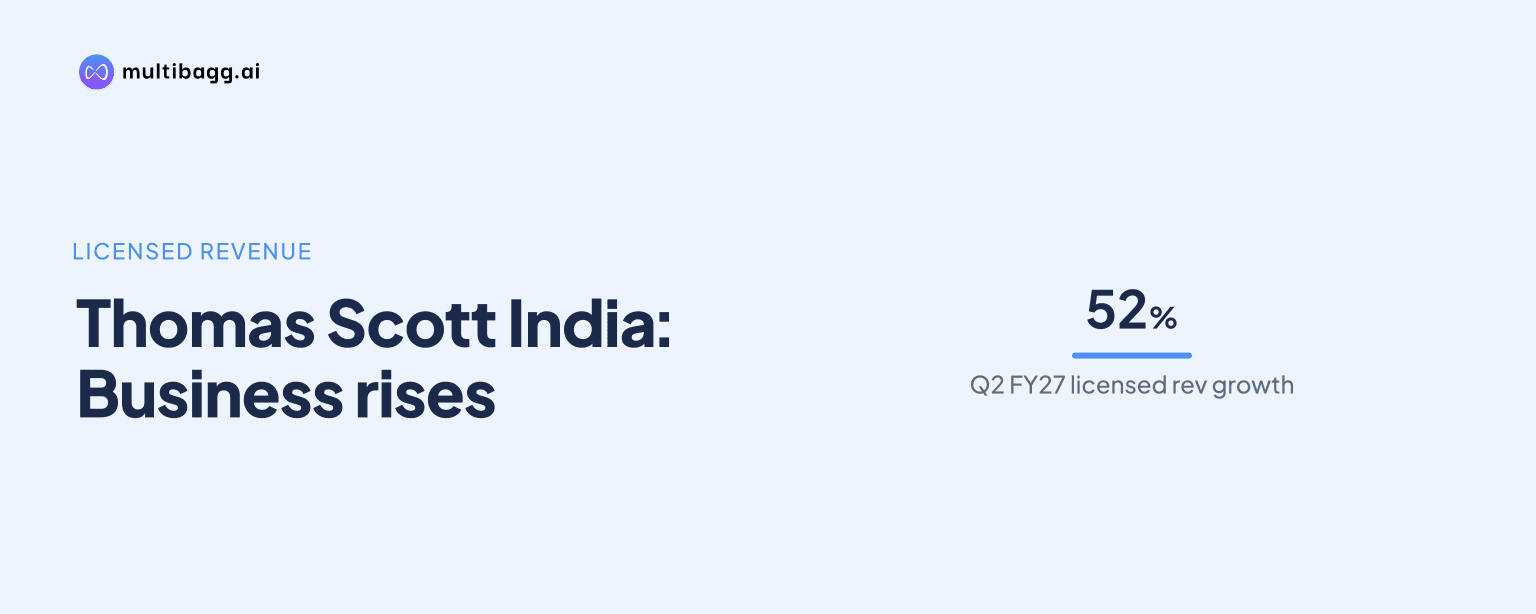
Thomas Scott India Limited’s licensed-and-other-brands revenue rose 52% year on year to Rs 49 crore in Q2 FY27, while it signed exclusive Forever 21 and Dockers licences for India, Nepal and Bangladesh. Management said on November 13, 2026 that the newly signed arrangements had not yet generated revenue.
Know Thomas Scott India inside out
Results, valuation, peers and who's buying, in one view.
What rights did Thomas Scott secure for Forever 21 and Dockers?
Thomas Scott secured exclusive rights to design, develop, manufacture, distribute, retail and operate e-commerce for Forever 21 and Dockers in India, Nepal and Bangladesh. The Forever 21 agreement is with IPCO LLC, which management identified as a subsidiary of Authentic Brands Group, while the Dockers agreement is with ABG Dockers LLC.
The agreements also appoint Thomas Scott as a global designated supplier, allowing it to manufacture and supply products to international partners of the two brands on a just-in-time basis. Management said this mechanism could connect its ready inventory with the global e-commerce supply chain, alongside its domestic sales through marketplaces including Myntra and Amazon.
Thomas Scott operates a portfolio of more than 15 brands and more than 15,000 stock-keeping units, or SKUs. Its manufacturing footprint spans Solapur, Bangalore and Gurgaon, while fulfilment centres across India support delivery, providing the operational base management cited for expanding direct licensing and international supply.
Has Thomas Scott started earning revenue from the new licences?
No, Thomas Scott had not recorded revenue from the Forever 21 and Dockers arrangements as of the November 13, 2026 Q2 FY27 earnings call. Management said revenue from the new businesses was still to build, so it retained the existing reporting format for like-for-like comparison with earlier periods.
Thomas Scott plans to separately report export revenue and own or direct-licence brands in coming quarters. Management said the new presentation will make the contribution of the agreements visible once sales develop, instead of leaving them within the current reporting categories of own brands, licensed brands and business-to-business activity.
The company also initiated exports of certain brands from its international portfolio during Q2 FY27 and set up the platform for that activity in the quarter. Management said it was working toward higher export turnover in coming quarters, but gave no export-sales figure, revenue target or date for first sales from Forever 21 or Dockers.
How did licensed-brand revenue compare with Thomas Scott’s other businesses?
Licensed and other brands were Thomas Scott’s largest reported Q2 FY27 vertical, with revenue of Rs 49 crore, up 52% year on year. This exceeded Rs 28 crore from the Thomas Scott own brand and Rs 2 crore from contract manufacturing, within total revenue from operations of Rs 79 crore.
Licensed and other brands grew faster than the own-brand operation, while contract manufacturing contracted by 29%. Management attributed the Rs 49 crore licensed-and-other-brands result to marketplace relationships and premiumisation of its international brand portfolio; it linked own-brand growth to product launches, online distribution and inventory supplied to distributors and aggregators.
For H1 FY27, licensed-brand revenue rose 33% year on year to Rs 87 crore, compared with a 31% increase in own-brand revenue to Rs 52 crore. Business-to-business revenue was stable at Rs 6 crore, while total revenue from operations rose 31% to Rs 145 crore, showing that licensed brands remained the larger reported revenue stream over the first half.
Got a follow-up? Ask IRIS
How will Thomas Scott supply international partners under the agreements?
Thomas Scott said international partners can buy from inventory held for its Indian territory, rather than placing a conventional factory production order. Management said partners could order as few as 20 to 30 units of a design, subject to a minimum overall order value, compared with typical manufacturing minimums of 500 to 3,000 units per design.
The just-in-time model is intended to reduce inventory risk for global partners because products are drawn from ready inventory. Management said it expects this business to produce margins at par with, or better than, its existing operations, rather than the margin profile of a conventional pure-play export business; this remains an expectation because revenue has not begun.
Management said Indian sales carry variable and semi-variable costs, including marketing expenditure, that would largely be borne by global partners in the designated-supplier model. Thomas Scott did not disclose its export pricing, the countries where international partners may sell products, or the share of revenue expected from this channel.
What financial and operating trends support the expansion?
Thomas Scott reported earnings before interest, tax, depreciation and amortisation, or EBITDA, of about Rs 11 crore in Q2 FY27, up 24% year on year, at a 13.31% margin. Profit after tax, or PAT, was about Rs 6 crore, up 34% year on year, while the PAT margin was 7.98%.
In H1 FY27, EBITDA increased 31% year on year to Rs 19 crore and PAT rose 43% to about Rs 12 crore. Fulfilment cost per unit declined from Rs 24 in FY24 to Rs 18 in H1 FY27, a reduction of about 25%, which management attributed to improved cost management and operational efficiency as volumes increased.
Management said its thread,ai and catalog,ai platforms are being deployed in demand forecasting, planning and catalogue management. Its build-for-demand, or test-and-scale, model is intended to assess consumer response, scale successful styles and manage inventory risk across its more than 15,000 SKUs.
Q2 FY27 margins also reflected sales timing, management said. Dussehra sales were mainly in October, after the September 30 quarter-end, whereas the prior-year Dussehra sale began in Q2 and continued into early Q3; management said some FY27 margin may therefore have shifted into Q3.
Conclusion
Thomas Scott’s Forever 21 and Dockers agreements add direct licensing, product development and potential international supply to a business where licensed-and-other-brands revenue already rose 52% to Rs 49 crore in Q2 FY27. The comparison with 28% growth in own-brand revenue and a 29% decline in contract manufacturing shows that licensed brands were the principal reported growth contributor during the quarter.
The next disclosures to watch are separate reporting for export revenue and direct-licence brands, which management said it plans to introduce in coming quarters as the new businesses build. Investors can also assess whether export turnover emerges, whether designated-supplier sales meet management’s stated margin expectation, and whether Q3 captures Dussehra sales that fell after the September 30 Q2 cut-off.