










Titan says Damas liability estimate is not investment impairment
Key highlights
- Titan said the Damas liability relates to put-option and call-option arrangements due at the end of four years.
- Titan said it sees no reason to impair Damas because its long-term opportunity has not diminished.
- Titan said it will reassess the Damas liability every quarter as the four-year period unfolds.
- Titan kept jewellery margin guidance anchored around 11% and plans to reconsider it after the full financial year 2027.
powered by IRIS
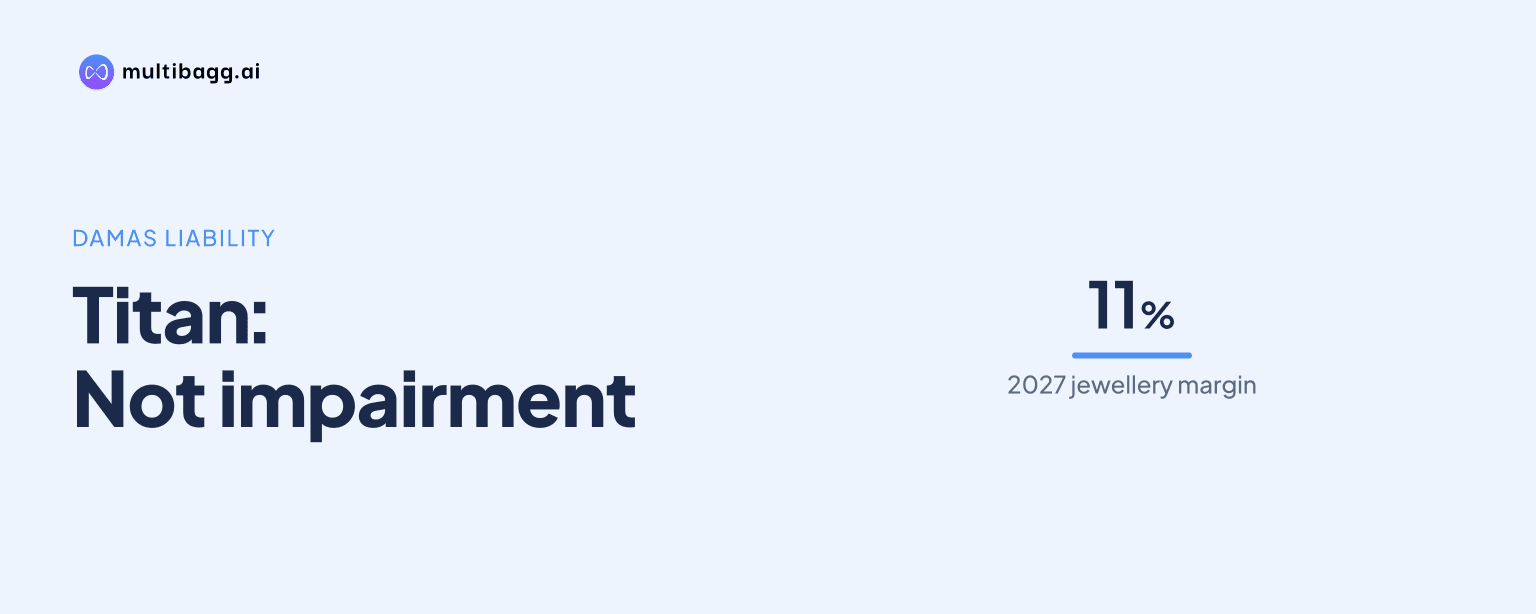
Titan Company Limited said the Damas liability revaluation is a quarterly accounting estimate for a put-option and call-option arrangement due at the end of four years, not an impairment of the investment. Titan said it sees no reason to write down Damas because the business’s long-term opportunity has not diminished.
Know Titan Company inside out
Results, valuation, peers and who's buying, in one view.
What does Titan say the Damas revaluation represents?
Titan says the Damas revaluation is an accounting requirement to estimate a future liability under put-option and call-option arrangements, rather than a judgement that Damas has lost value. Management said the liability relates to a payment that may arise at the end of a four-year period and requires a view of likely performance across that full period.
Ashok Sonthalia said Titan takes a complete view of probable performance over the four years when measuring the liability. As each quarter unfolds, Titan will reconsider what has happened and its updated view of the remaining period. He said accounting treatment is applied prudently, which can make such estimates conservative.
The call did not disclose the amount of the liability revaluation, the valuation assumptions, or any sensitivity to Damas performance over the four years. It also did not quantify the effect on quarterly profit, the balance sheet or cash flow. The disclosed explanation is therefore limited to the put-call mechanism and the quarterly reassessment process.
Is Titan writing down its Damas investment?
No. Titan said it sees no reason at this point to impair its Damas investment because it does not believe the long-term opportunity has diminished in any manner. Management distinguished the review of the investment carried on its balance sheet from the estimate of the separate four-year put-call liability.
Titan said an investment must be assessed over time to determine whether it continues to hold its value on the balance sheet. That assessment applies independently of the future-payment liability. In the case of Damas, management said its conclusion was that the long-term opportunity had not weakened enough to require an impairment.
The distinction is material because the two accounting exercises use different questions. The put-call liability estimates a possible payment at the end of four years based on likely performance, whereas impairment considers whether the investment itself retains its recorded value. Titan said the liability accounting action does not mean that it has written down the investment.
Why would a full Damas acquisition change the accounting?
Titan said a 100% acquisition would remove this particular future-payment liability because there would be no put-option or call-option payment to make at the end of four years. Management said that is the payment obligation it remeasured in the current quarter.
However, Titan also said a full acquisition would not remove the need to assess the investment’s value. Even without the four-year liability, the company would still need to consider whether the investment on its balance sheet continued to hold its value. Management said it would not have recorded the current liability action in that hypothetical structure, but the impairment assessment would still apply.
An analyst asked whether geopolitical conditions might have led to an impairment under a 100% acquisition. Titan did not identify geopolitical disruption as the cause of the liability revaluation. Instead, it repeated that the present action followed the accounting requirement to estimate likely performance across the four-year put-call period.
Got a follow-up? Ask IRIS
How often will Titan reassess the Damas liability?
Titan said it will revisit the Damas liability every quarter as the four-year period develops. Management described the exercise as a continuing assessment of probable performance, rather than a one-time calculation made at the acquisition date.
A quarterly revision to the liability would reflect Titan’s updated expectations for the future payment under the put-call arrangement. It would not automatically establish that the balance-sheet investment has become impaired, because Titan said the investment-value review and the four-year payment estimate are separate assessments.
Titan did not provide a target, range or trigger that would determine whether the liability rises or falls in future quarters. Investors therefore cannot calculate the effect of a change in Damas performance from the call alone. The disclosed point is that new quarterly information will feed into Titan’s estimate of the end-of-four-year obligation.
What else did Titan say about its operating outlook?
Titan said jewellery competition is likely to increase and maintained margin guidance anchored around 11%. Management said it would wait for the full financial year 2027 to close before reconsidering its future margin outlook, citing competitive intensity and uncertainty over whether gold prices will stay stable or rise again.
In jewellery, Titan said buyer growth below Rs 1 lakh is important to its strategy. Management identified products below Rs 50,000 and Rs 1 lakh, including lightweight jewellery, 14-karat studded jewellery and 18-karat gold jewellery, as ways to make purchases more accessible. It also cited its gold exchange programme, store upgrades and network expansion as growth levers.
Management said gold prices had been broadly flat for about six months, while customs-duty-related inventory gains since May had enabled aggressive promotions and discounts by some competitors. Titan said its position versus smaller players could improve if prices continued to soften, but it also said it was difficult to separate the effects of discounts, inventory gains and other market factors.
Titan said its watch and EyeCare divisions, newer businesses including fragrances and fashion accessories, Taneira, TEAL and the North American international jewellery business performed extremely well in the quarter discussed. Management said these non-jewellery businesses provide higher operating leverage, although the call did not provide segment-level revenue or profit figures.
Conclusion
Titan’s position is that the Damas revaluation concerns a possible future payment under a four-year put-call arrangement, rather than a write-down of its investment. Management separated a quarterly update to the liability estimate from the ongoing impairment review and said Damas’s long-term opportunity remains intact.
The next point to watch is Titan’s quarterly reassessment of probable Damas performance through the four-year period, since management said that estimate will be revisited as each quarter unfolds. Management also plans to review its margin outlook after the full financial year 2027, against continuing jewellery competition and gold-price movements.