










Titan keeps jewellery margins near 11% as rivalry rises
Key highlights
- Titan will keep jewellery margins anchored around 11% until the full financial year 2027 closes.
- Management said customs-duty-related inventory gains since May may support promotions for another two to three months.
- Titan expects organised jewellers entering new geographies to increase competitive intensity for years.
- Titan is targeting jewellery below Rs 1 lakh and below Rs 50,000 to support buyer growth.
powered by IRIS
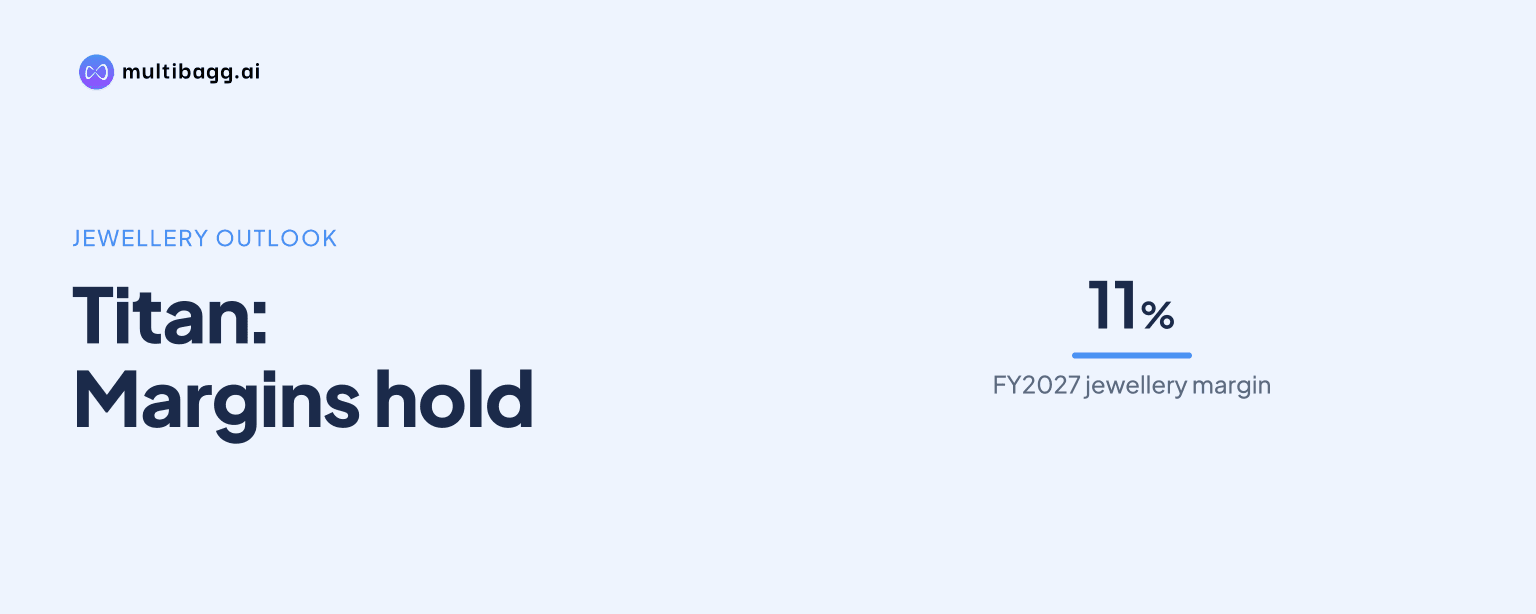
Titan Company Limited will keep jewellery margins anchored around 11% until the full financial year 2027 closes, as management expects competitive intensity to increase through organised expansion, local discounting and uncertain gold-price movements. Management said it can deliver margins near 11% but will not raise that aspiration hurriedly.
Know Titan Company inside out
Results, valuation, peers and who's buying, in one view.
Why is Titan keeping jewellery margins near 11%?
Titan is retaining its 11% jewellery-margin anchor because management expects competitive pressure to require tactical responses in some markets. Ashok Sonthalia said the company can confidently deliver margins around 11%, but does not want to change the aspiration while competition is rising and the future direction of gold prices remains uncertain.
Management plans to reassess the margin outlook only after the full financial year 2027 closes. Sonthalia said there are conflicting views on whether gold will stabilise or resume an upward movement, meaning Titan does not regard a correction in gold prices as a dependable basis for increasing its margin guidance.
Ajoy Chawla said Titan’s margin guidance will not change according to a short-term assessment of whether competitive intensity rises or falls. The company’s working assumption is that competition will keep increasing, so the 11% level is an operating anchor rather than a stated target for margin expansion.
What is increasing jewellery competition for Titan?
Titan expects competition to rise as organised jewellers expand beyond the geographies where they began. Arun Narayan said industry formalisation is likely to continue for years, with organised players entering new regions while smaller jewellers work to retain customers who may be shifting towards larger retailers.
Smaller jewellers are becoming more active and may use discounting to protect customer relationships, Narayan said. Sonthalia said the pressure is not confined to a single geography, although some catchments may have price-focused competitors. Titan’s response is therefore tailored to local market postures rather than based on one nationwide discounting policy.
Management separated this structural trend from a shorter-term inventory factor. Sonthalia said customs-duty-related gains had been available since May, supporting aggressive promotions and discounts. In his view, after four to five months had already passed, competitors could retain this promotional firepower for another two to three months.
How will Titan respond to local discounts?
Titan will respond through catchment-specific actions while continuing to develop its retail network and product offering. Sonthalia said the company has navigated comparable industry cycles before and will react differently where local competitors take a particular market posture, without identifying a uniform response across all locations.
Network expansion is part of that approach. Narayan said Titan is adding stores in existing cities and entering additional cities across its brands, while upgrading stores to make them larger and more attractive. The upgrades are intended to display more parts of the jewellery portfolio as organised competitors also increase their store networks.
Titan is also using its gold exchange programme, which Narayan said has operated for the past one year and is producing good results. Management presented gold exchange, store upgrades and network additions as mechanisms to support customer acquisition and retention, rather than as direct tools to raise the 11% margin anchor.
Got a follow-up? Ask IRIS
Which products will Titan use to add jewellery buyers?
Titan is concentrating on jewellery below Rs 1 lakh, particularly below Rs 50,000, because management sees buyer growth at those price points as important. Narayan said accessible jewellery can serve customers seeking everyday-use products if ticket-size growth and gold-rate growth provide less support than they have in earlier periods.
The relevant product formats are lightweight jewellery, 14-karat studded jewellery and 18-karat gold jewellery. These products are designed to offer choice at specified price points, giving Titan a way to address customer needs below Rs 1 lakh while broadening the potential buyer base.
This buyer-growth strategy differs from Titan’s ticket-size levers. Management identified wedding jewellery, high-value studded products and parts of the solitaire portfolio as higher-ticket categories. Narayan said Titan can emphasise these categories when buyer growth is comfortable and a larger average purchase value is required.
Can gold-market conditions reduce pressure on Titan?
Titan does not treat an improvement in gold-market conditions as certain. Sonthalia said Titan’s position would improve relative to smaller players if gold prices continued softening, because those players may not hedge in the same way. However, he also said competitors still held customs-duty-related gains that could continue supporting promotions for two to three months.
Management said it cannot isolate the effect of individual factors behind discounting. When an analyst referred to gold allegedly available at a 5% to 6% discount to the market rate, Sonthalia said it was extremely difficult to separate the effects of inventory gains, grey-channel supply and other factors on competitive pressure.
Sonthalia said management expects the government may at some point review customs duty and hopes it will reduce the duty, which Titan believes would reduce the attraction of grey channels. This was management’s expectation rather than a disclosed government decision, timetable or policy commitment.
Conclusion
Titan’s 11% jewellery-margin anchor reflects management’s view that competitive intensity is structural rather than only a temporary result of customs-duty-related inventory gains. Organised expansion into new geographies, smaller-player discounting and potential local responses mean Titan is prioritising network development, gold exchange and accessible jewellery below Rs 1 lakh.
The stated checkpoint is the close of the full financial year 2027, when management said it will rethink the margin outlook. Before then, the issues to watch are whether promotional activity linked to customs-duty gains fades after the indicated two to three months, whether gold prices change direction, and how store expansion and upgrades support buyer growth.