










Tonbo Imaging India Limited Reports ₹658.1 Crore Opportunity Pipeline
Key highlights
- Tonbo reported a ₹658.1 crore opportunity pipeline on September 30, 2026, including ₹249.8 crore in existing orders.
- The company disclosed ₹408.3 crore of opportunities under negotiation as of September 30, 2026.
- Tonbo won 45 of 131 bids, representing a 34% win rate.
- The Indian government accounted for 71% of Tonbo's FY26 sales, largely through tenders.
powered by IRIS
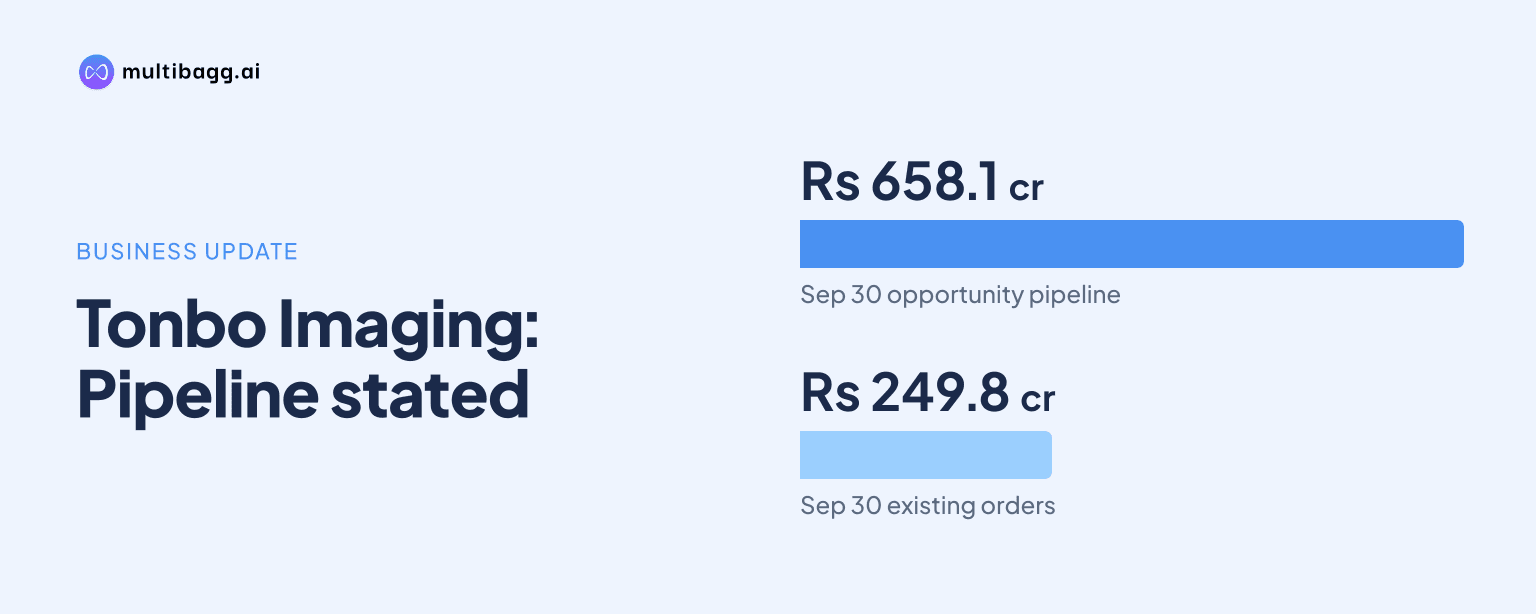
Tonbo Imaging India Limited reported a ₹658.1 crore opportunity pipeline as of September 30, 2026, comprising a ₹249.8 crore existing order book and ₹408.3 crore under negotiation. The figures underline demand for its defence electro-optical and infrared imaging systems, although conversion of negotiated opportunities remains subject to orders and procurement processes.
Know Tonbo Imaging India inside out
Results, valuation, peers and who's buying, in one view.
What is Tonbo's reported order pipeline?
Tonbo reported an existing order book of ₹249.8 crore and opportunities under negotiation worth ₹408.3 crore at the end of September 2026. Together, these stood at ₹658.1 crore. The company develops thermal cameras, weapon sights, driver-vision systems, thermal imaging payloads and missile seekers for defence and security applications.
The reported pipeline follows a period of expanding interest in domestically developed battlefield imaging equipment. Tonbo's products are used for surveillance, targeting and night operations, where thermal systems help detect heat emitted by people and vehicles. The company designs its products in Bengaluru, while partner factories manufacture units.
The article separately refers to confirmed orders of ₹314.2 crore in June 2026. This is a different reported date and figure from the ₹249.8 crore existing order book disclosed as of September 30, 2026. The data indicates that order-book figures can change as deliveries, new orders and tender outcomes are recorded.
Why is India's thermal-sight requirement relevant to Tonbo?
India's reported requirement for thermal and image-intensified sights creates a sizeable addressable market for Tonbo's core products. The company believes minimum domestic demand for tactical defence systems could be as high as 100,000 units, with estimated unit costs ranging from ₹3 lakh to ₹10 lakh, depending on the eventual request for proposal.
The stated domestic requirement includes 75,000 thermal weapon sights, 5,000 handheld thermal imagers, 27,000 image-intensified weapon sights and 56 laser target designators. Another company disclosure refers to about 80,000 thermal weapon sights and handheld thermal imagers combined, alongside around 27,000 image-intensifier sights. These figures show opportunities across several equipment categories, but final procurement volumes depend on official tenders.
Tonbo's chief executive Lakshmikumar said India has around 30,000 thermal sights, of which the company has supplied approximately 20,000. He also said the national requirement could rise from around 30,000 units to 300,000 units. These are management estimates rather than confirmed purchase orders.
How has Tonbo performed in Indian defence tenders?
Tonbo won 45 of 131 bids, or 34%, according to the supplied information. The Indian government accounted for 71% of its FY26 sales, largely through tenders, making government procurement and tender execution central to the company's commercial performance.
A Frost & Sullivan report cited in Tonbo's red herring prospectus said the company was India's largest manufacturer by sales value of thermal imaging systems supplied to government and defence agencies during FY24 to FY26. The same report, which was commissioned by Tonbo, estimated that it supplied 51% of thermal imaging units bought by the Indian government between April 2024 and March 2026.
The report also stated that Tonbo accounted for 94% of India's thermal imaging system exports by unit volume during FY24 to FY26. These market-share figures support the company's position in domestic thermal imaging, while readers should note that the research report was paid for by the company.
Got a follow-up? Ask IRIS
What recent contracts and deliveries has Tonbo disclosed?
Tonbo has disclosed minimum order quantities and letters of intent for 11 directed-energy systems, comprising five units for the Indian Navy and six for a European customer. Lakshmikumar said each system is priced at about ₹200 crore in India and $25 million in international markets.
The company has also delivered advanced thermal clip-on sights to the Indian Army ahead of schedule, according to the supplied report. The delivery was linked to the Arjun Thermal Imaging Weapon Sight family, which can be used as a standalone weapon sight, clip-on sight, handheld observation scope or helmet-mounted monocular.
A reported earlier milestone involved thermal imaging sights for the Army's SIG Sauer-716 assault rifles. Tonbo was the L-1 bidder for a contract to deliver 1,775 sights at a quoted value of about ₹37.28 crore. The clip-on configuration is intended to mount ahead of an existing day optic while retaining the original zero alignment.
What financial and operational factors should investors track?
Working-capital intensity remains a key operating factor for Tonbo. The supplied information places its working-capital cycle at 517 days in FY26, while another disclosure says customers took 212 days for payment. Such long collection periods can create liquidity pressure even where an order book and tender pipeline are substantial.
Tonbo had 339 permanent employees in Bengaluru, including about 130 engineers involved in product design. It spent ₹26 crore on research in FY26 and retains ownership of its designs. Manufacturing partners, including Kaynes Technology, build units, giving the company an asset-light production model while it focuses on product development and intellectual property.
The company says its products are free of restrictions under the US International Traffic in Arms Regulations, or ITAR. This non-ITAR positioning may be relevant for export customers and integration partners seeking systems without US-controlled technology restrictions. Its reported alignment with the Ministry of Defence's Indigenous Design, Development and Manufacture policy is also relevant to domestic procurement.
Conclusion
Tonbo's reported ₹658.1 crore pipeline reflects both an existing order book and a larger set of opportunities still under negotiation. Its tender record, domestic thermal-imaging market share and recent Army delivery point to established participation in India's indigenous defence-electronics supply chain, but long working-capital cycles remain an important financial consideration.
The next developments to watch are official requests for proposals covering thermal sights and related systems, conversion of the ₹408.3 crore negotiation pipeline into orders, and progress on the disclosed Navy and European directed-energy opportunities. Tender awards, deliveries and customer payment timing will determine how the reported opportunity translates into financial performance.