










Tonbo sets 2029-30 microwave delivery with Rs 160 crore
Key highlights
- Tonbo expects first high-power microwave customer delivery in 2029-30, while the product remains at TRL 4.
- The first system is budgeted at Rs 160 crore, including a Rs 120 crore sanctioned EXIM loan.
- Tonbo estimates an overall Indian directed-energy market of roughly 140 systems worth Rs 28,000 crore.
- Tonbo's T-Rex detection system has sold 20 systems internationally and can detect objects at 40 kilometres in darkness.
powered by IRIS
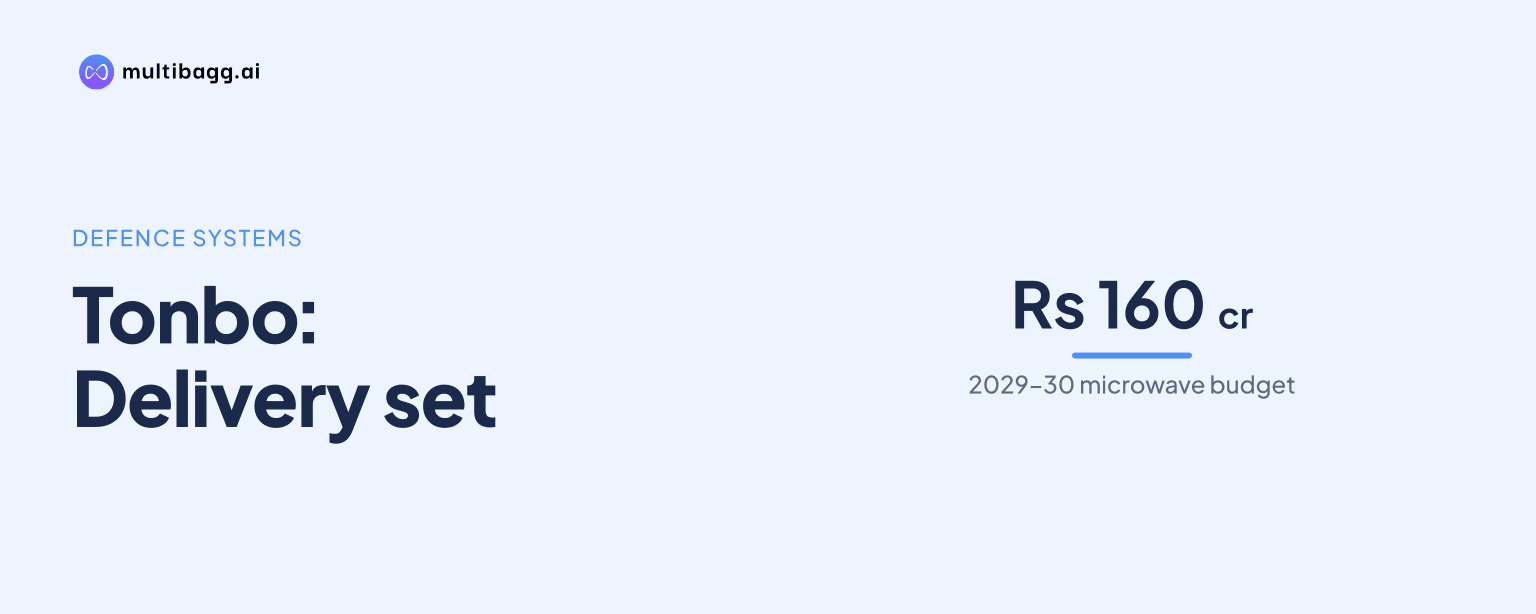
Tonbo expects first customer delivery of its high-power microwave system in 2029-30 after arranging Rs 160 crore for the initial build, but management says the product remains at Technology Readiness Level 4 (TRL 4), with engineering and testing risks to address through FY 2029.
Know Tonbo Imaging India inside out
Results, valuation, peers and who's buying, in one view.
When will Tonbo deliver its first high-power microwave system?
Tonbo said the first production high-power microwave system delivered to customers will start in 2029-30 and will not be delivered before that period. The system is intended to disrupt or destroy drone onboard electronics, and Tonbo is developing versions for an Indian Navy requirement, Indian Army requirements and shorter-range airborne applications.
The Navy project is being developed under an iDEX ADITI contract for a very-long-range naval system. Management said Tonbo is building three platform variants, meaning delivery timing will depend on the microwave technology as well as product engineering, testing, integration and customer specifications for naval, land and airborne uses.
Tonbo said it has worked for two to three years on the multi-beam klystron, pulse compressor and antenna designs needed for the system. However, management classified the integrated directed-energy product at TRL 4 and said its work through FY 2029 is to reduce the engineering and testing risks required to cross that development hurdle.
How is Tonbo funding the first microwave system?
Tonbo has lined up Rs 160 crore as the rough capital cost of building its first high-power microwave system, comprising a Rs 120 crore sanctioned EXIM loan, a Rs 25 crore iDEX ADITI grant and Rs 15 crore from its balance sheet. The three disclosed funding sources total the stated cost of the first build.
The disclosed financing is for the first system and does not set out a full-scale production budget. Tonbo reported net worth of Rs 564 crore and bank borrowings of about Rs 169 crore as of September 30, 2026; management said those borrowings were essentially for self-liquidating working-capital funding.
After the September 30 quarter, one bank increased Tonbo's cash-credit limit to Rs 50 crore from Rs 30 crore, while the company was working to increase limits with two other banks. Management presented available capital as one of three conditions for the program, alongside technology readiness and customer intent, rather than as evidence that the final system is ready for delivery.
What must happen before Tonbo records microwave-system sales?
Tonbo must build the system to customer specifications before signed letters of intent can become purchases at the indicated price. Management said customers had agreed in advance that they would buy if Tonbo delivered the specified performance, making the commitments conditional rather than completed system sales.
Management compared this arrangement with an early electric car: the battery must work and deliver the required range before a conditional buyer completes a purchase. Tonbo said the next program stage is product engineering, followed by mitigation of testing risk through FY 2029, before it can establish that the system meets the agreed specification.
Tonbo said it has a letter of intent from Europe and has discussed the product with Japan, but did not disclose the number, value or detailed terms of those commitments. Management also said it selects products through customer conversations, including discussions on specification and performance, rather than developing the high-power microwave system only to specifications set by the Defence Research and Development Organisation.
Got a follow-up? Ask IRIS
What market opportunity has Tonbo identified for directed energy?
Tonbo estimates the overall Indian directed-energy market at roughly 140 systems, with an indicated price of about Rs 200 crore per system, implying Rs 28,000 crore. Management distinguished that overall estimate from its smaller 2030 market figure, saying the 140-system calculation is not a forecast of systems to be delivered by 2030.
For the Indian Navy system, Tonbo said its quoted price is about Rs 200 crore per system. Management said its planned multi-beam klystron design is intended to address a range of 3 kilometres to 5 kilometres, while characterising Russian and Turkish systems as being at or below a range of 1 kilometre.
Management identified Epirus as the principal credible competitor based on available data and said Tonbo expects to compete internationally once its system is ready. That assessment remains management's market view, not evidence of contract awards or delivered-system performance, because Tonbo's own first customer delivery is not expected before 2029-30.
What can Tonbo sell before the full system is delivered?
Tonbo said certain subsystems can have commercial applications before the complete high-power microwave system reaches delivery in 2029-30. Its T-Rex drone-detection system was developed more than two years ago, has sold 20 systems in international markets and a couple in India, and can detect objects at a distance of 40 kilometres in darkness, according to management.
The detection system can help distinguish a drone swarm from birds, a function required within a counter-drone architecture. Tonbo is also developing a positioning system for a Middle East customer that directs energy toward an exact point in the sky; management said both the working detection system and the positioning work are at readiness levels above TRL 4.
This component approach differs from relying solely on the final system outcome after two or three years, according to management. Tonbo's established tactical systems can generally be delivered in three to six months after an order, while platform systems can take six to 18 months, illustrating the longer conversion cycle for integrated platform products.
Conclusion
Tonbo has set out a defined first-system funding structure and a 2029-30 delivery timetable for a high-power microwave product that remains at TRL 4. The Rs 120 crore sanctioned loan, Rs 25 crore grant and Rs 15 crore balance-sheet contribution address the Rs 160 crore initial-build cost, but do not remove the stated product-engineering and testing risks.
The next disclosed milestones are Tonbo's planned risk-reduction work through FY 2029, testing of the multi-beam klystron, pulse compressor and antenna design, and proof that the system meets customer specifications. Investors can also watch for additional sales of T-Rex and progress on the Middle East positioning-system program before the complete microwave system is due for delivery.