










Triveni Engineering: Tender Squeezes Maize Ethanol Economics
Key highlights
- Triveni said maize costs have reached ₹26-27 per kg while the new tender cuts maize-ethanol pricing by ₹3.
- Management estimated maize could supply 466 crore litres of the 1,100 crore-litre ESY 26-27 tender tranche.
- Triveni Alcohol profit before interest and tax rose to ₹43 crore in Q2 FY27 from ₹28 crore a year earlier.
- H1 FY27 Alcohol production fell 13% to 1,085 lakh litres while profit before interest and tax increased 44%.
powered by IRIS
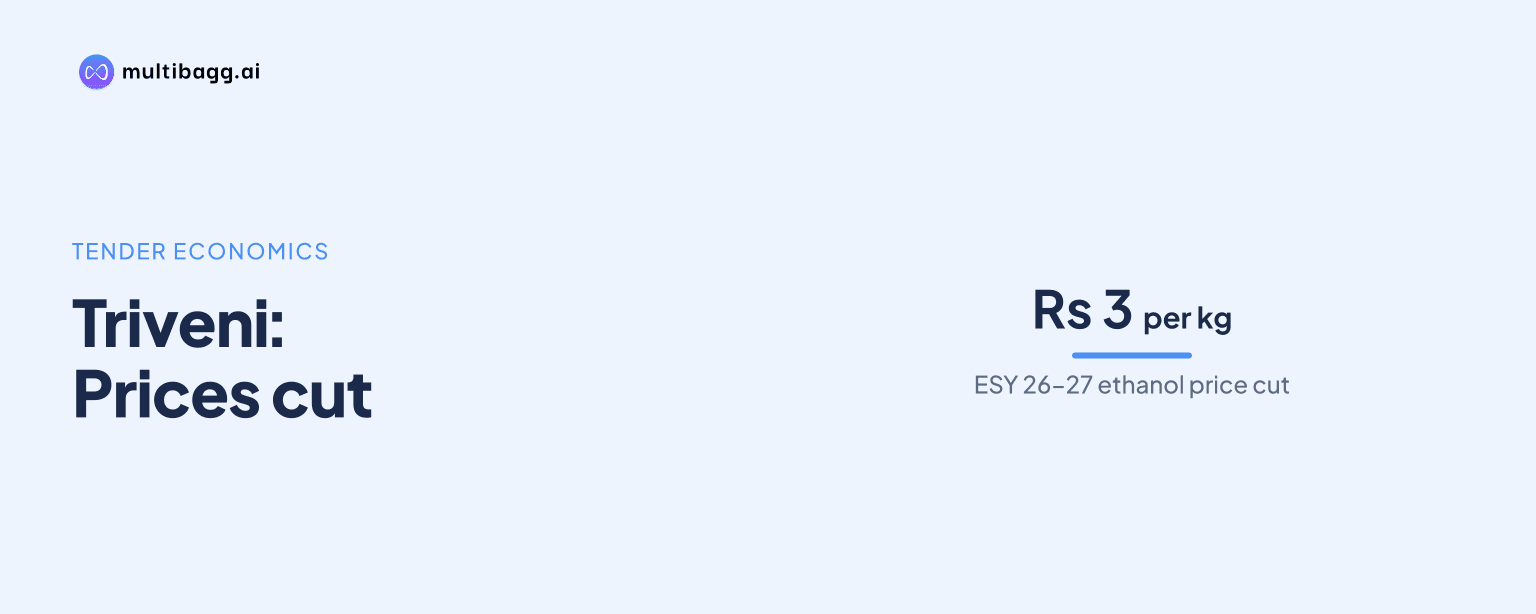
Triveni Engineering said the ESY 26-27 tender is set to pressure maize-ethanol economics after cutting the maize-based ethanol price by ₹3 while maize has reached ₹26-27 per kg. The 1,100 crore-litre tender excludes sugarcane juice, syrup and B-heavy molasses, and management estimated maize could supply 466 crore litres under its illustrative split.
Know Triveni Engineering and Industries inside out
Results, valuation, peers and who's buying, in one view.
Why does Triveni expect maize-ethanol margins to narrow?
Triveni expects margins to narrow because maize costs have risen to ₹26-27 per kg while the new tender reduces the procurement price for maize-based ethanol by ₹3. Management said the next major maize arrivals are still five to six months away, with the Uttar Pradesh crop expected in May 2027 after the Bihar crop.
The concern is that the revised tender could lift demand for maize before the next harvest. Management estimated maize could account for 466 crore litres of the first 1,100 crore-litre tranche and said this scale of demand makes a near-term decline in maize prices unlikely. It said the resulting economics could affect maize-ethanol profitability materially.
This is a change from H1 FY27, when Triveni said it procured maize at low prices and retained some inventory. Grain-based ethanol was the largest part of both production and supplies in H1 FY27, while higher maize-based and C-heavy molasses ethanol supplies helped Alcohol segment net revenue rise 19% in Q2 FY27.
Management did not quantify the effect of the ₹3 price reduction on segment profit or provide an FY27 Alcohol profit forecast. It said the tender could undergo further review and modification, although management expressed doubt that maize-ethanol pricing would be reconsidered. The disclosed outlook is therefore for pressure on contribution, not a numerical earnings estimate.
How does the ESY 26-27 tender change ethanol feedstock demand?
The ESY 26-27 tender excludes ethanol made from sugarcane juice, syrup and B-heavy molasses, while allowing maize, broken rice, surplus Food Corporation of India rice and C-heavy molasses. Public-sector oil marketing companies invited bids for 1,100 crore litres, and the tender limits Food Corporation of India rice-based ethanol to 30% of the overall volume.
Management’s illustrative split placed C-heavy molasses at 150 crore litres and Food Corporation of India rice at 324 crore litres. It then estimated up to 160 crore litres from another permitted feedstock category, leaving 466 crore litres from maize. The split was management’s assessment of the tender document as it stood during the call, rather than a final allocation.
The policy supports domestic sugar availability by removing juice and B-heavy molasses from ethanol supply, according to management, but it also reduces feedstock flexibility. That differs from H1 FY27, when Triveni identified a shift away from B-heavy molasses as one reason Alcohol production fell 13% year on year to 1,085 lakh litres.
Management said integrated, multi-feedstock sugar companies may be better placed than single-feedstock distilleries because they can alter inputs as economics shift. It said single-feedstock plants face an uphill task in seeking profitability in the next ethanol supply year, which is management’s industry assessment rather than a forecast for any competitor.
Got a follow-up? Ask IRIS
What supported Triveni Alcohol earnings in H1 FY27?
Triveni’s Alcohol business raised H1 FY27 revenue by 3% and profit before interest and tax by 44%, despite production declining 13% to 1,085 lakh litres. Management attributed the improvement to a higher proportion of grain-based ethanol, stronger distillers dried grains with solubles realisations and operating efficiencies.
Q2 FY27 provided the sharper comparison: segment net revenue increased 19% as sales volume rose 16%, and profit before interest and tax increased to ₹43 crore from ₹28 crore in the prior-year quarter. Higher supplies of maize-based and C-heavy molasses ethanol, alongside stronger distillers dried grains with solubles realisations, supported that increase.
Production fell during H1 FY27 because of fewer operating days, finished-goods storage constraints and lower B-heavy molasses ethanol output. Those lower volumes did not prevent the 44% rise in half-year profit before interest and tax because product mix, by-product revenue and efficiency gains improved the reported profitability.
Distillers dried grains with solubles, a distillery by-product, also supported results. Triveni said it obtained slight premiums to prevailing market prices, while broader prices had increased; management expected prices to remain broadly stable, with small increases, over the next three to six months.
What will determine Triveni Alcohol performance after Q3 FY27?
Triveni said feedstock economics, tender allocation, product mix and maize prices in H1 FY28 will determine Alcohol performance after Q3 FY27. Management described Q3 FY27 as relatively unaffected by the new tender, but said Q4 FY27 profitability and allocation could not yet be determined because tender terms were unresolved.
The company said it will prioritise feedstock economics when making tender bids and operating its distilleries. It also cited energy and process-efficiency work that had begun to benefit costs and is expected to influence production and conversion costs during ESY 26-27, but gave no numerical savings target.
Management identified maize prices in H1 FY28 as the biggest contributor to ESY 26-27 ethanol profitability. It linked that variable to the size of crops in Bihar and eastern Uttar Pradesh, with the Uttar Pradesh crop not expected until May 2027. This leaves procurement conditions before those arrivals as a central uncertainty.
The new tender follows ESY 25-26, when industry ethanol blending reached 20%. Public-sector oil marketing company allocation rose to 1,197 crore litres after an additional allocation, and supply had reached 987 crore litres by September 2026 with one full month remaining in that supply year.
Conclusion
Triveni reported improved Alcohol earnings in H1 FY27, including Q2 profit before interest and tax of ₹43 crore against ₹28 crore a year earlier, supported by grain-based ethanol, distillers dried grains with solubles and efficiency work. The ESY 26-27 tender changes that backdrop by excluding juice and B-heavy molasses, lowering maize-ethanol pricing by ₹3 and potentially directing 466 crore litres of demand to maize priced at ₹26-27 per kg.
The next markers are the final ESY 26-27 tender terms, Triveni’s bids and allocation, and the Bihar and eastern Uttar Pradesh maize crops that management says will shape H1 FY28 feedstock prices. Management expects Q3 FY27 to remain relatively unaffected, while it has not given a definitive Q4 FY27 profitability view because the tender had not been finalised.