










UFlex Egypt aseptic plant capex reaches Rs 1,057.8 crore by Q2 FY27
Key highlights
- UFlex incurred Rs 1,057.8 crore on the 12-billion-carton Ain Sokhna aseptic project by Q2 FY27.
- The Egypt project had Rs 151.6 crore of residual capex and is scheduled for H2 FY27 commissioning.
- UFlex commissioned its 39,600 MTPA Noida recycling project on May 1, 2026.
- The Dharwad BOPP project had Rs 420 crore remaining and is scheduled for FY27-28.
powered by IRIS
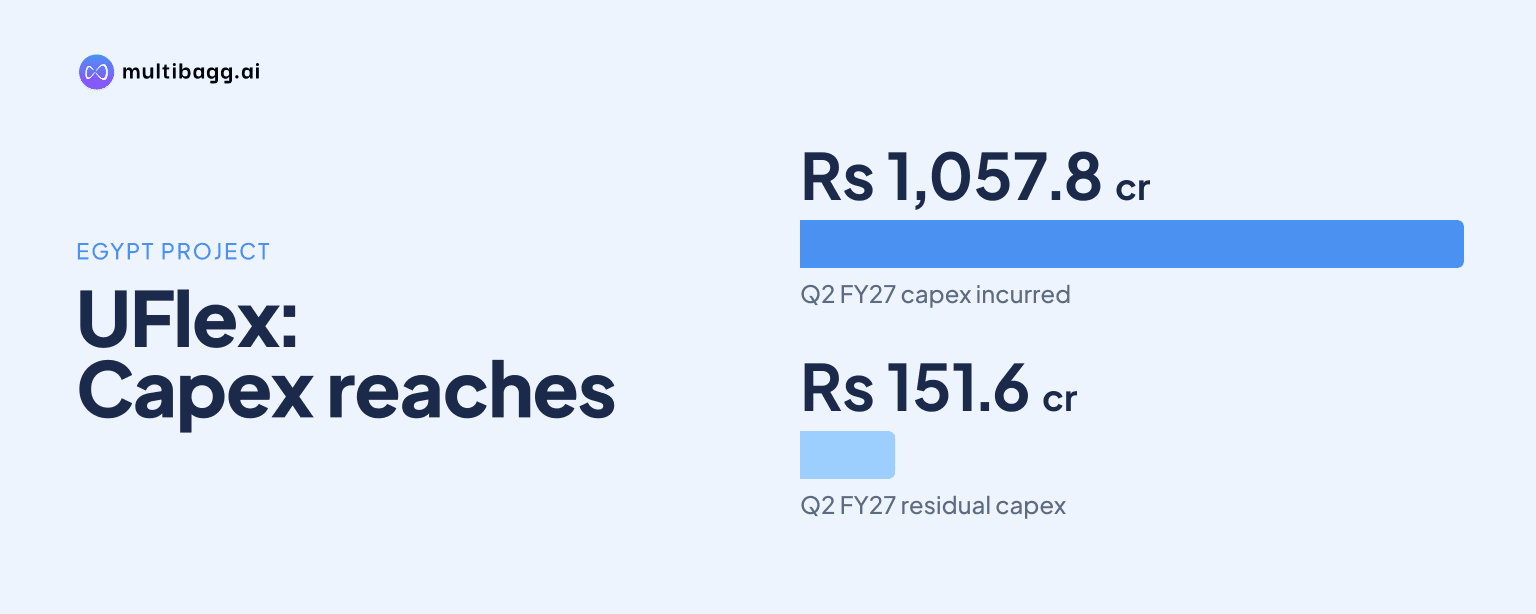
UFlex incurred Rs 1,057.8 crore on its 12-billion-carton greenfield aseptic packaging project at Ain Sokhna, Egypt, as of Q2 FY27, leaving Rs 151.6 crore of planned spending before H2 FY27 commissioning. Separately, UFlex reported total capital expenditure of Rs 1,047.1 crore in H1 FY27.
Know Uflex inside out
Results, valuation, peers and who's buying, in one view.
What has UFlex spent on the Egypt aseptic plant?
UFlex spent Rs 1,057.8 crore on the Ain Sokhna project by Q2 FY27, equal to about 87.5% of its planned Rs 1,209.3 crore capital expenditure. The project is designed for annual output of 12 billion carton packs and is the largest by planned expenditure among UFlex’s three disclosed projects. The remaining Rs 151.6 crore is scheduled for deployment before commissioning in H2 FY27.
UFlex’s Q2 FY27 capital expenditure was Rs 568.9 crore, compared with Rs 478.2 crore in Q1 FY27, taking H1 FY27 capital expenditure to Rs 1,047.1 crore. The Egypt project’s cumulative spending can exceed H1 capital expenditure because the project-incurred figure includes expenditure before FY27, while the H1 measure covers the six-month reporting period.
Annual capacity in the table is shown either in carton packs or metric tonnes per annum (MTPA). Biaxially oriented polypropylene is abbreviated as BOPP.
When is UFlex’s Egypt aseptic plant due to start?
UFlex plans to commission the Ain Sokhna aseptic packaging facility in H2 FY27, although the presentation does not give a month or date. H2 means the second half and FY means financial year. The disclosed Rs 151.6 crore residual capex is the remaining execution item identified for a project whose capacity is measured in carton packs rather than tonnes.
The planned start comes while UFlex described the aseptic packaging market as challenging in Q2 FY27. UFlex cited lower-priced imports from geographies benefiting from the free-trade agreement with India, while exports of aseptic packaging shipments were delayed by disruptions arising from the West Asia crisis. These conditions form the operating backdrop to the 12-billion-carton annual-capacity project.
At the group level, aseptic packaging production was 15,870 metric tonnes in Q2 FY27, or 64.5% utilisation of 24,600 metric tonnes per quarter capacity. Output was 6.8% higher year on year but 11.7% lower quarter on quarter from 17,983 metric tonnes in Q1 FY27. This existing production measure cannot be directly compared with the Egypt project’s carton-pack capacity.
Got a follow-up? Ask IRIS
How do UFlex’s Dharwad and Noida projects compare?
UFlex’s Dharwad brownfield BOPP line has the largest remaining outlay among the three projects, at Rs 420 crore as of Q2 FY27. It is planned to add 54,000 MTPA of capacity and had incurred Rs 295.4 crore against total planned expenditure of Rs 715.4 crore. UFlex lists commissioning in FY27-28 rather than in a specific quarter.
The Noida Sector 155 greenfield recycling project was commissioned on May 1, 2026, with Rs 316 crore incurred against planned expenditure of Rs 317.1 crore. Its annual capacity is 39,600 MTPA, leaving Rs 1.1 crore of residual capex at Q2 FY27. Unlike the Egypt facility’s carton-pack output, Noida’s capacity is measured in tonnes and covers a different production system.
UFlex also said technological enhancements at its Noida packaging-films plant increased overall new packaging-film capacity in India to 164,160 MTPA from 155,000 MTPA. Its integrated capacity disclosure, dated December 2025, listed India with 31,200 MTPA of BOPP capacity and 23,160 MTPA of cast polypropylene capacity. Dharwad is therefore a planned addition to the Indian BOPP base, while the Noida recycling project had already been commissioned by the Q2 FY27 update.
What do UFlex’s operating data show about the capacity backdrop?
UFlex’s Egypt packaging-films plant produced 26,043 metric tonnes in Q2 FY27, operating at 91.4% utilisation of quarterly capacity of 28,500 metric tonnes. Production fell 11.7% from 29,491 metric tonnes in Q1 FY27, when reported utilisation was 103.5%, but rose 29.0% from 20,184 metric tonnes in Q2 FY26. The aseptic project is separate from this packaging-films production base.
Across all packaging-films geographies, UFlex produced 135,778 metric tonnes in Q2 FY27, almost unchanged from 135,873 metric tonnes in Q1 FY27 and 12.5% above 120,644 metric tonnes a year earlier. Group utilisation was 85.37% in Q2 FY27, compared with 85.43% in Q1 FY27 and 75.9% in Q2 FY26. India and Mexico increased production quarter on quarter by 15.8% and 10.4%, respectively, while Egypt declined.
UFlex recorded Q2 FY27 revenue of Rs 4,869.4 crore, up 26.1% year on year, and H1 FY27 revenue of Rs 10,266.6 crore, up 31.9%. Net debt was Rs 9,039 crore at Q2 FY27, while normalised earnings before interest, tax, depreciation and amortisation margin was 15.6%, 550 basis points above the prior-year quarter.
Conclusion
UFlex’s disclosed expansion cycle combines a nearly funded Egypt aseptic-packaging plant, a commissioned Noida recycling facility and a partly funded Dharwad BOPP line. The Egypt project has Rs 1,057.8 crore incurred against a Rs 1,209.3 crore plan, while Noida is effectively complete and Dharwad retains Rs 420 crore to be spent. These projects add capacity across different packaging and recycling categories rather than a single production segment.
The next disclosed milestone is commissioning of the 12-billion-carton Ain Sokhna plant in H2 FY27. Investors can also watch the FY27-28 schedule for Dharwad’s 54,000 MTPA BOPP line, the remaining Rs 151.6 crore Egypt outlay, and whether aseptic packaging volumes improve from Q2 FY27 utilisation of 64.5% amid import competition and shipment disruption.