










UFLEX recycled 552 million PET bottles after Noida launch
Key highlights
- UFLEX recycled 552 million post-consumer PET bottles in Q2FY27.
- UFLEX recycled 2,603 MT of post-consumer MLP and MLAP waste in Q2FY27.
- UFLEX commissioned a Noida unit on 30 April 2026 with 36,000 MT of rPET chips and 3,600 MT of rMLP.
- UFLEX lists 79,020 MT of PCR PET chips across Mexico, Noida and Egypt.
powered by IRIS
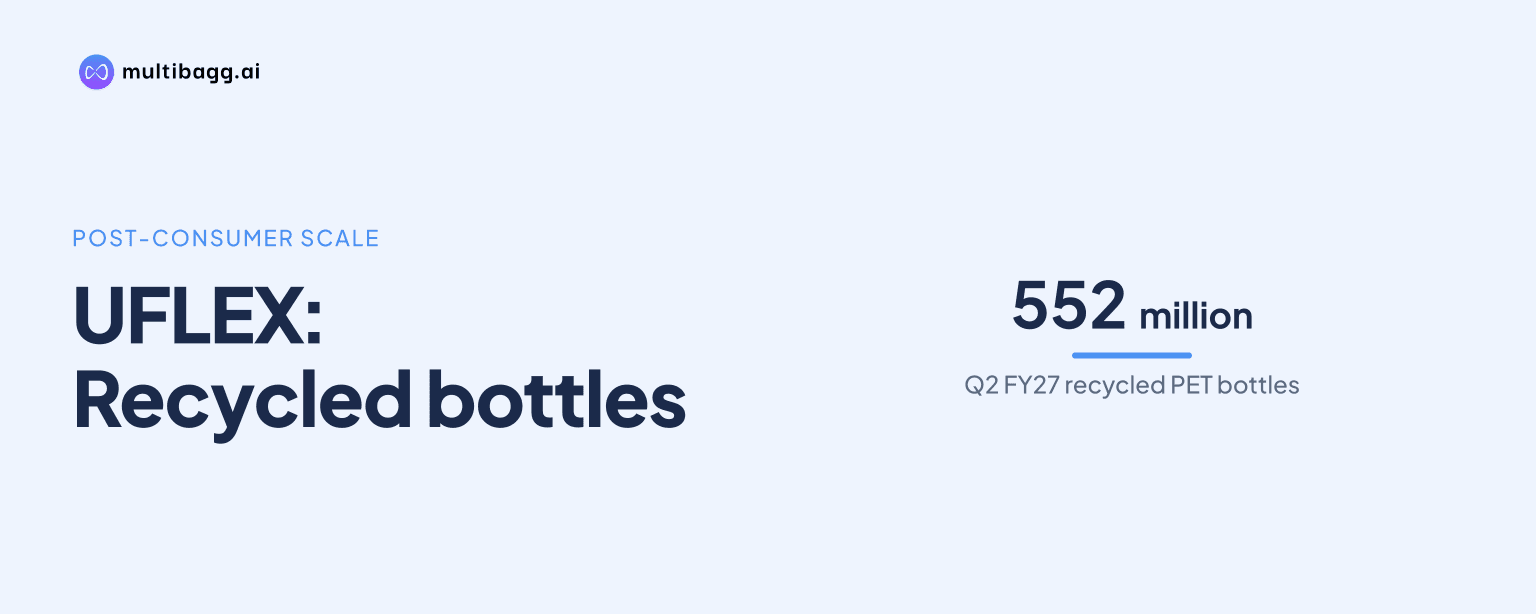
UFLEX recycled 552 million post-consumer polyethylene terephthalate (PET) bottles in Q2FY27 after commissioning its Noida recycling unit on 30 April 2026. The unit added 36,000 metric tonnes (MT) of recycled PET (rPET) chips and 3,600 MT of recycled multi-layered packaging plastic (rMLP), while UFLEX also recycled 2,603 MT of post-consumer packaging waste during the quarter.
Know Uflex inside out
Results, valuation, peers and who's buying, in one view.
What did UFLEX recycle in Q2FY27?
UFLEX recycled 552 million post-consumer PET bottles and 2,603 MT of post-consumer multi-layered packaging plastic (MLP) and multi-layered aluminium packaging (MLAP) waste in Q2FY27. The bottle total is a count of containers, whereas the MLP and MLAP total is measured in tonnes, so the presentation does not provide a conversion between the two waste streams.
UFLEX reports these activities under Project Plastic Fix, its sustainability programme. The programme’s stated processing and product chain includes post-consumer PET and MLP recycling, rPET flakes, post-consumer recycled (PCR) PET chips, ASCLEPIUS film with 100% rPET content, rMLP granules and recycled moulding products.
The Q2FY27 waste figures sit alongside a platform that UFLEX says has operated since 1995 and comprises more than 100 product variants across six facilities. The presentation does not disclose Q1FY27 or Q2FY26 bottle-recycling volumes, so it does not allow a quarter-on-quarter or year-on-year comparison of the 552 million bottle result.
When did UFLEX commission the Noida recycling unit?
UFLEX commissioned the Noida recycling unit on 30 April 2026, in Q1FY27, with 36,000 MT of rPET chips and 3,600 MT of rMLP. Q2FY27 was therefore the first quarter following its commissioning, although the presentation does not allocate a specified share of the 552 million recycled bottles to the Noida unit.
A separate plant-location disclosure lists Noida with 46,020 MT of PCR PET chips and 13,200 MT of rMLP granules. Those figures exceed the 36,000 MT of rPET chips and 3,600 MT of rMLP disclosed for the unit commissioned in April 2026, but UFLEX does not explain on these pages how the two sets of numbers relate.
The Noida site is also presented as having food-contact approvals from the US Food and Drug Administration (US FDA) and the Food Safety and Standards Authority of India (FSSAI). These labels apply to its PCR PET-chip operation; the presentation does not state that the 13,200 MT rMLP-granule activity has a food-contact approval.
Where are UFLEX’s recycling plants and what do they process?
UFLEX lists recycling operations in Mexico, Poland, Jammu, Noida, Egypt and Malanpur. The sites process PCR PET chips, rMLP granules, or rMLP moulding and granules, and their disclosed figures total 79,020 MT for PCR PET chips and 34,897 MT for rMLP-related activities.
Noida has the largest disclosed figure in both columns, at 46,020 MT of PCR PET chips and 13,200 MT of rMLP granules. Mexico and Egypt account for the remaining 33,000 MT of PCR PET chips, while Poland, Jammu and Malanpur are listed only for rMLP-related activity.
The PCR PET-chip total is 44,123 MT above the rMLP-related total. UFLEX does not label the figures on the plant slide as annual capacity or provide a common time period, so they are best read as the scales listed for each operation rather than as a consolidated annual production forecast.
Got a follow-up? Ask IRIS
Which UFLEX sites have food-contact-approved PCR PET chips?
UFLEX identifies Mexico, Noida and Egypt as the PCR PET-chip sites with food-contact approvals. Mexico is listed at 15,000 MT and marked US FDA approved, Noida is listed at 46,020 MT and marked US FDA and FSSAI approved, and Egypt is listed at 18,000 MT and marked US FDA and National Food Safety Authority (NFSA) approved.
Together, these three sites represent all 79,020 MT of PCR PET-chip scale shown in the presentation. The approval labels distinguish the PET-chip operations from the rMLP activities, which total 34,897 MT across Mexico, Poland, Jammu, Noida and Malanpur and are described as granules, moulding products or waste-recycling operations.
Mexico’s 6,000 MT of rMLP granules, Poland’s 3,900 MT and Jammu’s 1,497 MT supplement the Indian operations at Noida and Malanpur. The presentation does not state sales volumes, customers or utilisation for the food-contact-approved PCR PET-chip facilities, so it does not quantify how much of the listed scale was used in Q2FY27.
What products does UFLEX make from recycled packaging waste?
UFLEX lists rPET flakes, PCR PET chips, ASCLEPIUS 100% rPET-content film, rMLP granules and recycled moulding products as outputs from its recycling platform. This range links the 552 million PET bottles recycled in Q2FY27 to film and chip products, while the 2,603 MT of MLP and MLAP waste is associated with granules and moulded outputs.
Malanpur, listed at 10,300 MT of rMLP moulding and granules, is specifically described as an Asepto MLP waste-recycling operation. UFLEX lists pulp granules, egg trays, pulp paper sheets, kidney trays and wall mounts as paper-pulp outputs, alongside metallised corrugated roof sheets, partition sheets, alu poly granules, laptop and glass covers, tray plates and card bags from aluminium foil.
This product mix differs from the Mexico, Noida and Egypt sites, which are presented around PCR PET chips and food-contact approvals. UFLEX’s pages do not provide revenue, pricing or production volumes by recycled product, so the presentation establishes the product range and site scale rather than the financial contribution of each recycling output.
Conclusion
UFLEX’s Q2FY27 disclosure combines 552 million recycled post-consumer PET bottles and 2,603 MT of recycled MLP and MLAP waste with a six-location footprint. The listed platform includes 79,020 MT of PCR PET chips and 34,897 MT of rMLP-related activities, with Noida the largest named site at 46,020 MT of PCR PET chips and 13,200 MT of rMLP granules.
The key point to watch is whether UFLEX clarifies the relationship between the Noida unit commissioned on 30 April 2026 with 36,000 MT of rPET chips and 3,600 MT of rMLP, and the site’s larger listed figures. Future disclosures could also show whether the 552 million bottle total and 2,603 MT of packaging waste change after the new unit’s first full quarter of operation.