










UFLEX recycled 552 million PET bottles after Noida expansion
Key highlights
- UFLEX recycled 552 million post-consumer PET bottles in Q2FY27.
- UFLEX recycled 2,603 MT of post-consumer multi-layer packaging and aseptic packaging waste in Q2FY27.
- The Noida unit commissioned on April 30, 2026 has 36,000 MT of rPET chip capacity and 3,600 MT of rMLP capacity.
- UFLEX lists more than 100 recycling product variants across 6 facilities.
powered by IRIS
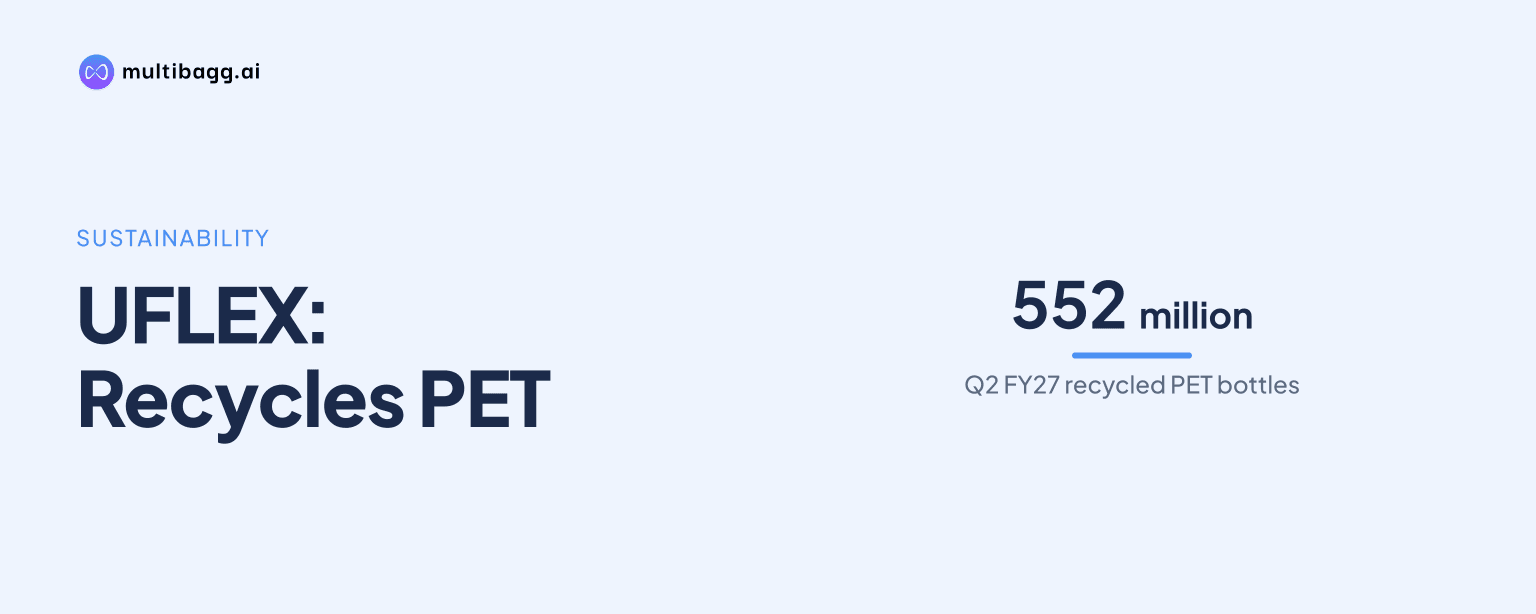
UFLEX recycled 552 million post-consumer polyethylene terephthalate (PET) bottles in the second quarter of fiscal 2027 (Q2FY27), after commissioning a Noida recycling unit on April 30, 2026. The new unit has 36,000 metric tonnes (MT) of recycled PET (rPET) chip capacity and 3,600 MT of recycled multi-layered packaging plastic (rMLP) capacity.
Know Uflex inside out
Results, valuation, peers and who's buying, in one view.
How much material did UFLEX recycle in Q2FY27?
UFLEX recycled 552 million post-consumer PET bottles during Q2FY27 and processed 2,603 MT of post-consumer multi-layered packaging and multi-layered aseptic packaging waste. The presentation reports these operating volumes under Project Plastic Fix, its recycling programme, rather than as a broader sustainability target.
The 552 million-bottle figure measures UFLEX’s PET recycling activity for the quarter. Alongside bottle recycling, the 2,603 MT of multi-layer waste processed shows that the programme also covers packaging structures converted into rMLP granules, moulding products and other outputs.
UFLEX states that its recycling operations have been operational since 1995 and now cover more than 100 product variants across six facilities. The product chain starts with post-consumer PET bottle and multi-layer packaging recycling, then extends to rPET flakes, post-consumer recycled (PCR) PET chips, ASCLEPIUS 100% rPET-content film, rMLP granules and recycled moulding products.
What changed at UFLEX’s Noida recycling plant?
UFLEX commissioned a Noida recycling unit on April 30, 2026, in Q1FY27, with 36,000 MT of rPET chip capacity and 3,600 MT of rMLP capacity. The commissioning preceded the reported Q2FY27 recycling volume of 552 million post-consumer PET bottles.
The geographic plant overview lists Noida with 46,020 MT of PCR PET chip capacity and 13,200 MT of rMLP granule capacity. The presentation separately identifies the unit commissioned in April 2026 as having 36,000 MT of rPET chip capacity and 3,600 MT of rMLP capacity.
Noida is the only listed site carrying both US Food and Drug Administration (FDA) and FSSAI food-contact approvals for PCR PET chips. Mexico’s PCR PET chips are labelled US FDA approved, while Egypt’s are labelled US FDA and NFSA approved; Jammu and Malanpur are listed for rMLP processing.
Where are UFLEX’s recycling capacities located?
UFLEX lists recycling capacity across six sites in India, Mexico, Egypt and Poland, with Noida carrying the largest disclosed PCR PET chip capacity at 46,020 MT. Mexico and Egypt add 15,000 MT and 18,000 MT, respectively, of PCR PET chip capacity.
The capacity mix differs by geography. Mexico combines 15,000 MT of PCR PET chips with 6,000 MT of rMLP granules, while Egypt is listed solely with 18,000 MT of PCR PET chips. Poland has 3,900 MT of rMLP granule capacity, so its disclosed recycling capacity is focused on multi-layer material rather than PCR PET chips.
India has three listed recycling locations with different functions. Noida combines 46,020 MT of PCR PET chips and 13,200 MT of rMLP granules; Jammu has 1,497 MT of rMLP granules; and Malanpur has 10,300 MT of rMLP moulding and granule capacity. UFLEX identifies Malanpur as Asepto multi-layer packaging waste recycling, with outputs from paper-pulp and aluminium-foil streams.
Got a follow-up? Ask IRIS
Which UFLEX recycling products have food-contact approvals?
UFLEX lists food-contact approval for PCR PET chips at Mexico, Noida and Egypt, while Noida is the only location shown with both US FDA and FSSAI approvals. Mexico’s 15,000 MT PCR PET chip capacity is labelled US FDA approved, and Egypt’s 18,000 MT capacity is labelled US FDA and NFSA approved.
The food-contact designations are attached to PCR PET chips, not to the rMLP capacities listed by UFLEX. This separates the PET recycling chain, which includes rPET flakes, PCR PET chips and ASCLEPIUS 100% rPET-content film, from the multi-layer waste chain, which includes rMLP granules and recycled moulding products.
UFLEX’s disclosed processing routes show different outputs for different packaging materials. PET bottles are recycled into rPET flakes and PCR PET chips, while post-consumer multi-layer packaging and multi-layer aseptic packaging waste can be converted into granules or moulding products. In Q2FY27, the multi-layer waste stream accounted for 2,603 MT of recycled material.
How does recycling fit within UFLEX’s wider operating footprint?
UFLEX’s recycling network spans India, the Americas, Europe and the Middle East and Africa, regions also shown in its revenue split by point of origin. In Q2FY27, India represented 45.3% of consolidated revenue, while the Americas represented 16.9%, Europe 17.3%, and the Middle East and Africa 17.8%.
The geographic mix changed from Q2FY26, when India accounted for 47.5%, the Americas 17.6%, Europe 16.6%, and the Middle East and Africa 15.4%. India and the Americas recorded lower revenue shares, while Europe and the Middle East and Africa recorded higher shares; the recycling map includes Mexico in the Americas, Poland in Europe and Egypt in the Middle East and Africa.
Packaging films, including PET chips, accounted for 67.0% of UFLEX’s Q2FY27 revenue split, compared with 63.0% in Q2FY26. Packaging accounted for 23.2% in Q2FY27, down from 27.9% a year earlier, providing business context for a recycling platform that includes PCR PET chips and 100% rPET-content film.
Conclusion
UFLEX’s Q2FY27 disclosure combines operating throughput and plant capacity: 552 million post-consumer PET bottles recycled, 2,603 MT of multi-layer waste processed, and a six-facility network offering more than 100 product variants. The April 2026 Noida commissioning added disclosed capacity for rPET chips and rMLP within that network.
What remains unresolved in the presentation is the operating utilisation of the 36,000 MT rPET chip and 3,600 MT rMLP Noida unit, as well as any future recycling-volume or capacity target. UFLEX discloses the April 30, 2026 commissioning and plant-by-plant capacities, but gives no further commissioning schedule or recycling throughput target.