










UFlex Retains FY27 30% Growth Target After Q2 Profit Surge
Key highlights
- UFlex Q2 FY27 revenue rose 26% year-on-year to Rs 4,869.4 crore.
- UFlex Q2 FY27 normalized EBITDA rose 95% to Rs 758.8 crore and margin reached 15.6%.
- UFlex H1 FY27 EBITDA of Rs 1,596.1 crore represented approximately 60%-62% of its full-year target.
- UFlex spent Rs 568.9 crore on Q2 FY27 capital expenditure for projects including Egypt aseptic packaging and Noida recycling.
powered by IRIS
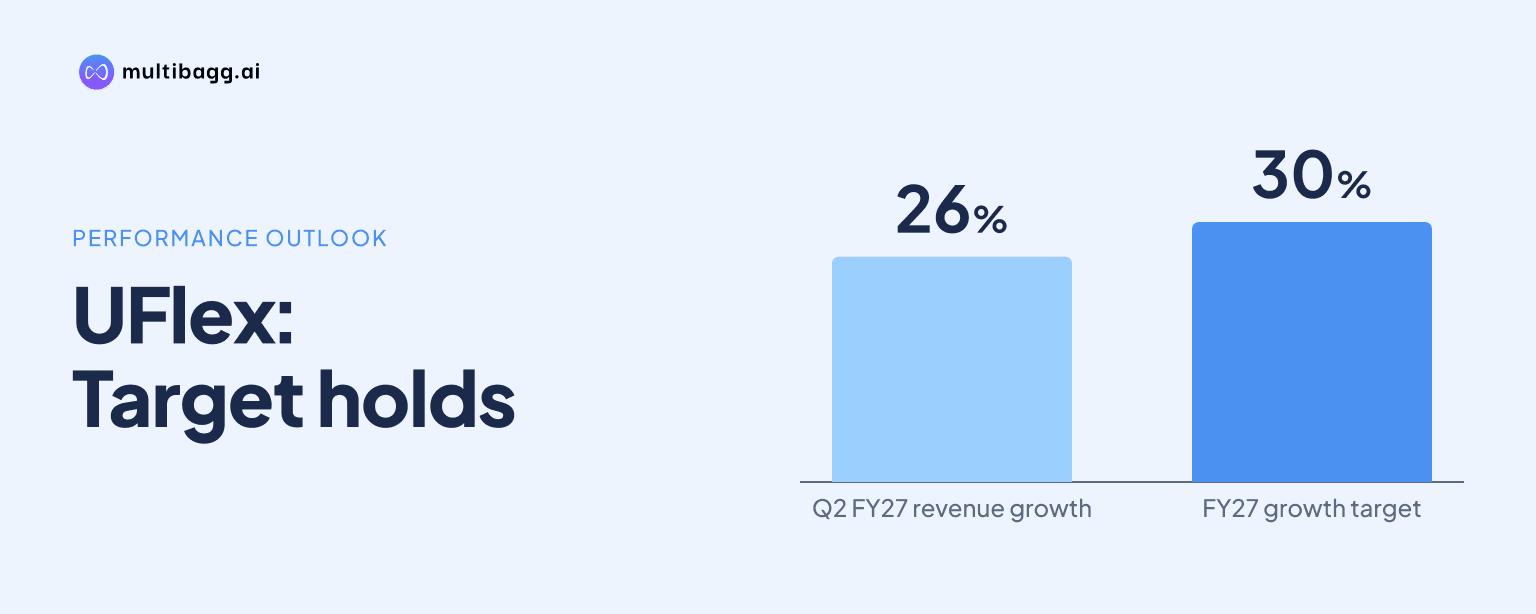
UFlex Limited retained its financial year 2027 (FY27) target for about 30% revenue and earnings before interest, tax, depreciation and amortisation (EBITDA) growth after Q2 FY27 net profit rose 689% year-on-year to Rs 210.6 crore. H1 FY27 EBITDA reached Rs 1,596.1 crore, or approximately 60%-62% of management’s full-year target.
Know Uflex inside out
Results, valuation, peers and who's buying, in one view.
Why is UFlex retaining its FY27 growth target?
UFlex is retaining its FY27 target because H1 FY27 revenue of Rs 10,266.6 crore reached approximately 49%-51% of the full-year target and EBITDA of Rs 1,596.1 crore reached approximately 60%-62%. Management said it remained confident of delivering around 30% growth in revenue and EBITDA for the full year.
Management linked the outlook to sustained current utilisation, subject to normal industry seasonality, a favourable product mix and higher utilisation at recently commissioned facilities. An analyst calculated that the guidance implied turnover of about Rs 20,000 crore and EBITDA of about Rs 2,700 crore; management said that calculation was correct based on FY26 results and the 30% growth target.
The outlook remains subject to the operating conditions management described for Q2 FY27, including elevated inflation, higher crude and energy prices, rising logistics costs, supply-chain disruptions and price and demand volatility related to the West Asia conflict. Management said UFlex’s integrated model and global footprint supported its confidence despite those risks.
What drove UFlex’s Q2 FY27 profit surge?
UFlex’s Q2 FY27 net profit after tax and non-controlling interest rose 689% year-on-year to Rs 210.6 crore, while normalized EBITDA rose 95% to Rs 758.8 crore and revenue increased 26% to Rs 4,869.4 crore. Normalized EBITDA margin increased by 550 basis points to 15.6%, while net profit margin increased by 360 basis points to 4.3%.
The Rs 1,008.4 crore year-on-year increase in quarterly revenue came from both overseas and Indian operations, with overseas businesses contributing 56% and India contributing 44%. Management attributed the revenue change to higher realization and local-sourcing premiums, particularly in overseas markets.
Management said raw-material cost pass-through, a better product mix and operating leverage supported the Rs 369.4 crore increase in normalized EBITDA. It also said capacity utilisation had reached about 80%, allowing fixed costs to be spread across more output, while overseas capacity generated better margins than Indian capacity under the prevailing competitive conditions.
Which businesses contributed most to UFlex’s Q2 growth?
UFlex identified Egypt, Mexico, Hungary, the United States, Poland and Nigeria as key overseas contributors in Q2 FY27, alongside India’s packaging films and polyethylene terephthalate (PET) chip businesses. Overseas operations supplied 56% of incremental revenue, exceeding India’s 44% share.
Overseas operations also accounted for most of the Rs 369.4 crore increase in normalized EBITDA, although the transcript reports two figures. The Q2 financial highlights put the overseas contribution at 74% and India’s at 26%, while the subsequent growth-drivers section put the overseas share at 70%; both statements identify overseas operations as the main profit contributor.
Total sales volume rose 1.5% year-on-year to 163,532 metric tonnes in Q2 FY27, a slower increase than the 26% rise in revenue. Packaging films volume grew 3% to 129,025 metric tonnes and represented 78.9% of group volume, while packaging business volume declined 3.9% to 34,507 metric tonnes, or 21.1% of volume, as management shifted India’s business towards higher-margin flexible packaging.
Got a follow-up? Ask IRIS
What capacity additions could support UFlex’s FY27 plan?
UFlex incurred capital expenditure of Rs 568.9 crore in Q2 FY27, mainly for an aseptic packaging facility in Egypt, a recycling unit at Sector 155 in Noida and a biaxially oriented polypropylene (BOPP) line at Dharwad, India. Management expects these projects to contribute progressively to revenue and EBITDA as utilisation rises.
The projects include a 39,600-metric-tonne-a-year recycling facility in Noida, an 80-million-unit woven polypropylene (WPP) bag facility in Mexico, and two coating lines in Egypt and Mexico. Management also cited product-mix optimisation in India flexible packaging, increased use of the Sanand aseptic plant and greater production of value-added films in Hungary as FY27 growth levers.
The 12-billion-pack aseptic facility in Egypt is scheduled for commissioning in H2 FY27. Management expects the plant to operate at around 30% capacity in its first year, around 60% in the following year and around 100% in the third year; it also cited additional capacity headroom in Dubai, Nigeria, the Commonwealth of Independent States (CIS) and Poland.
The Dharwad BOPP line is expected to begin commercial operations most likely in H1 FY28, rather than in H2 FY27. Management therefore tied the retained FY27 target principally to current utilisation, the Egypt aseptic commissioning and the ramp-up of assets already commissioned, rather than to a full-year contribution from Dharwad.
Conclusion
UFlex’s retained FY27 plan reflects a Q2 in which revenue rose 26% to Rs 4,869.4 crore, normalized EBITDA rose 95% to Rs 758.8 crore and net profit rose 689% to Rs 210.6 crore. H1 EBITDA’s 60%-62% share of management’s full-year target indicates that profitability has advanced faster than revenue against the stated annual plan, with overseas operations, realization, mix and utilisation central to that outcome.
The next disclosed milestones are commissioning of the 12-billion-pack Egypt aseptic facility in H2 FY27 and its planned ramp from about 30% utilisation in the first year to about 100% in the third. Management also expects the Dharwad BOPP line to begin commercial operations most likely in H1 FY28, while further growth depends on utilisation across Noida, Mexico, Egypt, Dubai, Nigeria, CIS and Poland.