








Utkarsh SFB targets 15% FY28 ROE, 60%-65% cost ratio
MAX Plan at ₹4,999/yr

Find your next multibaggerBe a Pro Investor
Research stocks and track your picks on the go. Download the app.
Key highlights
- Utkarsh SFB targets 15% ROE in FY28 after seeking a two-digit ROE exit in FY27.
- Utkarsh SFB's cost-to-income ratio improved to 84% after Q2 FY27 from 110% in Q3 FY26.
- Management expects a 60% to 65% sustainable cost-to-income ratio in FY28.
- Half-year provisions fell to Rs 275 crore from Rs 872 crore in the comparable prior-year half.
powered by IRIS
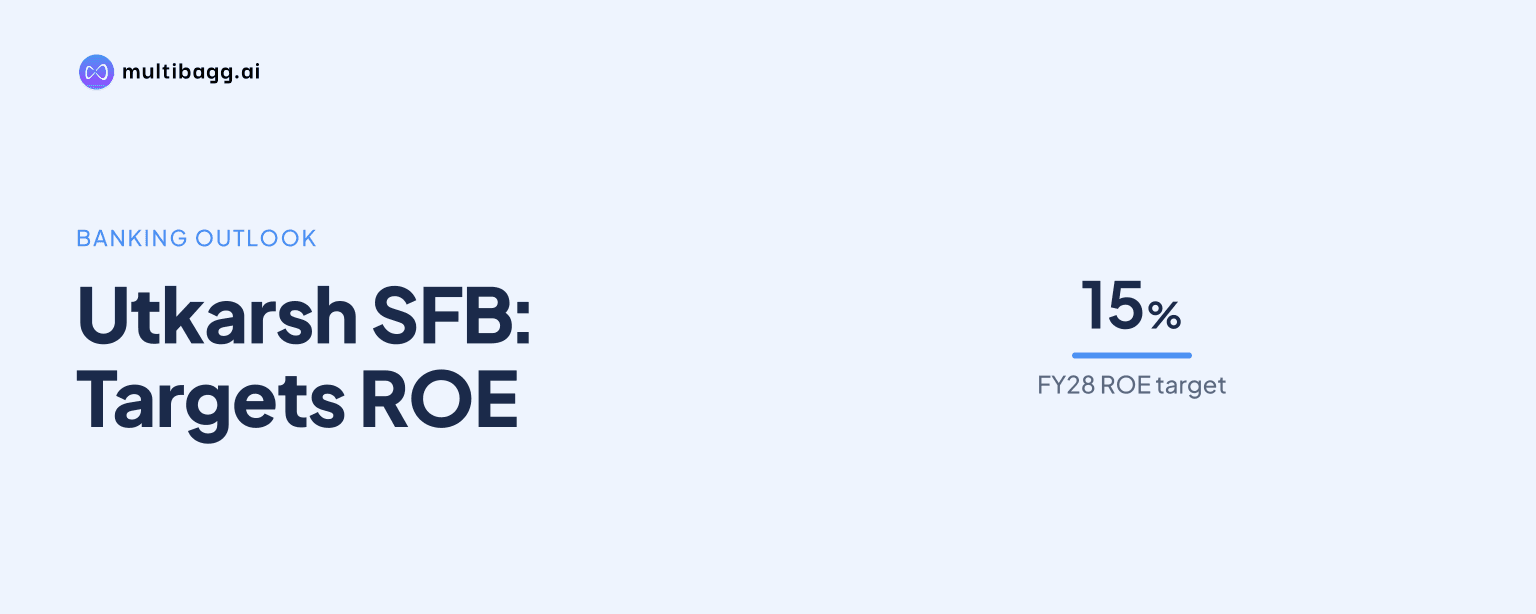
Utkarsh Small Finance Bank Limited is targeting a 15% return on equity in FY28, with management aiming to lower its cost-to-income ratio to a sustainable 60% to 65% from 84% after Q2 FY27. Management said a two-digit return on equity exit in FY27 is the building block for that FY28 outcome.
Know Utkarsh Small Finance Bank inside out
Results, valuation, peers and who's buying, in one view.
How does Utkarsh SFB plan to reach 15% ROE in FY28?
Utkarsh SFB plans to reach 15% return on equity, or ROE, in FY28 by restoring profitability through FY27, rather than by providing a separate return-on-assets target. Management said it expects to exit FY27 with a two-digit ROE, which would form the base for the 15% full-year FY28 objective.
Management identified higher net interest margin, or NIM, rising fee income, stable operating costs and lower credit costs as the main components of the recovery. NIM had risen to 6.3% at the time of the call from 5.1% in Q2 FY26, while higher disbursements are expected to increase both interest-accruing assets and processing-fee income.
Utkarsh SFB said roughly 50% of its loan portfolio is on floating interest rates, allowing it to pass some funding-cost changes to borrowers. About 80% of deposits are term deposits, where rates remain fixed until maturity, and management said the bank had no market borrowings, limiting the immediate effect of higher deposit rates on its overall funding cost.
Product-level disbursement yields show the range of lending economics management is seeking to deploy. Retail micro, small and medium enterprise loans yield around 13%, housing loans about 11%, commercial vehicle and construction-equipment loans around 12.2%, wholesale loans about 10.9% to 11%, personal loans about 16%, and gold loans around 12%.
How much does Utkarsh SFB expect its cost-to-income ratio to decline?
Utkarsh SFB expects its cost-to-income ratio to decline to about 70% to 75% in FY27 and to a sustainable 60% to 65% in FY28. Management said the ratio had improved to 84% after Q2 FY27 from 110% in Q3 FY26, as income recovered after a period of slippages and earlier cost corrections took effect.
Management said the expected ratio improvement will come mainly from income growth rather than a large further reduction in absolute operating expenses. Employee costs and other operating costs are expected to remain broadly in the same range, while business volumes rise, following cost initiatives undertaken over the previous two years.
Utkarsh SFB has not opened a branch for more than 18 months and described its existing network as mature. It operates about 780 microfinance branches and around 330 general-banking branches, and management said productivity gains from the current network, core banking system and loan-origination system should avoid branch-expansion costs.
The bank had about 18,300 employees and expects headcount to stay broadly in the same range for the next six months, with a variation of roughly 100 to 200 employees. Any additions would primarily be field staff for collections or business sourcing, while management said it did not expect to add middle or senior management roles.
Got a follow-up? Ask IRIS
Can lower provisions support Utkarsh SFB's profitability recovery?
Lower provisions can support Utkarsh SFB's recovery because half-year provision expense fell to Rs 275 crore from Rs 872 crore in the comparable prior-year half. Management said credit cost had declined to 3.3% from a previous level of 9.7% and expects the improvement trajectory to continue in Q3 and Q4.
Management said the reported Q1-to-Q2 comparison needs adjustment for benefits linked to the Credit Guarantee Fund for Micro Units and an asset reconstruction company transaction. On its adjusted basis, Q1 provisioning was Rs 240 crore and credit cost was 5.1%, compared with Rs 166 crore and 3.3%, respectively, in Q2.
Commercial-vehicle slippages remain an execution variable. Management said slippages in the segment had fallen from around Rs 44 crore in earlier quarters to Rs 27 crore in each of the prior two quarters, before increasing marginally to around Rs 30 crore in the latest quarter; loans disbursed from April 2025 had outstanding balances of around Rs 400 crore, with non-performing assets below 1%.
Microfinance collection performance was also relevant to the credit-cost outlook. In Maharashtra, which accounts for less than 5% of the portfolio, October collection efficiency was 98.83%, compared with an average around 99.5% earlier in the financial year; management said collections remained stable despite floods in Bihar during the preceding month.
What growth and recoveries are expected to lift Utkarsh SFB income?
Utkarsh SFB expects 25% to 30% growth in FY27, despite reporting 7.5% year-on-year growth at the half-year stage. Management said the second half usually contributes more disbursements and expects opportunities in the coming two quarters to support the required acceleration in portfolio growth.
Disbursements rose 30% year on year in Q4, followed by 50% growth in Q1 and 55% in Q2, according to management. Non-microfinance disbursements grew almost 72% in Q1 and 87% in Q2, a faster pace than overall disbursements that management expects to produce interest income and processing fees.
Management said about 60% of FY26 incremental disbursements were generated in the second half, compared with the first half. It expects the next two quarters to maintain the earlier pace, but did not provide a quarterly loan-growth target or a forecast for the mix between microfinance and non-microfinance lending.
Recoveries from written-off loans may add to income, although management did not set a numerical target. Utkarsh SFB recovered around Rs 20 crore during the current financial year and expects a substantially higher amount in the final two quarters; it estimated the available joint-liability-group write-off book, excluding asset reconstruction company transactions, at around Rs 600 crore and cumulative write-offs since inception at Rs 855 crore.
Conclusion
Utkarsh SFB's 15% FY28 ROE objective depends on several connected management assumptions: NIM remaining above the 5.1% reported in Q2 FY26, disbursements generating more interest and fee income, operating costs staying broadly flat, and credit cost continuing below the 9.7% earlier peak. The planned move from an 84% cost-to-income ratio to 60% to 65% is the central operating measure linking these elements.
The next disclosures to watch are the expected Q3 and Q4 decline in provisions, progress toward the FY27 cost-to-income range of 70% to 75%, and delivery against the 25% to 30% FY27 growth expectation. Commercial-vehicle slippages, microfinance collection efficiency and recoveries from the Rs 855 crore cumulative write-off book remain relevant to whether management's FY28 profitability plan is achieved.

