








Utkarsh SFB targets 25%-30% loan growth after 7.5% H1 expansion
MAX Plan at ₹4,999/yr

Find your next multibaggerBe a Pro Investor
Research stocks and track your picks on the go. Download the app.
Key highlights
- Utkarsh SFB targets 25%-30% loan growth this year after 7.5% H1-on-H1 expansion cited on the call.
- Utkarsh SFB's total disbursements grew 55% year on year in Q2, while non-microfinance disbursements rose 87%.
- Utkarsh SFB has not opened a branch for more than 18 months and operates about 780 microfinance and 330 general banking branches.
- Utkarsh SFB reported Rs 239 crore of quarterly slippages and a September-quarter PCR of about 55.5%.
powered by IRIS
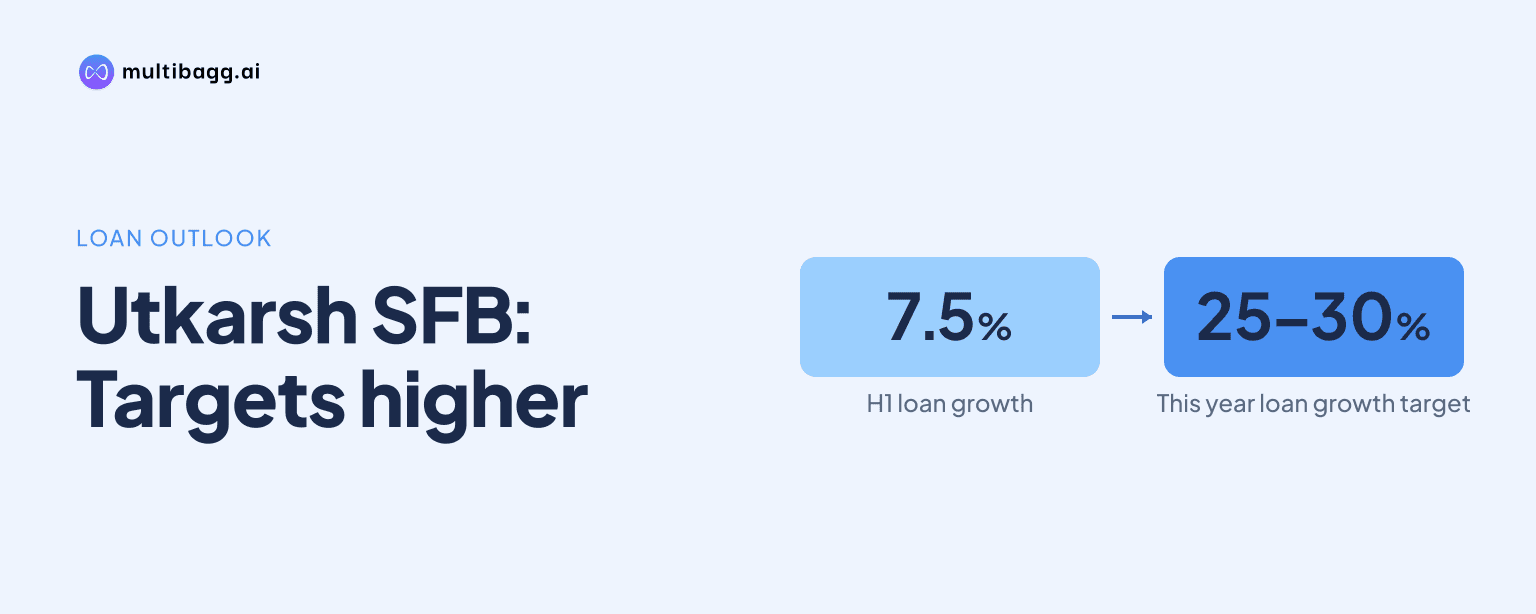
Utkarsh Small Finance Bank said it targets 25%-30% loan growth for the current year, although an analyst cited only 7.5% H1-on-H1 expansion, with Q2 disbursements up 55% year on year and non-microfinance disbursements up 87%. Management said the target relies on sharper second-half execution from its existing network.
Know Utkarsh Small Finance Bank inside out
Results, valuation, peers and who's buying, in one view.
Can Utkarsh SFB reach 25%-30% loan growth this year?
Utkarsh SFB is targeting 25%-30% loan growth for the current year, not FY27, based on management’s response during the Q2 FY26 call. When an analyst asked whether the target meant 10%-15% growth after 7.5% H1-on-H1 expansion, Govind Singh said the 25%-30% expectation applied to “this year” and would be “25% plus.”
The required acceleration is substantial because the 7.5% H1 comparison cited by the analyst was well below the full-year range. Management’s case rests on rising origination activity: total disbursements grew 30% year on year in Q4, 50% in Q1 and 55% in Q2. It said larger disbursements create interest-accruing assets, which can subsequently lift the outstanding loan book.
The disclosed trend shows total disbursement growth increased from 30% in Q4 to 55% in Q2, while non-microfinance growth exceeded total growth in both Q1 and Q2. The call did not disclose absolute disbursement values, the outstanding loan book or quarterly loan-growth milestones, so the conversion of disbursements into the 25%-30% target remains dependent on second-half execution and repayments.
What will drive Utkarsh SFB's second-half loan growth?
Utkarsh SFB said higher productivity from its mature branch network, technology upgrades, manpower and products will drive second-half growth. It has not opened a branch for more than 18 months, and management said it operates about 780 microfinance branches and around 330 general banking branches. The plan is therefore to increase throughput from existing infrastructure rather than add branches.
The new core banking system, or CBS, affected Q2 disbursements because August business slowed during the launch, according to management. Utkarsh SFB cited that disruption as a reason for limited growth in micro, small and medium enterprises, or MSME, and housing loans between March 2026 and September 2026. It operates MSME and housing lending from about 90 locations and expects those businesses to pick up.
Loan against property, or LAP, is the primary secured-lending driver, management said. Utkarsh SFB offers micro LAP below Rs 25 lakh, standard LAP from Rs 25 lakh, and prime LAP above Rs 1 crore, alongside business-banking loans backed by hard collateral. Its gold-loan portfolio was above Rs 400 crore, while management said LAP would be its largest non-microfinance segment in several forms.
Management also cited the previous year’s seasonal pattern. It said H2 FY26 accounted for almost 60% of incremental disbursements relative to H1 FY26, and it expects the coming H2 to maintain a comparable pace. That pattern provides context for the target, but does not establish that the 7.5% H1 expansion will translate into 25%-30% full-year loan growth.
Got a follow-up? Ask IRIS
How could asset quality affect Utkarsh SFB's growth plan?
Utkarsh SFB reported Rs 239 crore of fresh slippages in the quarter, including Rs 66 crore from microbanking and Rs 173 crore from non-microbanking. Commercial vehicle and construction equipment contributed Rs 30 crore, MSME contributed Rs 64 crore, and wholesale lending contributed Rs 33 crore. Management called wholesale lending an outlier because the book is close to six years old after nearly five years with nil non-performing assets.
The bank said wholesale lending, commercial vehicle and construction equipment, and MSME exposures are supported by immovable property or vehicle collateral. It said recoveries are under way, although action under the Securitisation and Reconstruction of Financial Assets and Enforcement of Security Interest Act, or SARFAESI, can take time. Collateral does not prevent fresh slippages, making collections and recovery timing relevant to the growth plan.
Reported provisioning also requires a like-for-like comparison, management said. Q1 provisions of Rs 109 crore included a Rs 75 crore Credit Guarantee Fund for Micro Units, or CGFMU, credit and a Rs 65 crore asset reconstruction company, or ARC, transaction. Without those two items, management said Q1 provisions would have been about Rs 249 crore, compared with Rs 166 crore in the reported quarter.
The September-quarter provision coverage ratio, or PCR, was about 55.5%. The microfinance and joint liability group, or JLG, book had PCR of 67.7%, compared with 36% for secured lending and 65.1% for unsecured lending including retail unsecured loans. Management said small finance banks follow Reserve Bank of India income-recognition and asset-classification norms rather than expected credit loss provisioning.
Can Utkarsh SFB improve profitability while expanding lending?
Utkarsh SFB said higher disbursements, productivity gains, net interest margin, or NIM, improvement and lower credit costs should support profitability. Management said NIM was 6.3%, compared with 5.1% in Q2 FY26, and added that higher disbursements should increase processing-fee income. An analyst raised an 8% NIM target, but management did not provide a revised target in this exchange.
The bank said it has moved retail loans fully onto its loan origination system, or LOS, and uses internal tools for underwriting, due diligence, bureau-report summaries and rule-based processes. Management described artificial intelligence use as calibrated and internal rather than customer-facing. The intended mechanism is better underwriting and workflow efficiency across the existing branch network.
Credit costs and half-year provisions have declined on management’s presentation. Half-year provisions were Rs 275 crore, down from Rs 872 crore in the prior-year half, while credit cost was 3.3% in the current quarter versus 9.7% at an earlier point. Management said the reported Q1 credit cost of 2.3% would have been 5.1% after adding back CGFMU and ARC benefits.
Management’s stated returns objective is a double-digit return on equity, or ROE, at the FY27 exit and 15% ROE for FY28. It did not provide a return on assets target. The profitability plan depends on converting higher disbursements into earning assets while containing credit costs and avoiding branch-expansion costs.
Conclusion
Utkarsh SFB’s current-year 25%-30% loan-growth target is materially above the 7.5% H1-on-H1 expansion cited on the call. Management’s supporting evidence is the increase in total disbursement growth from 30% in Q4 to 55% in Q2, including 87% Q2 growth in non-microfinance disbursements, alongside a mature network of about 1,100 branches.
The next indicators are H2 disbursement growth, its conversion into outstanding loans, and the recovery in MSME and housing activity after the August CBS transition. Management also expects commercial vehicle and construction equipment slippages to decline as flow rates from SMA-1 to SMA-2 improve, while it has set a double-digit ROE target for the FY27 exit and 15% ROE for FY28.

