








Utkarsh SFB says Q2 provisions lower on adjusted basis
MAX Plan at ₹4,999/yr

Find your next multibaggerBe a Pro Investor
Research stocks and track your picks on the go. Download the app.
Key highlights
- Utkarsh SFB reported Q2 FY27 provisions of Rs 166 crore, versus an adjusted Q1 FY27 amount of about Rs 249 crore.
- Q1 FY27 reported provisions of Rs 109 crore included Rs 75 crore of CGFMU credit and Rs 65 crore from an ARC transaction.
- Net fresh NPA slippages fell to about Rs 175 crore in Q2 FY27 from Rs 415 crore in Q2 FY26.
- Gross NPA was 5.9% in September 2026, nearly 630 basis points lower year on year.
powered by IRIS
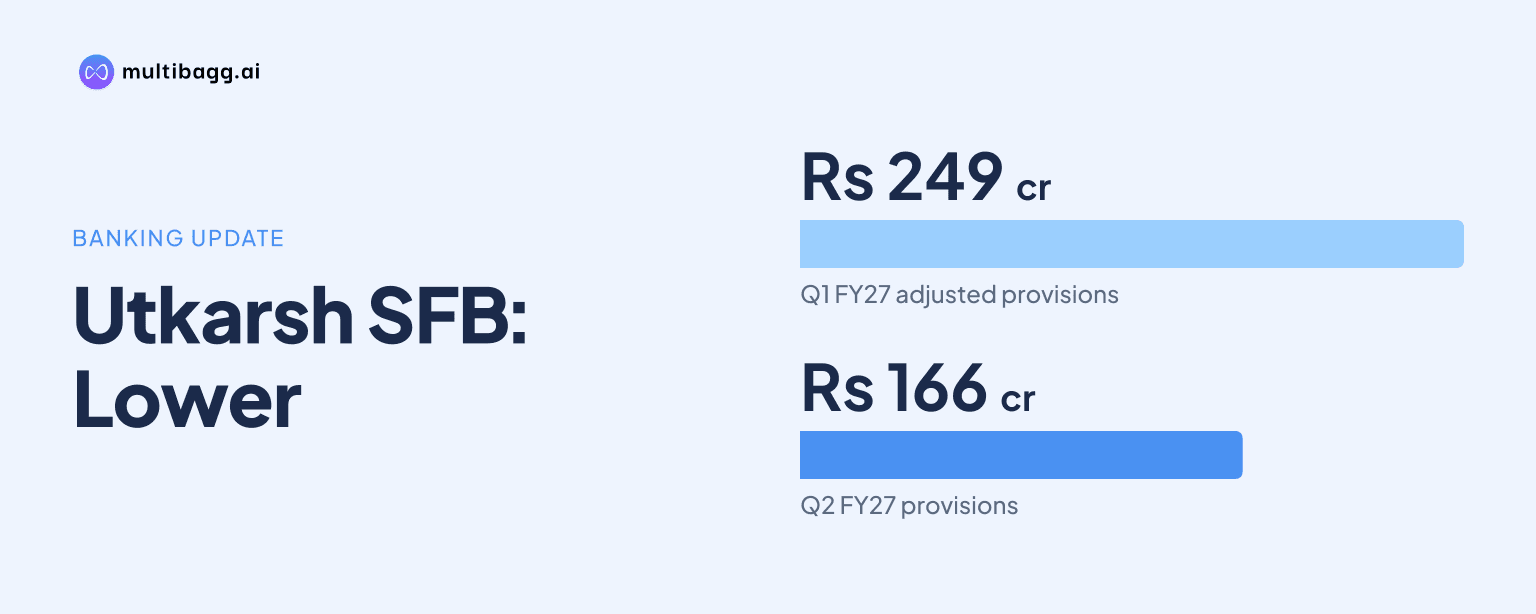
Utkarsh Small Finance Bank said Q2 FY27 provisions were Rs 166 crore, below an adjusted Q1 FY27 amount of about Rs 249 crore after removing Rs 75 crore of CGFMU guarantee credit and Rs 65 crore from an ARC sale that reduced Q1’s reported provision to Rs 109 crore.
Know Utkarsh Small Finance Bank inside out
Results, valuation, peers and who's buying, in one view.
Why did Utkarsh SFB's reported provision expense rise in Q2 FY27?
Utkarsh SFB's reported provision expense rose because Q1 FY27 contained Rs 140 crore of benefits that did not recur in Q2 FY27. Management said the Rs 109 crore provision reported in Q1 included a Rs 75 crore credit related to the Credit Guarantee Fund for Micro Units, or CGFMU, scheme and a Rs 65 crore benefit from an asset reconstruction company, or ARC, transaction. On that basis, management said the comparable Q1 provision would have been about Rs 249 crore, versus Rs 166 crore in Q2.
This changes the sequential comparison. Reported provision expense increased by Rs 57 crore from Rs 109 crore in Q1 to Rs 166 crore in Q2, but management's adjusted comparison indicates a decline of about Rs 83 crore. Management separately said Q1 provisions would have been about Rs 190 crore without the CGFMU credit alone, which was available under regulatory norms after the Bank paid the guarantee premium.
Did Q2 FY27 slippages increase at Utkarsh SFB?
Yes, gross slippages discussed on the call were Rs 239 crore in Q2 FY27, although management said the increase was concentrated outside micro banking and was not materially driven by drought or the West Asia crisis. Micro banking contributed Rs 66 crore and non-micro-banking businesses contributed Rs 173 crore. Commercial vehicle and construction equipment contributed Rs 30 crore, micro, small and medium enterprises contributed Rs 64 crore, and wholesale lending contributed Rs 33 crore of fresh slippages.
The Rs 239 crore figure differs from the Bank's measure of fresh non-performing asset, or NPA, slippages net of recoveries and upgrades. On that net basis, fresh NPA slippages fell to about Rs 175 crore in Q2 FY27 from Rs 415 crore in Q2 FY26. For H1 FY27, net fresh NPA slippages were Rs 300 crore, compared with about Rs 810 crore in H1 FY26.
Management said the wholesale book was nearly six years old and had operated with nil NPAs for almost five years before the latest delinquencies. It said non-micro-banking slippages in commercial vehicles, construction equipment, MSME and wholesale lending were backed by collateral, including property or vehicles. The Bank reported Rs 8 crore of recoveries in wholesale lending during Q2 FY27, while noting that recovery under the Securitisation and Reconstruction of Financial Assets and Enforcement of Security Interest process can take time.
Got a follow-up? Ask IRIS
What evidence did Utkarsh SFB give for improving asset quality?
Utkarsh SFB cited lower new stress formation, stronger collections and a smaller overdue pool in micro banking. Collection efficiency in the X bucket of the joint liability group, or JLG, segment was 99.6% in Q2 FY27, compared with 98.6% in Q2 FY26. The special mention account pool within micro banking fell to 1.7% in September 2026 from 4.9% in September 2025, while gross NPA was 5.9% of the gross loan portfolio in September 2026, nearly 630 basis points lower year on year.
Micro-banking provisions were another indicator highlighted by management. It said provisions in that portfolio had peaked at Rs 401 crore in Q2 FY26 and fell to Rs 92 crore in Q2 FY27. Management attributed the movement to lower slippages and X-bucket collection efficiency remaining above 99% for the preceding six to seven months.
CGFMU coverage also affects the provision line because it permits a lower provision requirement for covered loans. The Bank said about 48% of its microfinance book related to disbursements through Q4 FY26 was covered under the scheme, increasing to almost 80% after including H1 FY27 disbursements. The guarantee window was not open for fresh guarantees during a government approval process for its next phase, although management said the Bank had accrued the required 1% guarantee fee for eligible disbursements.
How does the provision trend fit Utkarsh SFB's portfolio strategy?
The provision trend fits Utkarsh SFB's effort to reduce its historical dependence on group lending and expand secured credit. JLG loans represented 88% of the gross loan portfolio in March 2020, or 90% including business-correspondent JLG exposure, but had reduced to 24% in September 2026, or 26% including that exposure. Secured lending increased to 52% of the gross loan portfolio from 47% a year earlier.
Non-JLG lending led disbursement growth in H1 FY27. Total disbursements rose 52% year on year, with JLG disbursements up 2% and non-JLG disbursements up 94%. The gross loan portfolio grew 7.5% year on year and 2.3% sequentially. Management said loans against property, including micro loans against property below Rs 25 lakh, larger loans against property and prime loans above Rs 1 crore, would remain the primary secured-lending driver.
Management linked better provisioning and collections to an improving profitability trajectory but did not provide a quarterly profit forecast. Its operating measures included more than 1,400 collection personnel supporting JLG and micro-banking business loans, a specialised call centre for overdue accounts and enhanced branch-level monitoring. The Bank also said its new core banking system was launched during Q2 FY27, which affected disbursements in August.
Conclusion
Utkarsh SFB's central argument is that Q2 FY27 provisions of Rs 166 crore should be compared with an adjusted Q1 amount of about Rs 249 crore rather than the reported Rs 109 crore. That interpretation rests on Rs 140 crore of Q1 benefits from CGFMU-related provision credit and an ARC transaction, while net fresh NPA slippages fell to about Rs 175 crore from Rs 415 crore a year earlier and micro-banking provisions declined from their Rs 401 crore peak to Rs 92 crore.
The next test is whether the Bank sustains lower new stress after Q2 FY27 gross slippages of Rs 239 crore, particularly in MSME, commercial vehicle and construction equipment, and wholesale lending. Investors can also watch for the CGFMU guarantee window to reopen, as management expected, and for progress toward management's stated medium-term goals of around 55% secured lending, net interest margins of around 8% and return on equity of about 15% for FY28.

