










Vardhman sees 6-8 million-bale cotton gap as imports lag
Key highlights
- Vardhman cited a 28 million-29 million-bale Indian crop estimate against consumption of 35 million-36 million bales.
- Vardhman calculated an implied Indian cotton shortfall of about 6 million-8 million bales.
- Vardhman said Brazilian cotton can take about 35-50 days to reach India after shipment.
- Management discussed Indian cotton prices of Rs 64,000-Rs 66,000 per candy under current futures conditions.
powered by IRIS
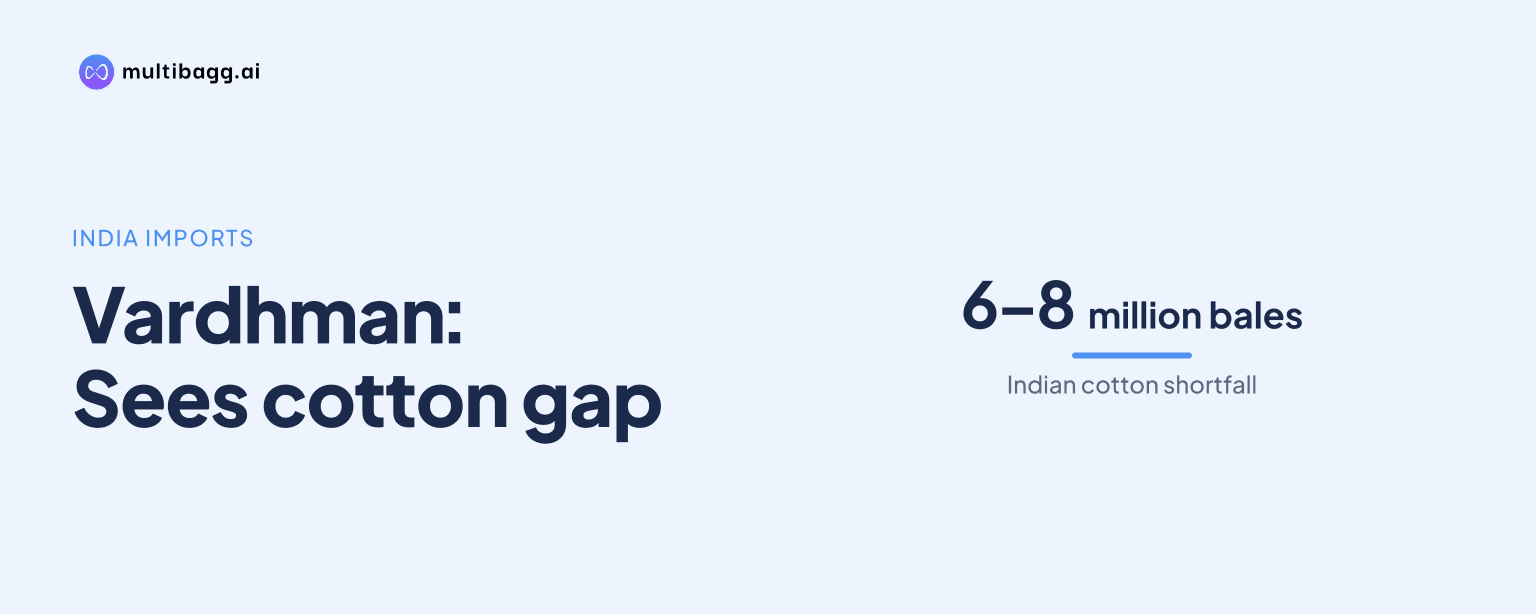
Vardhman said India could face a cotton shortfall of 6 million to 8 million bales, with a 28 million-29 million-bale crop estimated against consumption of 35 million-36 million bales, and management said the duty-free import window ending December 31 is too short for most newly booked overseas cargoes to arrive.
Know Vardhman Textiles inside out
Results, valuation, peers and who's buying, in one view.
What cotton shortfall does Vardhman expect in India?
Vardhman expects India’s cotton crop to fall short of consumption by about 6 million to 8 million bales. Management cited the first survey by the Cotton Association of India, which estimated the crop at 28 million-29 million bales, while it said domestic consumption was unlikely to be below 35 million-36 million bales.
The comparison points to a tighter domestic supply position as the cotton season develops. Vardhman did not present the 28 million-29 million-bale crop estimate as its own forecast, but said the gap between that estimate and consumption could make Indian prices tighter unless imports provide balancing supply.
Management said the domestic crop position matters alongside international pricing. Indian cotton is directly related to New York futures, according to Vardhman, but a crop materially below consumption could lift Indian prices above world-market levels if imported cotton remains constrained by duty or shipment timing.
Why does Vardhman doubt the duty-free import window will help?
Vardhman does not expect the two-month duty-free import period to materially improve cotton availability in India. Management said the government announced the measure on October 31 and that it runs only until December 31, leaving insufficient time for most new transactions to be shipped and delivered.
For a buyer booking cotton after October 31, a Brazilian or Australian shipment would generally not be available before the first or second week of December, Vardhman said. Even if it shipped in the first week of December, management said the cargo could not arrive in India before December 31. Cotton booked earlier may reach India during the window, but management did not expect a large fresh volume.
Vardhman said a three-month duty-free period would be more workable for new imports. Its stated timeline is about one month to arrange a shipment and roughly 35-50 days for cotton from Brazil to reach India, meaning a two-month concession does not normally accommodate both booking and transit.
What cotton price range is Vardhman discussing?
Vardhman said Indian cotton prices are unlikely to decline substantially under current conditions. Management indicated a domestic range of Rs 64,000 to Rs 66,000 per candy if New York futures remain around 75-85 US cents per pound and the rupee is in the range of Rs 94 to Rs 96 per US dollar.
That range is higher than the Rs 54,000-Rs 55,000 per candy at which Vardhman said it bought cotton earlier, including imported cotton converted to Indian costs. Prices later rose to Rs 64,000-Rs 65,000 per candy as New York futures increased and the rupee moved, creating a trading gain for the company during that period.
Management said yarn prices are generally set with reference to prevailing cotton prices. As a result, it said higher cotton costs need to be accompanied by improved yarn pricing for the value chain to absorb the increase. Vardhman also said raw Narma cotton was selling at about Rs 9,000 per quintal, above the minimum support price.
Got a follow-up? Ask IRIS
What could change Vardhman’s cotton outlook?
A longer duty-free import period or a change in New York futures could alter Vardhman’s outlook. Management said an extension of at least three months could allow more newly arranged Brazilian cargoes to reach India and help address the gap between a 28 million-29 million-bale crop and 35 million-36 million bales of consumption.
New York futures are the other key variable identified by management. Vardhman said futures were about 79-82 US cents per pound at the time of the call, with prices over the next six months indicating about 84 US cents per pound before a later decline to about 78 US cents per pound in December 2027.
Management said Indian cotton costs could remain in the Rs 64,000-Rs 66,000 per candy range if futures stay within the 75-85 US-cent benchmark it described. If futures fall, government intervention through the Cotton Corporation of India, or CCI, could become possible through purchases and later sales to industry, according to management.
How does the cotton position affect Vardhman’s spinning plans?
Vardhman said its spinning operations are running at almost 100% capacity utilisation, leaving little unused capacity to raise output in response to changing yarn demand. Management said this has been the company’s historical operating position over the past 10, 20 and 30 years.
The company has announced an open-end spinning project with capacity of about 50 tonnes per day, expected to become operational in six to seven months. Management also described the announced project as costing about Rs 500 crore, while saying no major additional spinning expansion has been announced for the next two years.
At the industry level, management said about 12 million-13 million spindles have permanently left India’s system over the past three years. It estimated rated national spinning capacity had declined from about 52 million-53 million spindles to no more than 40 million spindles, a change it linked to improved yarn pricing.
Vardhman said routine balancing and modernisation expenditure is generally Rs 400 crore-Rs 500 crore. A new plant with at least 100,000 spindles would cost more than Rs 1,000 crore at current costs, management said, adding that raw-material availability and government policy remain relevant to broader sector investment decisions.
Conclusion
Vardhman’s assessment is that India’s cotton balance could tighten because projected consumption of 35 million-36 million bales exceeds the 28 million-29 million-bale crop estimate by 6 million-8 million bales. Management’s concern is not only the size of the gap, but also whether imports can arrive soon enough to narrow it under the duty-free period ending December 31.
The next issues to watch are any extension of the duty-free import period, revisions to the Cotton Association of India crop estimate, and movements in New York futures from the 75-85 US-cent range discussed by management. Vardhman also expects its 50-tonnes-per-day open-end project to start within six to seven months, while any larger spinning expansion remains unannounced.