










Vardhman Favors Organic Expansion After Five-Year M&A Search
Key highlights
- Vardhman expects a 50-tonnes-per-day plant to add about 8% organic growth within five to six months.
- Vardhman said it has not found an acquisition worthwhile over the past five years.
- India's spinning sector has lost 12 million spindles and about 1,000 factories, according to Vardhman management.
- Vardhman said fabric utilisation improved from about 70% to 75% in the second quarter to around 80% at the time of the call.
powered by IRIS
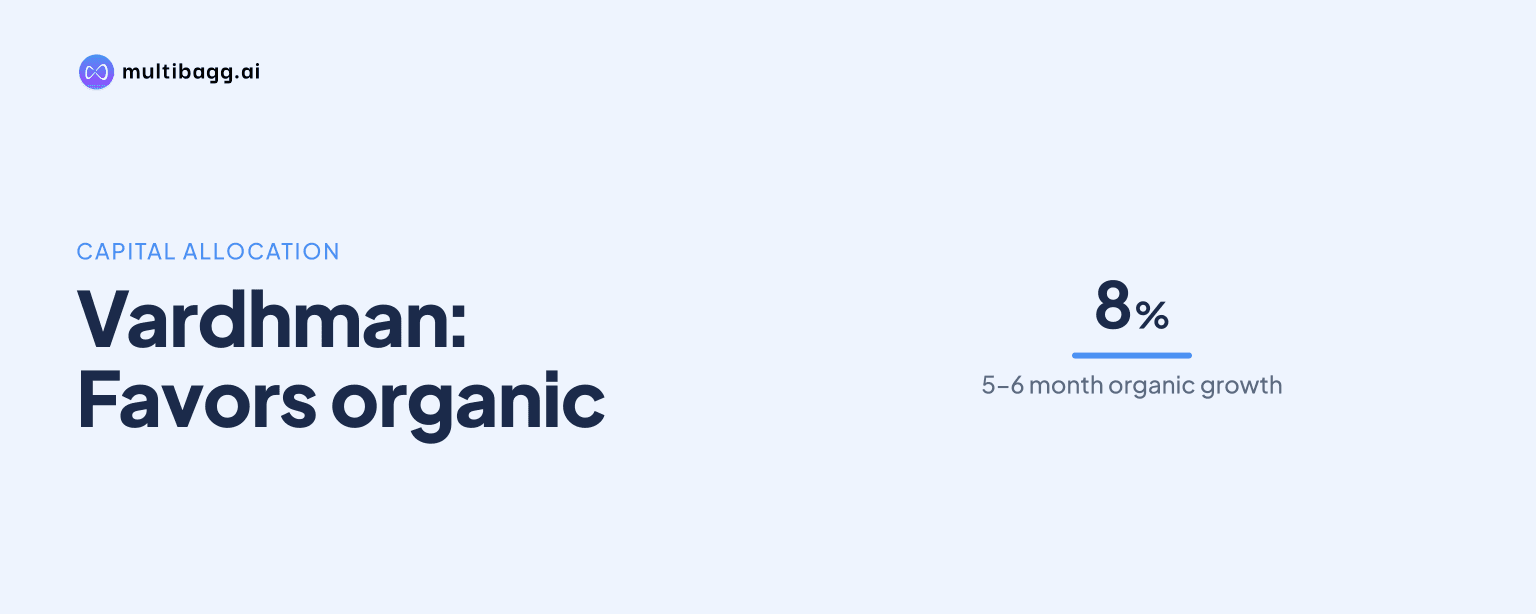
Vardhman favors organic spinning expansion after finding no worthwhile acquisition over the past five years, as management said distressed mills often lack suitable scale, equipment or operating culture. A plant under construction is expected to add about 8% growth, or 50 tonnes per day on a 700-tonnes-per-day base, within five to six months.
Know Vardhman Textiles inside out
Results, valuation, peers and who's buying, in one view.
Why does Vardhman prefer organic spinning expansion to acquisitions?
Vardhman prefers organic expansion because management said the smaller mills it has examined would be difficult to restore. Neeraj Jain said the company had recently visited two or three smaller organisations, but found their machine parks, operating culture or overall condition unsuitable for an easy turnaround. He said that, by the time some companies are offered for sale, much of their value may already have been removed.
Vardhman remains open to a meaningful transaction, but management said buying a very small organisation would not make strategic sense. Jain said the company has continued to review targets but has not found anything worthwhile in the past five years. Management's preference is to operate factories over 10, 20 or 30 years rather than make an acquisition during a six- to eight-month period of distress.
What does industry consolidation mean for Vardhman's acquisition options?
Vardhman said Indian spinning consolidation has been driven largely by loss-making mills shutting down rather than by planned combinations. Management said the industry previously had about 51 million to 52 million spindles across 3,000 factories, and that 12 million spindles and 1,000 factories have since exited. Based on those figures, the closed factories averaged about 12,000 spindles each.
The remaining industry has about 40 million to 41 million spindles across 2,000 factories, or roughly 20,000 spindles per factory, according to management's calculation. Vardhman said this average factory size remains too small, while possible targets can also be in states where it does not operate or have practices incompatible with its model. An analyst put Vardhman's market share at about 6% to 7%, but management did not state a market-share target.
What organic capacity growth does Vardhman have underway?
Vardhman has one plant under construction that management expects to provide about 8% organic growth in the next five to six months. Jain described the addition as 50 tonnes per day against the existing 700-tonnes-per-day base. This project provides an identified increase in output while the company assesses larger capacity decisions.
A larger expansion in Madhya Pradesh is constrained by land development, according to the discussion on the call. Vardhman said it has land in Dhar and is speaking with the government on development alongside another company on the same platform. An analyst suggested that an eight- to nine-month land delay followed by at least one year of construction could make a larger project a two-year exercise, but management did not present that timing as guidance.
Got a follow-up? Ask IRIS
What policy condition could make Vardhman expand faster?
Vardhman said certainty on cotton availability at internationally competitive prices is the main condition for a larger expansion decision. Management wants duty-free imports when domestic raw material is unavailable. Jain said annual increases of 6% to 7% in the minimum support price, or MSP, could make conditions difficult for Indian spinners if New York cotton futures do not rise sufficiently to offset higher domestic cotton costs.
Management said temporary import-policy windows of two or three months do not provide enough visibility for a major capacity commitment. If duty-free imports were allowed or trade became freer, Jain said India could add spinning capacity and Vardhman could expand more quickly. Until then, the company is balancing the available opportunity against uncertainty over raw-material policy and pricing.
How do current yarn and fabric conditions support Vardhman's plans?
Vardhman said yarn demand from China remained at about 20 million kilograms to 25 million kilograms of imports from India at the time of the call. Management cited Chinese cotton prices of around US$1 and concerns over the use of Xinjiang cotton as factors supporting purchases of Indian yarn. It said cotton-yarn spreads at current prices were broadly comparable between the second and third quarters, although actual profitability can vary with older inventory costs.
Fabric utilisation improved to around 80% at the time of the call from about 70% to 75% in the second quarter, despite added capacity. Management expects utilisation to reach 90% to 95% in a few quarters and said current capacity could support at least a 15% increase in revenue. Separately, 40% to 50% of renewable-power decisions made over the prior two years had been completed, with the remaining portion expected in the next three to four months.
Conclusion
Vardhman's approach combines a near-term 8% capacity addition with caution toward buying distressed spinning assets. The sector has lost 12 million spindles and 1,000 factories, but management said many available assets remain too small, poorly maintained or culturally unsuitable to fit its long-term operating model.
The next item to watch is progress on cotton-import policy and land development in Dhar. Management said clarity on access to competitively priced cotton could support a larger capacity decision, while the 50-tonnes-per-day plant is due in five to six months and the remaining renewable-energy projects are expected to become available within three to four months.