










Vardhman resets EBITDA goal to 16%-20%, sees 5%-8% CAGR
Key highlights
- Vardhman reset its long-term EBITDA margin ambition to 16%-20%, from its earlier 18%-22% range.
- Management described 5%-8% as Vardhman’s best-case long-term revenue CAGR, versus historical growth of about 6%-7%.
- Fabric utilisation improved to about 80% from roughly 70%-75% in the second quarter.
- The technical-textile plant was at about 35%-40% utilisation and is expected by management to break even around 50%.
powered by IRIS
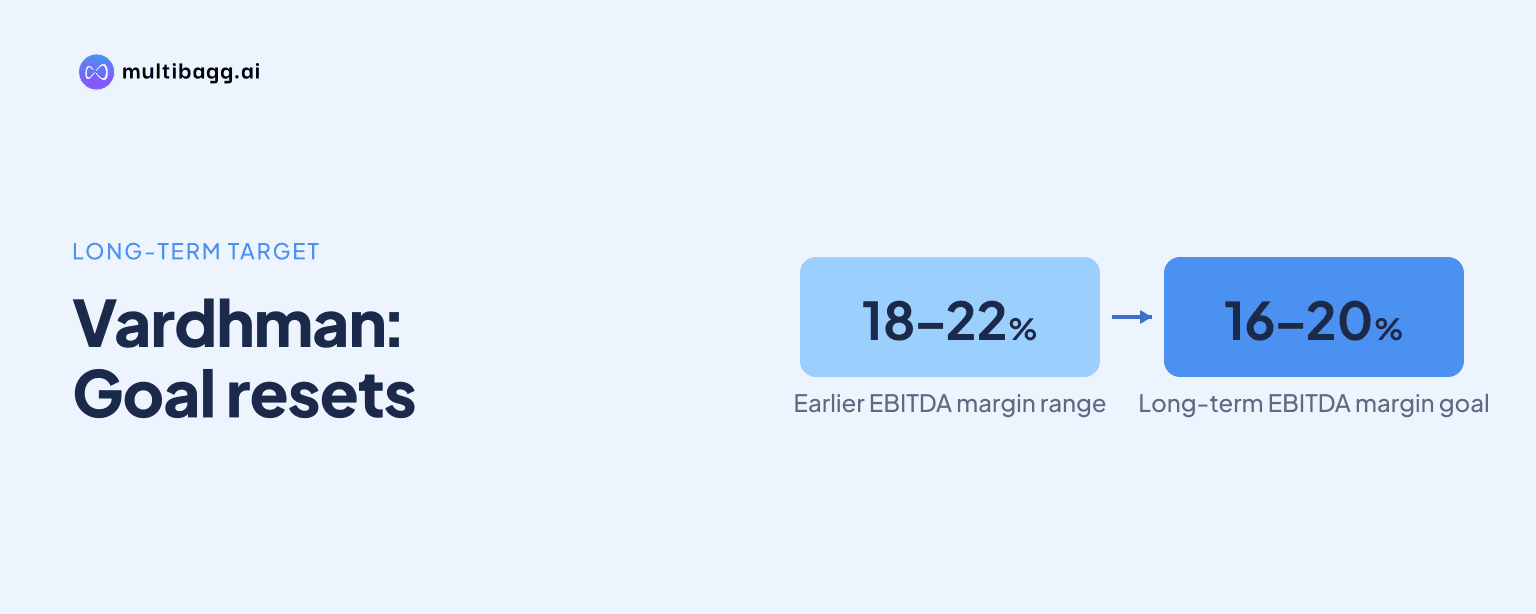
In its long-term outlook, Vardhman reset its earnings before interest, tax, depreciation and amortisation (EBITDA) margin ambition to 16%-20%, from 18%-22%, after cotton rose from about Rs 34,000-Rs 35,000 to about Rs 65,000 per candy; management also called 5%-8% its best-case revenue compound annual growth rate (CAGR).
Know Vardhman Textiles inside out
Results, valuation, peers and who's buying, in one view.
Why did Vardhman lower its long-term EBITDA margin target?
Vardhman lowered its long-term EBITDA margin framing because higher cotton prices have changed the absolute profit required to sustain a given percentage margin. Management said its earlier guidance, stated seven to 10 years ago, was 18%-22%, but cotton prices rose from about Rs 34,000-Rs 35,000 per candy to roughly Rs 65,000 per candy after COVID-19.
The mechanism is particularly relevant to yarn: if raw-material costs rise, Vardhman must generate roughly twice as much absolute profit to retain the same percentage margin, which management said is not normally possible. It therefore said a 16%-20% EBITDA margin would be a satisfactory long-term outcome if achieved, supported by fabric development, renewable power and other operating improvements.
Vardhman’s revised margin range is an ambition rather than a reported result or formal quarterly forecast. Management linked it to work already under way in fabric and sustainable power, but did not provide a date by which the company expects to reach 16%-20% or a segment-by-segment margin bridge.
What revenue growth does Vardhman expect over the long term?
Vardhman sees 5%-8% as its best-case long-term revenue CAGR, compared with management’s view that its revenue growth has usually been about 6%-7% over a 10-year period. Management said the larger scale of the organisation makes 10% annual growth capital intensive, rather than presenting double-digit growth as its base expectation.
Management illustrated the constraint with a company of Rs 10,000 crore-Rs 12,000 crore in scale: 10% growth would require about Rs 1,000 crore of investment every year. It also said capital employed to turnover is below one-to-one, implying total investment of about Rs 1,500 crore, including Rs 500 crore of modernisation spending that is intended primarily to retain customers rather than generate immediate growth.
This is a more measured framework than one based on capacity additions alone. Vardhman said periods of faster growth have followed development of a new site, while subsequent three- to five-year periods have involved consolidation, depending on market conditions and available opportunities.
Can Madhya Pradesh PM MITRA Park drive Vardhman’s next expansion?
Vardhman identifies the Madhya Pradesh PM MITRA Park site as its principal potential platform for a larger future expansion, because management said its other locations are full. The company said it had previously achieved its biggest growth between 2005 and 2015 after developing two major projects, at Ludhiana and Satlapur.
Management’s sequence for Madhya Pradesh is to obtain the land, establish one project, settle operations and then build confidence and operating culture at the location before accelerating expansion. It said a small greenfield project would not by itself be sufficient to make money, and that the site could ultimately support not only spinning and weaving but other segments as well.
The expansion is therefore not a disclosed, fully costed construction programme. Management said there are ideas under consideration but no decision on additional segments, making the site a long-term option rather than a stated revenue contribution within the 5%-8% CAGR range.
Got a follow-up? Ask IRIS
What must improve before Vardhman can expand faster?
Vardhman says clearer raw-material policy and access to internationally competitive cotton are central conditions for faster spinning expansion. Management noted that India’s rated spinning capacity has fallen from about 52 million-53 million spindles to no more than about 40 million, after an estimated 12 million-13 million spindles permanently exited the system over the past three years.
The investment hurdle is substantial: management estimated that a 100,000-spindle operation now requires about Rs 800 crore-Rs 1,000 crore. It said uncertainty over cotton availability and government policy has constrained sector investment, even as trade agreements could raise demand for yarn used in garments and home textiles.
Vardhman also described the short duration of duty-free cotton imports as a practical issue. Although the duty-free period was announced until December 31, management said Brazilian or Australian cotton shipments generally require 35-50 days, so a two-month window was unlikely to materially increase imported supply unless cotton had been booked earlier.
How do fabric and technical textiles fit Vardhman’s margin plan?
Vardhman expects fabric utilisation and technical textiles to contribute to improvement over the next six to nine months, though this is management’s outlook rather than a guarantee. Fabric utilisation was around 80% at the time of the call, compared with about 70%-75% in the second quarter, with the comparison affected by newly added capacity.
Management said the fabric operation would have been fully utilised without the expansion, and it expects utilisation to rise toward 90%-95% in a few quarters. It also said existing fabric capacity could support at least 15% more revenue as utilisation improves, but does not publicly disclose fabric-segment revenue.
The technical-textile plant had reached about 35%-40% utilisation after two customers approved it and began placing orders. Management said the plant should reach break-even at least around 50% utilisation and expressed hope of 100% utilisation in six to eight months; early operations can incur losses because sampling and customer approvals take time.
Conclusion
Vardman’s updated framework pairs a lower 16%-20% EBITDA margin ambition with a 5%-8% best-case revenue CAGR, acknowledging that cotton costs near Rs 65,000 per candy have altered the economics behind the earlier 18%-22% margin range. The company’s case for gradual growth rests on better fabric utilisation, technical-textile ramp-up and disciplined capital deployment rather than a near-term commitment to large new capacity.
The next items to watch are progress at the Madhya Pradesh PM MITRA Park site, where management sees the main future expansion opportunity once land is available, and the operating milestones already identified for fabric and technical textiles. Management expects fabric performance to improve over six to nine months and hopes technical textiles can reach full utilisation within six to eight months, while cotton-import policy remains unresolved.