










Vardhman says low-cost cotton lifted Q2 FY27 yarn results
Key highlights
- Vardhman bought cotton at Rs 54,000-Rs 55,000 per candy before market prices rose to Rs 64,000-Rs 65,000 per candy.
- New York cotton futures rose from US$0.64-US$0.65 per pound to nearly US$0.75-US$0.80 per pound, management said.
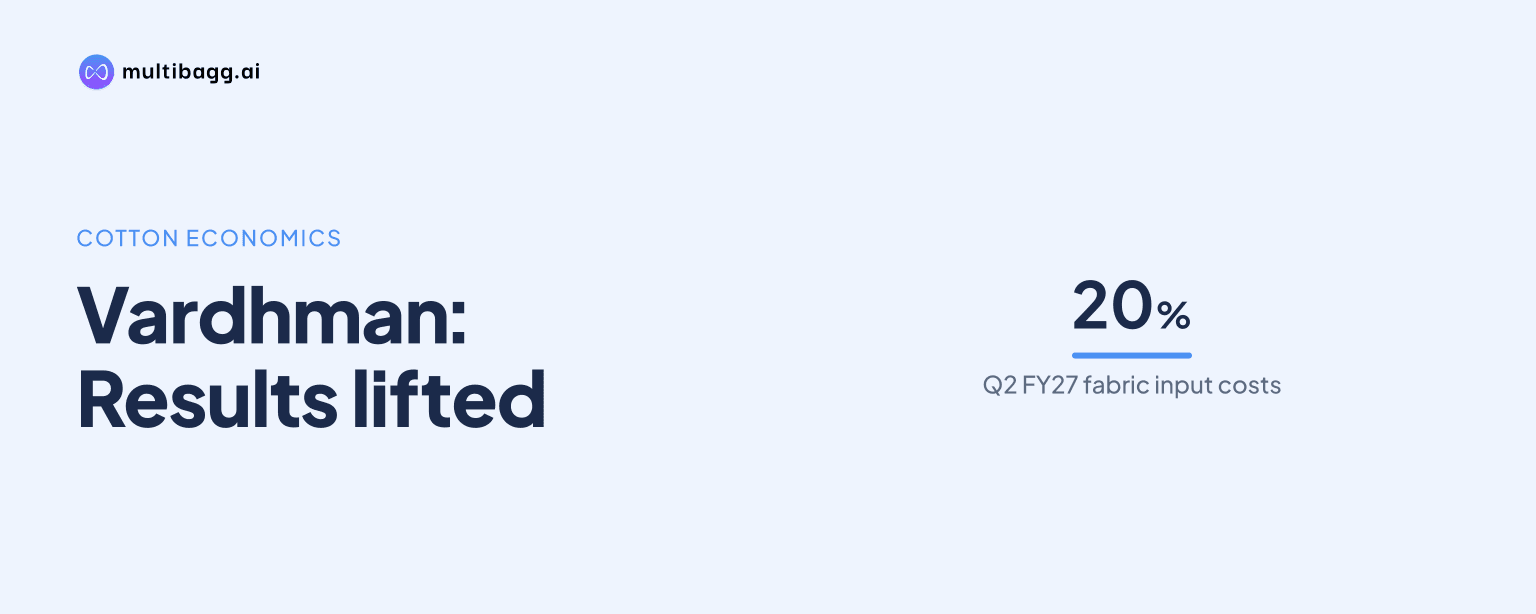
- Vardhman said fabric input costs rose by an average of about 20% year on year in Q2 FY27.
- Vardhman's 50-tonnes-per-day open-end project is expected to start within six to seven months of the November 6, 2026 call.
powered by IRIS
Vardhman Textiles Limited said Q2 FY27 yarn performance benefited partly from trading gains because cotton bought at Rs 54,000-Rs 55,000 per candy was used after market prices rose to Rs 64,000-Rs 65,000 per candy. Vardhman also cited stronger yarn demand, higher selling prices, cost control and production improvements in the period.
Know Vardhman Textiles inside out
Results, valuation, peers and who's buying, in one view.
What drove Vardhman's better yarn performance in Q2 FY27?
Vardhman said better yarn demand and lower-cost cotton inventory drove its improved Q2 FY27 yarn performance versus both Q1 FY27 and the previous period. Managing Director Neeraj Jain said export demand had improved over roughly the preceding six months, supporting yarn prices in export markets and, in turn, domestic pricing.
Management said rising raw-material costs could be passed on to yarn customers during the period. It also attributed improvement to cost control, higher production, product and customer improvements, and the effect of modernisation completed in the previous year. Green-power initiatives also began contributing in Q2 FY27, although Vardhman did not quantify the earnings contribution from any individual factor.
The company distinguished the inventory-related benefit from operational improvements. Vardhman said yarn prices are generally set using prevailing cotton prices, while part of its cotton inventory had been purchased at a substantially lower cost. That difference between historical input cost and current yarn pricing created what management described as a trading gain.
How did low-cost cotton create Vardhman's trading gain?
Vardhman's trading gain resulted from cotton bought at Rs 54,000-Rs 55,000 per candy before later raw-cotton prices reached Rs 64,000-Rs 65,000 per candy. Jain said Vardhman bought both Indian and imported cotton because domestic availability and quality were uncertain while Cotton Corporation of India procurement was under way.
Vardhman had expected to use imported cotton under advance licences, at least for export commitments. However, the government subsequently permitted duty-free cotton imports for a couple of months. Jain said much of Vardhman's incoming cotton arrived in that window, making its imported cotton cost comparable with Indian cotton and adding to the procurement advantage.
Two market movements lifted replacement costs. New York cotton futures rose from US$0.64-US$0.65 per pound to nearly US$0.75-US$0.80 per pound during the period management discussed. Jain also linked rupee depreciation to higher crude prices following the Iran war, saying the currency movement raised landed imported-cotton costs and helped increase Indian raw-cotton prices.
The Rs 10,000-per-candy change between the earlier and later price ranges was relevant because yarn selling prices moved with current cotton prices. Vardhman could therefore realise improved yarn prices while some production still used earlier, lower-cost cotton. Management did not disclose the volume of cotton involved, the rupee value of the gain or its share of Q2 FY27 profit.
Got a follow-up? Ask IRIS
Can Vardhman retain yarn pricing as new cotton arrives?
Vardhman said its new-season cotton cost would be materially higher than last year, with landed costs and Indian-market prices at about Rs 65,000 per candy on November 6, 2026. The company had only started buying new-season cotton, and Jain said yarn prices would need to improve to offset the higher input cost.
Management put New York futures at about US$0.79-US$0.82 per pound at the time of the call. Jain said the next six months indicated prices near US$0.84 per pound, while December 2027 was near US$0.78 per pound. Using rupee levels of Rs 94-Rs 96, he said the converted Indian cotton cost was Rs 64,000-Rs 65,000 per candy.
Jain said Indian cotton could remain at Rs 64,000-Rs 66,000 per candy if New York futures stayed within US$0.75-US$0.85 per pound. He said he could not make a definitive call on futures because multiple factors affect them. The comments indicate that the earlier inventory-cost benefit is not replicated in new purchases made at around Rs 65,000 per candy.
Management also identified a policy variable. Jain said Narma, or raw cotton, was selling at about Rs 9,000 per quintal, below the minimum support price, or MSP. He said Cotton Corporation of India intervention may not be required if futures remain at current levels, but lower futures could lead to purchases by the agency and later sales to industry.
Why did Vardhman's fabric business lag yarn in Q2 FY27?
Vardhman said fabric revenue and profit were lower than both Q1 FY27 and the corresponding quarter a year earlier, unlike yarn performance. Executive Director Sagrika Vir said lower export volumes amid tariff uncertainty, domestic pricing pressure and higher yarn costs weighed on the fabric business.
Fabric input costs were higher by an average of about 20% year on year in Q2 FY27, according to management. Vardhman said lower export volumes put more supply into the domestic market, increasing competition and restricting its ability to pass through higher inputs. It also said recently commissioned processing capacity was not yet fully utilised, lowering fixed-cost absorption.
In its naturals business, Vardhman expanded processed-fabric capacity by more than 25% over the past year. Management said it was working to raise utilisation. In performance fabrics, the facility commissioned in March focused on sampling, customer approvals, audits and stabilisation through Q1 FY27 and Q2 FY27.
Vardhman said it had onboarded a few sportswear and outdoor customers and had confirmed orders plus a healthy pipeline in synthetics. Management expects the synthetics business to turn operating positive in the second half of FY27, subject to improving utilisation. Any further expansion in synthetics depends on stable utilisation and the targeted product mix, it said.
Conclusion
Vardhman's Q2 FY27 yarn improvement reflected both market conditions and company actions. Better export-led demand supported yarn prices, while cotton acquired at Rs 54,000-Rs 55,000 per candy was consumed after replacement costs had risen to Rs 64,000-Rs 65,000 per candy. Cost control, higher production, modernisation and green-power initiatives were additional management-cited contributors.
The next issue is whether yarn realisations rise with new cotton purchased at about Rs 65,000 per candy. Management also said its 50-tonnes-per-day open-end project should be operational within six to seven months of the November 6, 2026 call, while fabric utilisation and the planned second-half FY27 operating outcome for synthetics remain key disclosed milestones.