










Vardhman sees synthetics unit operating-positive in H2 FY27
Key highlights
- Vardhman expects its March-commissioned synthetics unit to become operating-positive in H2 FY27.
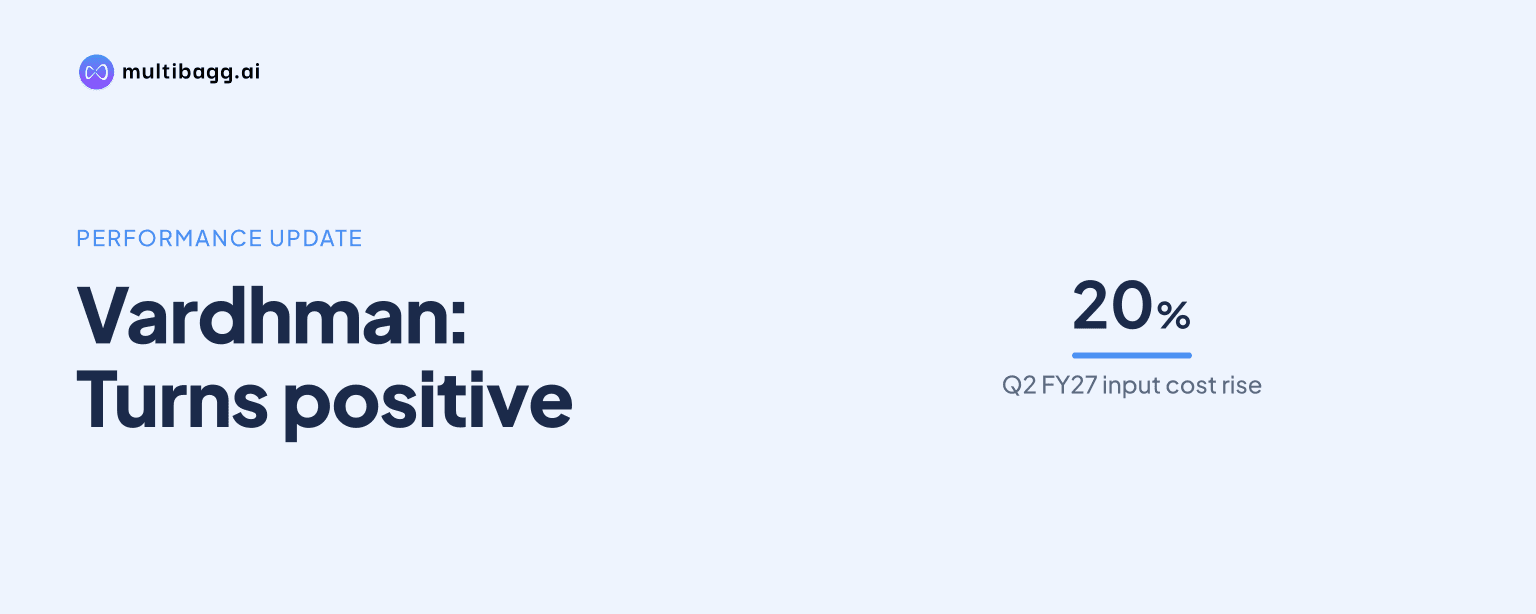
- Vardhman said fabric input costs were about 20% higher year on year in Q2 FY27.
- Vardhman expanded processed-fabric capacity in its naturals business by more than 25% over the past year.
- Vardhman said some export customer orders were delayed by one or two months amid tariff uncertainty.
powered by IRIS
Vardhman Textiles Limited expects its March-commissioned synthetics performance-fabrics unit to turn operating-positive in H2 FY27, supported by confirmed orders, customer approvals and a healthy order pipeline. Management said utilisation should improve during the second half before Vardhman moves into higher-value coated nylon, coated polyester and other performance products.
Know Vardhman Textiles inside out
Results, valuation, peers and who's buying, in one view.
When will Vardhman’s synthetics unit become operating-positive?
Vardhman expects its synthetics business to become operating-positive in H2 FY27, management said on the November 6, 2026 earnings call. The performance-fabrics operation was commissioned in March, and Q1 FY27 was focused on sampling, customer approvals, audits and stabilising the new facility rather than running at mature utilisation levels.
During Q2 FY27, Vardhman continued sampling and product development while onboarding a few leading sportswear and outdoor customers. Management said confirmed orders and a healthy pipeline should lift utilisation through H2 FY27, providing the volume needed to absorb operating costs. This is management’s expectation, not a reported profitability result or a disclosed utilisation target.
Vardhman has set out a sequential plan for the business. It intends to improve capacity utilisation first and then move into higher-value products including coated nylon, coated polyester and more performance-oriented fabrics. Management did not disclose the plant’s capacity, current utilisation, order value or the revenue level needed for the unit to become operating-positive.
Why was Vardhman’s fabric business under pressure in Q2 FY27?
Vardhman’s fabric business recorded lower top line and bottom line in Q2 FY27 than both Q2 FY26 and Q1 FY27. Management attributed the decline to lower export volumes amid tariff uncertainty, domestic pricing pressure, higher yarn costs and lower fixed-cost absorption at recently commissioned processing capacity.
Fabric input costs were about 20% higher year on year in Q2 FY27 as yarn prices increased, according to management. Lower exports also redirected competitive pressure into the domestic market, limiting Vardhman’s ability to pass higher yarn costs to customers. That contrasted with the yarn business, where management said demand and pricing improved over the preceding six months.
The fabric division was also absorbing the cost of additional processing capacity. In Vardhman’s naturals business, processed-fabric capacity increased by more than 25% over the past year, but management said the company was still working to utilise the new capacity. The synthetics unit faces a similar absorption issue because it is earlier in its ramp-up following the March commissioning.
The comparison across businesses is material to the H2 FY27 plan. Vardhman said yarn benefited from improved demand, price increases and gains associated with cotton purchased at lower prices, while fabric faced a 20% year-on-year input-cost increase and delayed exports. The synthetics target therefore depends on volume growth overcoming the fixed costs of a new operation.
Got a follow-up? Ask IRIS
What demand evidence has Vardhman reported for performance fabrics?
Vardhman said it has confirmed orders, a healthy pipeline and a few onboarded leading sportswear and outdoor customers for its synthetics offering. The unit spent Q1 FY27 on samples, approvals, audits and stabilisation, and retained a sampling and development focus in Q2 FY27 as it extended synthetic fabrics to existing customers.
Customer approvals are relevant because performance fabrics can require development work before bulk production begins. Vardhman did not name the sportswear or outdoor customers, disclose their order values, or provide a timetable for repeat orders. It is also undertaking developments for the defence segment, although management gave no approval status, launch date or sales estimate for that work.
Management said some export customers had delayed orders by one or two months during tariff uncertainty, rather than cancelling most orders. It said this postponement affected development cycles and later bulk conversions, contributing to lower export volumes in Q2 FY27. Management nevertheless said the order pipeline was improving following the recent U.S. election, which is its outlook rather than a guarantee of demand.
Vardhman is expanding its customer base in Europe and Australia while seeking improved conditions in the U.S. market. Its product plan includes premium woven fabrics, stretch, cotton, nylon and performance fabrics, supported by faster product development and customer response. Management said buyers increasingly seek price, compliance, fibre-stage traceability, quality and delivery reliability.
What must happen for Vardhman to meet its H2 FY27 target?
Vardhman must convert confirmed orders and its pipeline into enough production volume to increase synthetics utilisation in H2 FY27. Management said higher-value coated nylon and coated polyester products will follow once capacity is utilised, making the product-mix upgrade conditional on the initial volume ramp rather than an immediate driver of profitability.
Export recovery remains an unresolved variable. Q2 FY27 fabric volumes were lower as tariff uncertainty delayed customer developments and bulk conversions, and management did not disclose a quarterly export-volume forecast or a synthetics utilisation target. Its expectation of better business sentiment does not quantify how quickly delayed orders will move into production.
Input costs and domestic competition are also relevant. Vardhman said yarn-driven fabric input costs rose about 20% year on year in Q2 FY27, while domestic pricing pressure restricted pass-through. Higher volumes may improve fixed-cost absorption, but management did not quantify the level of utilisation required for the synthetics operation to stay operating-positive beyond H2 FY27.
A decision on further synthetics capacity is another disclosed milestone. Vardhman said it will consider expansion only after the current business reaches stable utilisation and the targeted product mix. The company has therefore not committed to another synthetics project based solely on the March commissioning or the H2 FY27 operating-positive expectation.
Conclusion
Vardhman’s H2 FY27 target is based on a defined progression at its March-commissioned synthetics unit: sampling, approvals, audits and stabilisation in Q1 FY27; continued development and customer onboarding in Q2 FY27; and higher utilisation from confirmed orders in the second half. The target comes while the wider fabric business manages lower Q2 FY27 volumes, 20% higher year-on-year input costs and recently expanded processing capacity.
The next indicators are synthetics utilisation, conversion of sportswear and outdoor orders into bulk production, and progress toward coated nylon and coated polyester fabrics. Management has left further synthetics expansion conditional on stable utilisation and the intended product mix, while the pace of export-order recovery after one-to-two-month postponements remains unresolved.