










Vardhman targets 60% green power by FY 2027-28, net zero by 2045
Key highlights
- Vardhman targets 60% green power generation in FY 2027-28.
- Vardhman aims to achieve net-zero emissions by 2045.
- Vardhman targets a 30% reduction in freshwater consumption by 2030.
- Vardhman lists 34% of inputs sourced sustainably in FY26.
powered by IRIS
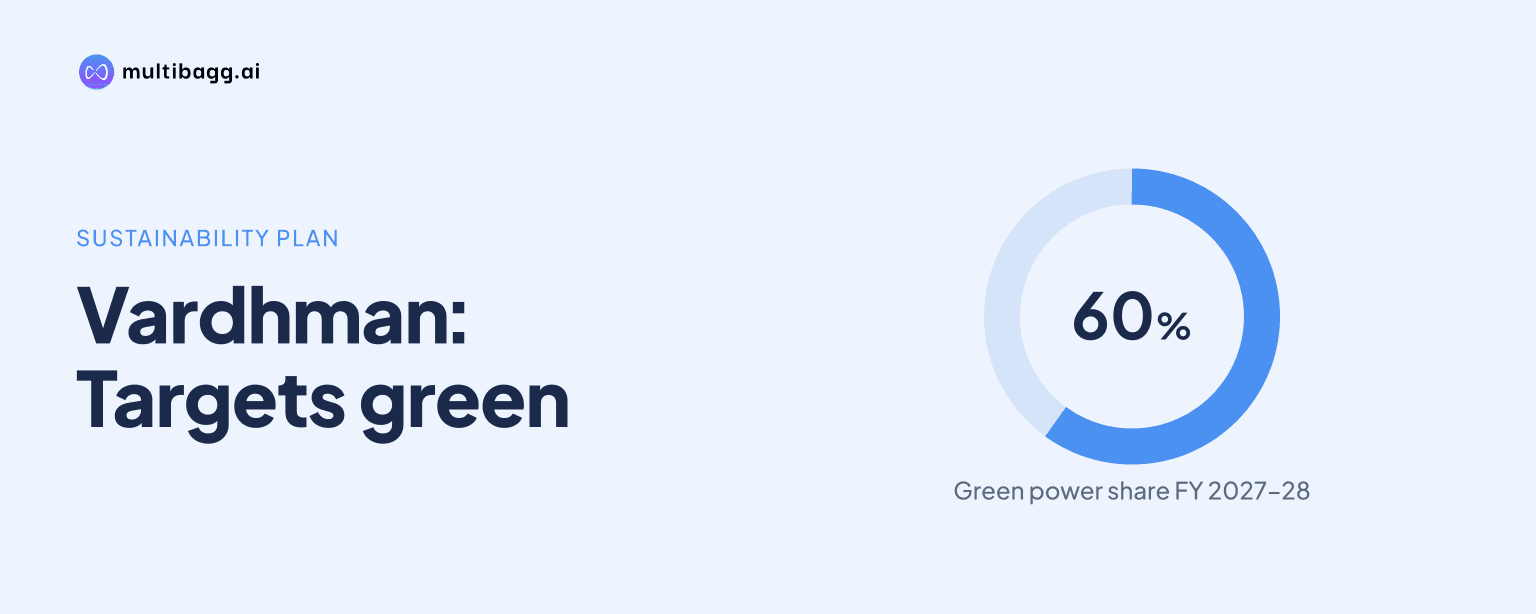
Vardhman has set a 60% green power generation target for FY 2027-28 and a net-zero emissions target for 2045, alongside 2030 goals to cut freshwater consumption by 30%, reduce waste sent to landfill by 50% and make packaging 100% sustainable.
Know Vardhman Textiles inside out
Results, valuation, peers and who's buying, in one view.
What does Vardhman’s sustainability roadmap cover?
Vardhman’s roadmap covers environmental, social and economic priorities through nine stated sustainability goals. These include reducing freshwater use, shifting to greener energy sources, minimising emissions, eliminating hazardous chemicals, reducing and upcycling waste, improving traceability, and supporting ethically and sustainably sourced raw materials.
Vardhman presents the programme under the name PRO, meaning Proactively Responsible Organisation, and describes it as a framework spanning environmentally conscious operations, social welfare and stakeholder prosperity, and an economic thrust to expand its green-product portfolio. The presentation links this approach to textile operations with more than 1.25 million installed yarn spindles, 1,550 fabric looms and processed-fabric capacity of 240 million metres a year.
The disclosed milestones combine dated targets with operating commitments that have no stated deadline. The dated commitments are FY 2027-28 for green power generation, 2030 for waste, water, packaging and chemical-compliance objectives, 2045 for net-zero emissions, and FY 2050 for a net-positive-impact ambition.
How does Vardhman plan to change its energy and emissions profile?
Vardhman plans to achieve 60% green power generation in FY 2027-28 and net-zero emissions by 2045. These are the presentation’s two explicit energy and climate milestones, while its wider sustainability-goals list says the company intends to decouple growth from energy consumption and shift to greener sources.
The disclosed timing creates a sequence: the green-power-generation target falls in FY 2027-28, while the emissions endpoint is 2045. The presentation does not specify a green-power baseline, a greenhouse-gas emissions baseline, the emissions categories included in the net-zero target, or the technologies and capital expenditure intended to deliver either milestone.
Vardhman also lists climate-change mitigation among its nine sustainability goals, placing emissions reduction alongside its energy transition. For a vertically integrated textile manufacturer with more than 1.25 million spindles and annual processed-fabric capacity of 240 million metres, the stated 60% target applies to green power generation rather than to a stated share of total energy consumption.
Got a follow-up? Ask IRIS
What are Vardhman’s 2030 targets for water, waste and packaging?
Vardhman targets a 30% reduction in freshwater consumption and a 50% reduction in waste sent to landfill by 2030, while also aiming for 100% sustainable packaging by 2030. The three commitments address production inputs, waste disposal and packaging materials within the same target year.
The waste goal specifically measures waste sent to landfill, rather than all waste generated. That distinction matters because Vardhman’s broader objective is to minimise, reuse and upcycle waste to reduce landfill burden; however, the presentation does not disclose current landfill volumes, a baseline year or the share of waste already reused or upcycled.
The water target is framed as a reduction in freshwater consumption, and Vardhman’s sustainability-goals list adds an intention to rejuvenate water sources. The company does not provide a freshwater-consumption baseline, plant-level water data or a mechanism for measuring source rejuvenation, so the presentation establishes the 30% 2030 objective without quantifying the operational starting point.
For packaging, Vardhman states a 100% sustainable-packaging objective by 2030. The presentation does not define the materials or criteria that qualify as sustainable packaging, nor does it state the present proportion meeting that standard. The target sits alongside the 50% landfill-reduction goal, linking packaging design with Vardhman’s stated waste-management agenda.
How do sourcing, chemicals and workforce actions fit the plan?
Vardhman lists 34% of inputs sourced sustainably in FY26 and targets 100% compliance with its stated chemical requirement by 2030 as part of its environmental and supply-chain agenda. The presentation also identifies enhanced traceability and ethically and sustainably sourced raw materials as one of its nine sustainability goals.
The sourcing figure is presented for FY26, whereas the chemical-compliance target is scheduled for 2030. Vardhman does not disclose the input categories included in the 34% figure, the standard used to determine sustainable sourcing, or the calculation method for the chemical-compliance target, so the source provides the percentage and deadline without a methodology.
The social component includes zero fatalities and occupational diseases as a stated objective, plus 4,465 training and awareness programmes held. Vardhman’s broader social goals call for work conditions that support productivity, training that accelerates holistic development, and mainstreaming marginalised people in the formal economy.
These workforce commitments accompany an employee base of more than 23,000 people and a presence across more than 75 countries, according to the company overview. The presentation does not state the period covered by the 4,465 programmes, the number of participants, a fatality baseline or a deadline for the zero-fatalities and occupational-diseases objective.
Conclusion
Vardhman has disclosed a dated sustainability pathway rather than only broad principles: 60% green power generation is targeted for FY 2027-28, major water, waste and packaging milestones are set for 2030, net-zero emissions are targeted for 2045 and net-positive impact is an FY 2050 ambition. The roadmap also combines environmental measures with FY26 sustainable-input sourcing, chemical compliance, training and workplace-safety aims.
The next disclosed milestone to watch is the FY 2027-28 green-power target, followed by the 2030 commitments for 30% lower freshwater consumption, 50% less waste sent to landfill, 100% sustainable packaging and 100% chemical-requirement compliance. The presentation does not provide baselines, interim milestones or implementation spending for these objectives, leaving progress reporting against those measures unresolved.