








Vibhor Steel's Odisha utilisation awaits pending key approvals
MAX Plan at ₹4,999/yr

Find your next multibaggerBe a Pro Investor
Research stocks and track your picks on the go. Download the app.
Key highlights
- Vibhor Steel said Odisha pipe output was about 1,500-2,000 tonnes per month in H1 FY27.
- The second Odisha galvanising tank has capacity of 2,000-4,000 tonnes per month, depending on order mix.
- Vibhor Steel said one Odisha galvanising tank was operating at almost 2,000 tonnes per month.
- Pipe represented about 81% of revenue, while highway guardrails represented about 12%.
powered by IRIS
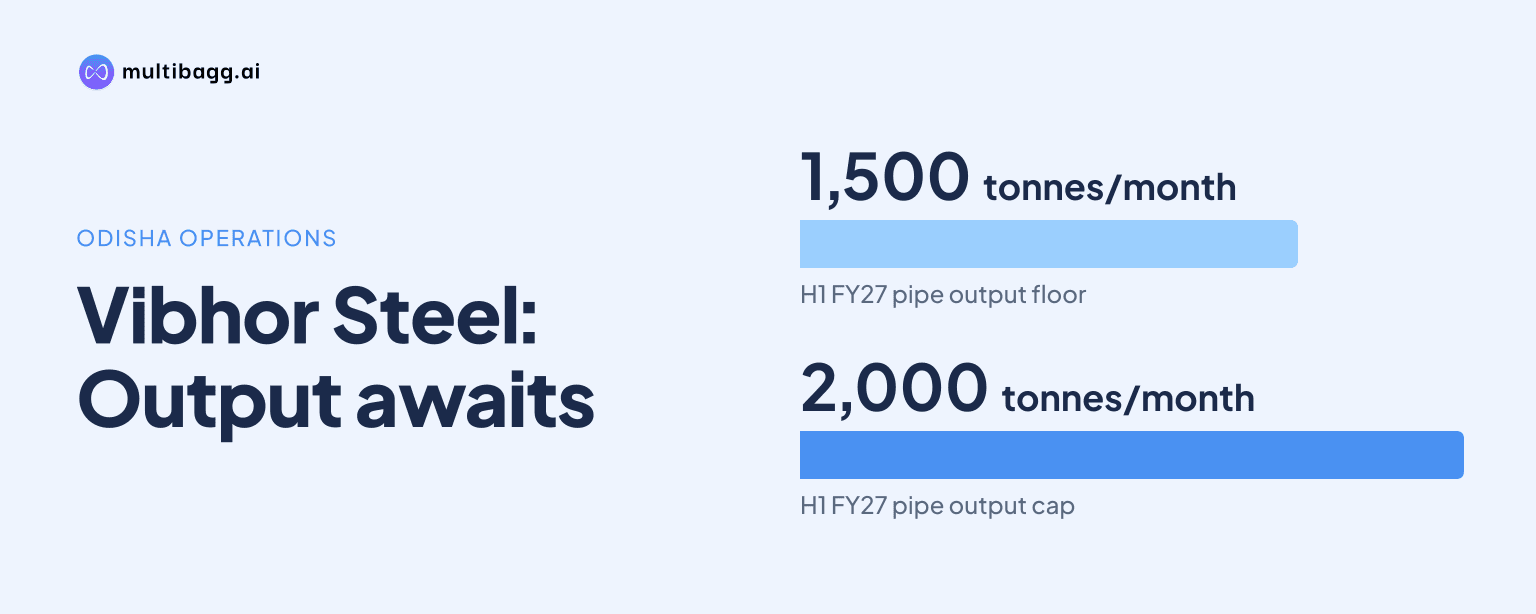
In H1 FY27, Vibhor Steel Tubes’ Odisha pipe operation produced about 1,500-2,000 tonnes a month, while pending telecom and transmission approvals limited fuller utilisation. Vibhor Steel said telecom certification and swaged-pole progress could raise pipe output to about 2,500-3,000 tonnes monthly, while approvals could also fill its larger galvanising tank with poles and towers.
Know Vibhor Steel Tubes inside out
Results, valuation, peers and who's buying, in one view.
What is constraining Vibhor Steel’s Odisha plant utilisation?
Pending telecom and transmission-related approvals are constraining higher utilisation at Vibhor Steel’s Odisha operations. Management said the 13-metre second galvanising tank is awaiting transmission approvals and, primarily, telecom approval before it can take more work. Odisha has pipes, highway guardrails, poles and transmission towers, so management measures utilisation separately by product and galvanising asset rather than as one plant-wide percentage.
Power Grid approval is a major outstanding permission for transmission-line towers. Management said it has certifications and permissions from many states, while documents submitted to Power Grid had been accepted and formalities completed, although some further requirements may remain. It said the approval process had been pending for about one year and that receiving it should help increase Odisha capacity use.
Telecom-tower certification is another pending item. Vibhor Steel said its inspection had been completed and certification was expected soon, after which it plans to approach mobile network teams. It has also applied for railway products through the Research Designs and Standards Organisation, or RDSO, but management expects telecom approval before railway approval.
How much Odisha capacity is Vibhor Steel using now?
Vibhor Steel reported Odisha pipe production of about 1,500-2,000 tonnes a month in H1 FY27. One of the two galvanising tanks was operating at almost its 2,000-tonne monthly capacity, while the second 13-metre tank has installed capacity of 2,000-4,000 tonnes a month depending on the product and order mix.
Highway guardrails are nearer to their stated capacity, with about 1,000 tonnes of output against 1,500 tonnes of installed capacity. Management said it should be able to reach 1,500 tonnes soon. In contrast, transmission towers and poles are expected to shape utilisation of the galvanising tanks because their output depends on certifications, approvals and order execution.
Odisha differs from the company’s other galvanising operations. Management said all galvanising tanks in Maharashtra were full and both tanks in Hyderabad were operating at maximum capacity, whereas Odisha was still moving towards its utilisation zone. The unused Odisha capacity is therefore associated with the larger second tank and approval-dependent product lines rather than all of Vibhor Steel’s galvanising operations.
Got a follow-up? Ask IRIS
Which products could change Vibhor Steel’s Odisha mix and margins?
Telecom certification and a Bureau of Indian Standards, or BIS, certificate for swaged poles could lift Vibhor Steel’s Odisha pipe output to about 2,500-3,000 tonnes a month, management said. The swaged-pole machine has been installed, but Vibhor Steel plans to apply for BIS certification only after samples are made. The product is therefore not yet a contributor to reported output.
Vibhor Steel has obtained mandatory Central Power Research Institute, or CPRI, Bangalore certification for 132-rated monopoles and plans to apply for 220 and 400 ratings. Management said it has monopole and transmission inquiries, an order in Madhya Pradesh and an ongoing order in Chhattisgarh. It also identified inquiries from Maharashtra, Rajasthan, Telangana and Andhra Pradesh, while distinguishing those inquiries from confirmed orders.
The potential product shift matters because pipe accounted for about 81% of revenue, highway guardrails about 12%, and towers, poles and other products about 6%-7%. Management said highway guardrail earnings before interest, tax, depreciation and amortisation, or EBITDA, were at least 1 percentage point above pipe, poles were about 1%-1.5% above pipe, and transmission-line products could be 3%-4% above pipe.
Management said the larger tank could eventually be occupied by new products with capacity of up to 4,000 tonnes a month. It also described a potential mix in which pipe runs at about 2,000-2,500 tonnes while other products use more galvanising capacity. That outcome remains conditional on the approvals and order conversion that management has not presented as complete for every product.
When could Odisha and Haryana add to Vibhor Steel’s revenue?
Management said Odisha’s additional products should begin showing in company numbers by the next financial year, while cautioning that it could not give an exact timing. Its stated basis was available capacity, continuing inquiries and progress of approval files, rather than a disclosed revenue target for Odisha or a committed production date.
Vibhor Steel is also establishing Vibhor Infra, a subsidiary unit in Hisar, Haryana, for highway guardrails, poles and transmission-line towers. Management said some companies were due to inspect the facility in December and January, and it expected production around the first quarter of the following year, or roughly six to eight months. It said the Haryana unit would start with products that have higher EBITDA percentages than pipe.
For crash barriers, management cited current average production of 1,500-2,000 tonnes a month and a target of about 2,500 tonnes during the year. Haryana could add another 1,000 tonnes, taking potential crash-barrier output to about 3,500-4,000 tonnes if installed capacity is properly used. NATRAX testing for highway guardrails was due on the 28th, and management said certification would enable buyers requiring that test to consider its products.
Conclusion
Vibhor Steel’s Odisha utilisation is currently determined by approvals and product mix as well as installed capacity. The first galvanising tank is already near 2,000 tonnes a month, but pipe output is at 1,500-2,000 tonnes and the second tank requires telecom, transmission, pole and tower work for fuller use. Management’s stated margin comparisons indicate why it is seeking a greater contribution from guardrails, poles and transmission products.
The next events to watch are telecom certification, Power Grid approval, the BIS application for swaged poles after samples are made, and NATRAX testing for guardrails. Management also expects Haryana production around the first quarter of the following year and said Odisha’s additional products could begin contributing in the next financial year, subject to approvals and conversion of inquiries into orders.

