








Vibhor Steel Tubes says inventory gains drove EBITDA rise
MAX Plan at ₹4,999/yr

Find your next multibaggerBe a Pro Investor
Research stocks and track your picks on the go. Download the app.
Key highlights
- Vibhor Steel Tubes said revenue increased 27% year on year in the second quarter and first half of financial year 2027.
- Management said rising inventory values were the main reason for the reported EBITDA increase.
- Pipes accounted for about 81% of revenue, versus 12% for highway guardrails.
- Odisha's second 13-metre galvanising tank has installed capacity of 2,000 to 4,000 tons depending on order mix.
powered by IRIS
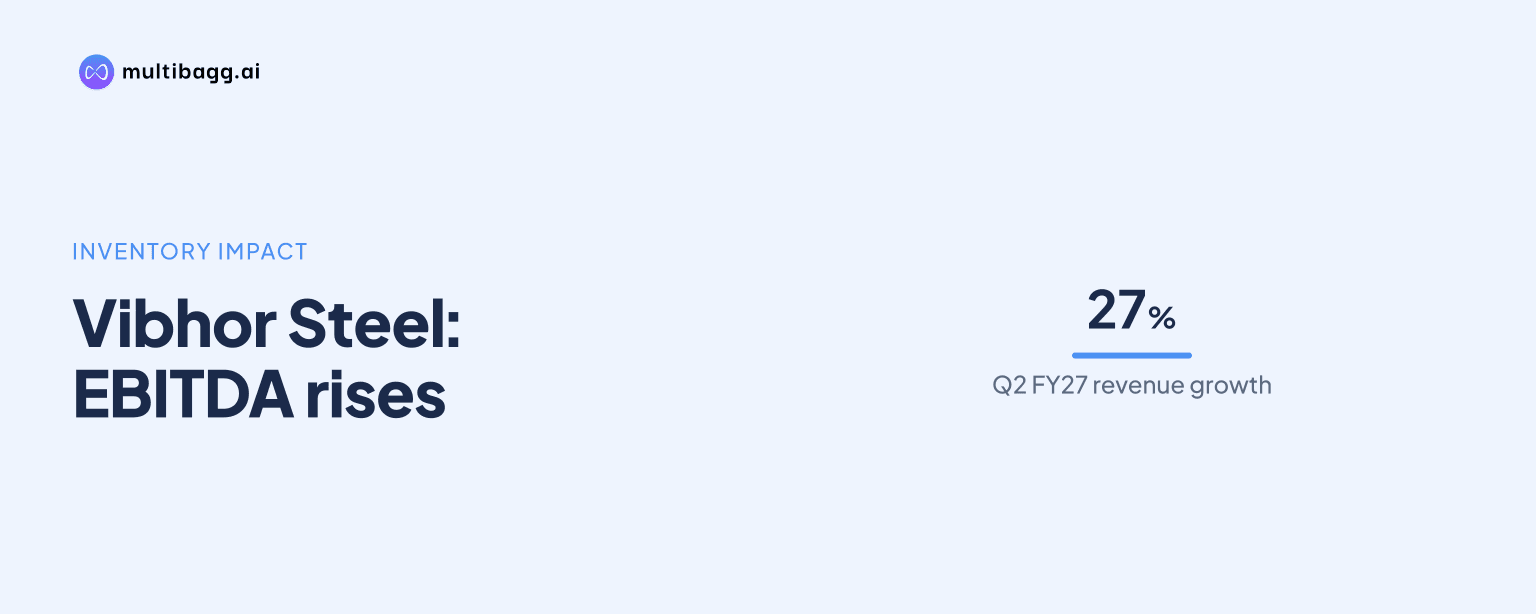
During the second quarter and first half of financial year (FY) 2027, Vibhor Steel Tubes Limited said rising steel inventory values were the main reason for its earnings before interest, tax, depreciation and amortisation (EBITDA) increase, while revenue rose 27% year on year. Management said higher-margin guardrails, poles and towers made a smaller additional contribution.
Know Vibhor Steel Tubes inside out
Results, valuation, peers and who's buying, in one view.
What drove Vibhor Steel Tubes' EBITDA increase?
Rising inventory values were the principal driver of Vibhor Steel Tubes' EBITDA increase in FY 2027 to date. Managing Director Vibhor Kaushik said steel prices had increased month after month during the year, benefiting inventory held by the company. He linked the price trend to geopolitical developments, breakdowns at some steel manufacturers and resulting scarcity of steel.
The call contained two year-on-year EBITDA growth figures that were not reconciled. In the opening remarks, management said EBITDA was up 54%, alongside a 27% revenue increase. Later, it described operating-profit growth as 34.72% year on year. In the question-and-answer session, however, management was clear on the mechanism behind the rise: inventory growth was the main reason, while sales of certain products with greater EBITDA contribution were an additional factor.
Can inventory gains support future EBITDA growth?
Vibhor Steel Tubes did not forecast that inventory-related EBITDA gains would recur at the same rate in a future quarter. Management said forecasting was difficult, particularly because the FY 2027 rise came from steel prices moving higher. The company said it was seeking to keep inventory aligned with sales rather than over-leveraging or undercutting its inventory position.
That policy is intended to limit the effect of a future steel-price decline on EBITDA, according to management. The company said a balanced inventory level should mean that downward price fluctuations do not cause a massive hit to EBITDA. This is a management objective rather than a quantified safeguard: the call gave no inventory value, holding period, steel-price sensitivity or target EBITDA margin for the second quarter or first half of FY 2027.
The FY 2027 first half also differed from the company’s usual seasonal pattern. Management said the first half is generally slower and the second half normally improves as contractors, engineering, procurement and construction contractors, and distributors work toward deadlines. This year, management said the first half had been as progressive as it expects the second half to be, supported by demand and the Odisha plant gaining momentum.
Which products could change Vibhor Steel Tubes' margin mix?
Pipes remained Vibhor Steel Tubes' dominant revenue source, accounting for about 81% of revenue at the time of the call. Highway guardrails accounted for about 12%, while towers, poles and other products supplied about 6% to 7%. As a result, pipe economics still had the largest effect on the consolidated EBITDA outcome despite management’s assertion that several newer products carry better margins.
Management said highway guardrails have EBITDA margins at least 1 percentage point above pipes, while towers are 2 to 3 percentage points above pipes. In a separate example, it said poles could be about 1% to 1.5% higher and transmission-line products sometimes 3% to 4% higher. These were management’s product-level indications, not reported segment margins, and the call did not disclose the EBITDA margin for pipes, guardrails, poles or towers.
The implication is that mix, rather than inventory appreciation alone, could become more important if new products represent a larger share of output. Management said products such as octagon poles, high-mast stadium poles, monopoles and transmission-line towers had begun to generate orders in Odisha. It also said the proposed Hisar subsidiary, Vibhor Infra, would start with highway guardrails, poles and transmission-line towers, products it described as having a higher EBITDA percentage than pipes.
Got a follow-up? Ask IRIS
What needs to happen before the newer products scale?
Approvals and certifications are the immediate constraint on scaling several Odisha products. Vibhor Steel Tubes said its Power Grid documents had been submitted and accepted, with some further formalities potentially remaining. It also said certification from a Bangalore body is mandatory for monopoles and that it had obtained certification for a monopole rated 132, while applications for 220 and 400 ratings were planned.
Telecom-tower certification was awaiting issuance after inspection, and management expected it before railway approval. The company had also applied to the Research Designs and Standards Organisation for railway products. At the Sundargarh operation, management said one galvanising tank was running at almost its 2,000-ton capacity, while a 13-metre second tank had installed capacity of 2,000 to 4,000 tons depending on the order mix. Telecom and transmission-line approvals were identified as factors needed to use more of that capacity.
Pipe output at Odisha was about 1,500 to 2,000 tons, according to management, with a potential increase to 2,500 to 3,000 tons after telecom approval and certification for a swaged pole. Highway guardrail output was about 1,000 tons against 1,500 tons of installed capacity. By contrast, management said galvanising capacity was already full at the Maharashtra and Hyderabad plants, making Odisha approvals and the North India expansion the key variables for the company’s next production phase.
Conclusion
Vibhor Steel Tubes' FY 2027 profitability improvement was chiefly tied to inventory gains from rising steel prices, not solely to a structural operating change. Revenue increased 27%, while management cited two different EBITDA growth rates, 54% and 34.72%, during the same call. Its product mix remains pipe-led at about 81% of revenue, so the realised contribution from guardrails, poles and towers is still limited despite management’s stated margin differentials.
The next items to watch are the pending Power Grid, telecom, railway and swaged-pole approvals, as well as the Hisar unit’s planned production start in roughly six to eight months, or around the first quarter of the next year. Management said a larger 4,000-ton galvanising tank could increasingly serve non-pipe products once approvals arrive, which would test whether product mix can support EBITDA when inventory prices are stable or decline.

