










VRL targets 9%-10% volume growth as branch network expands
Key highlights
- VRL expects 9%-10% tonnage growth in the second half of FY27 and over the medium term.
- More than 60 new branches contributed about 2 percentage points of VRL’s roughly 10% first-half volume growth.
- VRL added 67 branches in the first half of FY27, including 51 during the quarter.
- VRL plans about Rs 150 crore to Rs 160 crore of capital expenditure in the second half of FY27.
powered by IRIS
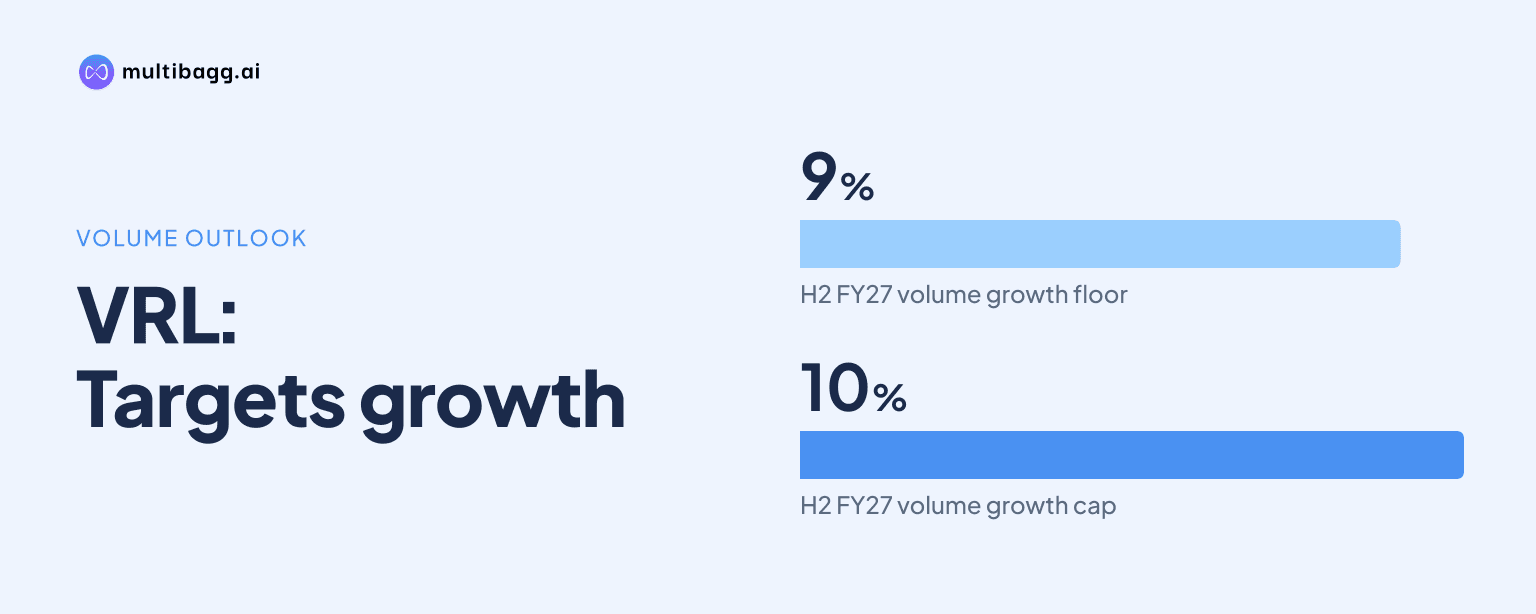
VRL targets 9%-10% tonnage growth in the second half of FY27 and over the medium term after first-half tonnage rose about 9.5% and more than 60 new branches contributed roughly 2 percentage points of growth. Management is concentrating further branch additions in underpenetrated northern and eastern states, including Uttar Pradesh, Bihar and West Bengal.
Know VRL Logistics inside out
Results, valuation, peers and who's buying, in one view.
How fast does VRL expect volumes to grow?
VRL expects 9%-10% volume growth in the second half of FY27 and considers the same range achievable over the medium term. That is above its initial expectation of about 8% tonnage growth for the current financial year, after first-half tonnage growth reached about 9.5%.
Management said the first-half result showed that freight-rate changes were not creating pressure on customer volumes. An analyst noted that realisation had risen from about Rs 6 per kg to about Rs 9 per kg since pricing adjustments started in June 2024, while management said operators across the industry were raising rates to address higher fuel, driver-salary and other costs.
The growth was not tied to one commodity category. Management said fast-moving consumer goods and textiles recorded better festival-season growth than industrial and other segments, while the other segments grew steadily. VRL’s business-to-business less-than-truckload network serves more than 10 lakh customers across industries, giving it a diversified base for volume additions.
What are new branches contributing to VRL’s growth?
New branches contributed about 2 percentage points of VRL’s roughly 10% first-half volume growth, according to management. VRL added 51 branches in the quarter and 67 branches in the first half of FY27; management referred to more than 60 current-year openings when quantifying the volume contribution.
The next expansion focus is Uttar Pradesh, Bihar and West Bengal, where management said VRL’s presence was still not at the desired level. The company aims to add branches in those markets and replicate the network it has built in southern and western India, where it described its interstate and intrastate operations as strong.
Management said expansion in northern and eastern India was delivering better zone-to-zone growth than the southern market and was adding to overall tonnage. Additional branches widen customer catchments and route coverage, while also supporting intra-city freight movement. Management agreed with an analyst that this expansion would promote intra-city traffic.
Will branch additions raise VRL’s freight realisation?
VRL said current-year realisation gains primarily reflect freight-rate increases rather than new branches or routes. It raised freight rates by about 5% from April 1 and by about 4% in mid-May, producing a cumulative increase of about 9% in the current financial year.
Management said new branches and routes should not make a significant direct contribution to realisation. It also said it does not favour either short-haul or long-haul operations as a fixed strategy, instead operating where opportunities arise; margins are broadly similar across intrastate and interstate traffic.
Fuel remains the principal driver of freight-rate changes. Contractual customers represent about 17%-18% of revenue and generally have fuel-escalation clauses that require rates to move in either direction under an agreed formula. For non-contractual customers, VRL can adjust prices by route, region or commodity.
Got a follow-up? Ask IRIS
How will VRL fund branch and fleet expansion?
VRL expects capital expenditure of about Rs 150 crore to Rs 160 crore in the second half of FY27, covering commercial vehicles and one or two properties. Management said annual capital expenditure of about Rs 250 crore to Rs 300 crore should continue over the longer term, subject to cash flow and debt levels.
First-half capital expenditure was about Rs 158 crore, including about Rs 76 crore in the first quarter and about Rs 82 crore in the second quarter. The spending covered commercial vehicles and land and building facilities in Vijayawada, Nagpur, Lucknow and Raipur, intended to strengthen infrastructure and consolidate logistics hubs.
The company reported higher operating cash generation alongside lower debt. Cash generated from operations before working-capital changes rose to about Rs 415 crore in the first half from about Rs 314 crore a year earlier, while net cash from operating activities increased to about Rs 363 crore from about Rs 334 crore. Net debt fell to about Rs 337 crore on September 30, 2026, from about Rs 440 crore on March 31, 2026.
Can VRL expand capacity while retaining its owned-fleet model?
VRL plans to add higher-capacity vehicles, with fewer units but capacity growth intended to be broadly equivalent to tonnage growth. Management said it prefers to use owned vehicles and capacity for growth rather than outside vehicles, citing the operating-margin benefit of that model.
VRL had 5,941 vehicles at the end of H1 FY27. About 76% of the fleet was debt-free, while about 11% was fully depreciated and remained in operation. The company is replacing and scrapping older vehicles while improving utilisation, and management agreed that gross additions should rise as the heavier scrappage phase ends.
Management reported an earnings before interest, taxes, depreciation and amortisation (EBITDA) margin of 23.3% in the quarter, compared with 19.7% a year earlier. It said a 21%-22% EBITDA margin is sustainable going forward, even after toll and other overhead increases that management estimated could affect margins by about 1%-1.5%.
Conclusion
VRL’s 9%-10% volume target is based on first-half tonnage growth of about 9.5%, with newly opened branches accounting for roughly 2 percentage points of the increase. The strategy combines network expansion in Uttar Pradesh, Bihar and West Bengal with additional fleet capacity, while freight-rate changes remain the main driver of realisation rather than route additions.
The next measure will be whether second-half tonnage stays within the 9%-10% range as VRL spends about Rs 150 crore to Rs 160 crore on further capital expenditure. Management also identified fuel-price movements as an unresolved factor: a substantial reduction of more than about 5% could lead it to reconsider freight rates, while contracts covering about 17%-18% of revenue include fuel-escalation clauses.