










VRL Logistics Q2 profit more than doubles to Rs 103 crore
Key highlights
- VRL Logistics’ Q2 FY27 PAT rose about 106% to Rs 103 crore from Rs 50 crore a year earlier.
- Q2 FY27 total income increased 20% to Rs 967 crore and EBITDA rose 43% to Rs 226 crore.
- Freight volume grew 11% to 10.79 lakh tonnes and realisation per tonne increased 9% to Rs 8,840.
- Net debt declined to Rs 337 crore on September 30, 2026, from Rs 440 crore on March 31, 2026.
powered by IRIS
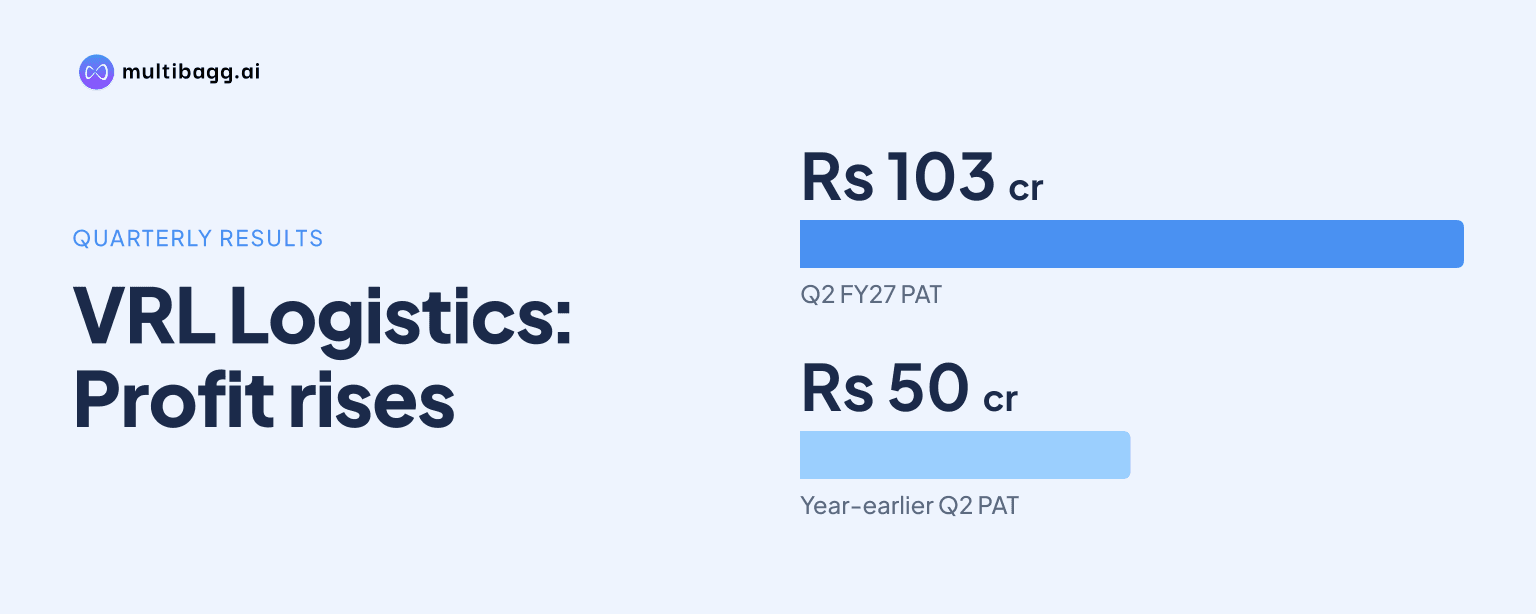
VRL Logistics Limited more than doubled profit after tax in Q2 FY27 to Rs 103 crore from Rs 50 crore a year earlier, as total income increased 20% to Rs 967 crore and EBITDA margin rose 367 basis points to 23.3%. Higher freight realisation and 11% volume growth outweighed higher fuel procurement costs.
Know VRL Logistics inside out
Results, valuation, peers and who's buying, in one view.
How did VRL Logistics perform in Q2 FY27?
VRL Logistics reported higher income, operating profit and net profit in Q2 FY27. Total income rose to Rs 967 crore from Rs 804 crore in Q2 FY26, while earnings before interest, tax, depreciation and amortisation, or EBITDA, increased 43% to Rs 226 crore from Rs 158 crore. Profit after tax, or PAT, grew about 106% to Rs 103 crore from Rs 50 crore.
Margins improved alongside the income increase. EBITDA margin reached 23.3% in Q2 FY27 from 19.7% in Q2 FY26, while PAT margin rose to 10.7% from 6.2%. Management said the Q2 FY27 PAT of Rs 103 crore was higher than the company’s profit in the first half of the previous year.
What drove VRL Logistics’ Q2 FY27 income growth?
VRL Logistics’ Q2 FY27 income growth came from higher freight volumes and realisation per tonne. Goods transport volume increased 11% year on year to 10.79 lakh tonnes from 9.76 lakh tonnes, while freight realisation rose 9% to Rs 8,840 per tonne from Rs 8,079 per tonne. Management attributed the realisation gain to earlier freight-rate hikes and rationalisation initiatives.
Management said its focus on remunerative business and pricing discipline helped retain and add customers while raising revenue quality. VRL Logistics regained business and tonnage from some customers that had stopped using its services after freight-rate rationalisation and the company’s withdrawal from low-margin contracts. It added 51 branches in Q2 FY27, taking additions in H1 FY27 to 67 branches.
The company’s business-to-business less-than-truckload, or LTL, freight operations serve more than 10 lakh customers across industries. Management said a substantial majority of LTL consignments are paid at booking or delivery through paid and to-pay arrangements, keeping the trade-receivable cycle at about 10 to 11 days. This collection mechanism reduces reliance on extended customer credit.
How did VRL Logistics manage higher fuel costs?
VRL Logistics said calibrated freight-rate adjustments passed on a substantial part of fuel-cost inflation while goods volumes grew 11% in Q2 FY27. Fuel procurement cost per litre increased to about Rs 97 from about Rs 85 during the period. Management said crude-oil volatility and geopolitical developments also reduced the benefit usually obtained from bulk fuel procurement.
Several expense ratios nevertheless declined as a share of total income, supporting the 23.3% EBITDA margin. Employee cost increased in absolute terms to Rs 159 crore from Rs 147 crore but fell to 16.48% of income from 18%. Administrative expenses declined to 1.43% of income from 2.28%, which management mainly attributed to lower legal and professional expenses than in the previous year.
Other operating expenses fell to 10.06% of income from 10.48%, despite higher transport volumes, additional toll plazas and higher toll rates effective from April 1. Management also cited better control of toll and hamali, or loading and unloading, costs as a proportion of income. Vehicle-running costs increased moderately because of higher driver incentives and modest driver salary increases.
Got a follow-up? Ask IRIS
Is VRL Logistics generating cash and reducing debt?
VRL Logistics increased operating cash generation in H1 FY27 and reduced net debt despite Rs 158 crore of capital expenditure. Cash generated from operations before working-capital changes rose to about Rs 415 crore from about Rs 314 crore in H1 FY26. Net cash generated from operating activities increased to Rs 363 crore from Rs 334 crore in the same comparison.
Capital expenditure totalled Rs 76 crore in Q1 FY27 and Rs 82 crore in Q2 FY27. The Rs 158 crore spent in H1 FY27 funded commercial vehicles and land and building facilities at locations including Vijayawada, Nagpur, Lucknow and Raipur. Management said these investments are intended to support future network expansion and consolidation of logistics hubs.
Net debt stood at Rs 337 crore on September 30, 2026, down from Rs 440 crore on March 31, 2026. Net debt to EBITDA improved to 0.3 times from 0.4 times at the end of FY26. Management said it plans H2 FY27 capital expenditure of about Rs 150 crore to Rs 160 crore, including vehicles and one or two properties, with remaining cash flow to be used to reduce debt further.
What does VRL Logistics expect from volume growth and margins?
VRL Logistics management expects tonnage growth of about 9% to 10% in H2 FY27 after reporting around 9.5% growth in H1 FY27. At the start of the financial year, management had expected about 8% tonnage growth. It said freight-rate increases across the industry, reflecting fuel, driver salary and other inflation, had not created volume pressure in the first half.
Management also said an EBITDA margin of around 21% to 22% is sustainable going forward, compared with the 23.3% reported in Q2 FY27. It identified faster branch expansion in Uttar Pradesh, Bihar and West Bengal as a source of incremental freight. Management said growth on zone-to-zone routes in northern and eastern markets had been higher than in southern markets.
VRL Logistics had 5,941 vehicles at the end of H1 FY27, of which about 76% were debt-free and around 11% were fully depreciated. The company is replacing and scrapping older vehicles while seeking better use of its owned fleet. Management linked the fleet programme and 67 new H1 branches with operating leverage and the 11% Q2 FY27 increase in tonnage.
What are the terms of VRL Logistics’ share buyback?
VRL Logistics approved a buyback of up to Rs 280 crore at Rs 320 per equity share. The offer covers up to 87.5 lakh equity shares, representing about 5% of paid-up equity share capital. Shareholders approved the proposal through a postal ballot concluded on October 3, 2026, and promoters are not participating.
The record date for eligibility was October 22, 2026, and the tendering window ran from October 27 to November 2, 2026. Settlement of bids was scheduled for November 9, 2026. Management said the consequential reduction in equity share capital and other equity would be reflected in the nine-month results ending December 31, 2026, following completion and settlement.
Conclusion
VRL Logistics’ Q2 FY27 performance combined a 9% increase in freight realisation per tonne with an 11% rise in transported tonnage, lifting total income to Rs 967 crore and PAT to Rs 103 crore. The 367-basis-point increase in EBITDA margin to 23.3% indicates that lower employee, administrative and other operating expense ratios offset fuel procurement costs rising to about Rs 97 per litre.
The next measures to watch are management’s planned Rs 150 crore to Rs 160 crore H2 FY27 capital expenditure, its stated expectation of about 9% to 10% volume growth, and the November 9, 2026 scheduled buyback settlement. Management’s 21% to 22% sustainable EBITDA-margin view also leaves freight pricing, fuel costs, branch additions and net debt reduction as disclosed operating markers for the second half.