










VRL ROCE recovered to 25% in FY26 from FY24’s 15% level
Key highlights
- VRL reported FY26 ROCE of 25%, compared with 15% in FY24.
- Net cash from operating activities rose to Rs 362.5 crore in SEP-26 from Rs 334.2 crore in SEP-25.
- VRL disclosed net debt of Rs 337 crore at 30 September 2026, down from Rs 440 crore at 31 March 2026.
- VRL added 44 net branches in H1FY27, taking its network to 1,337 branches.
powered by IRIS
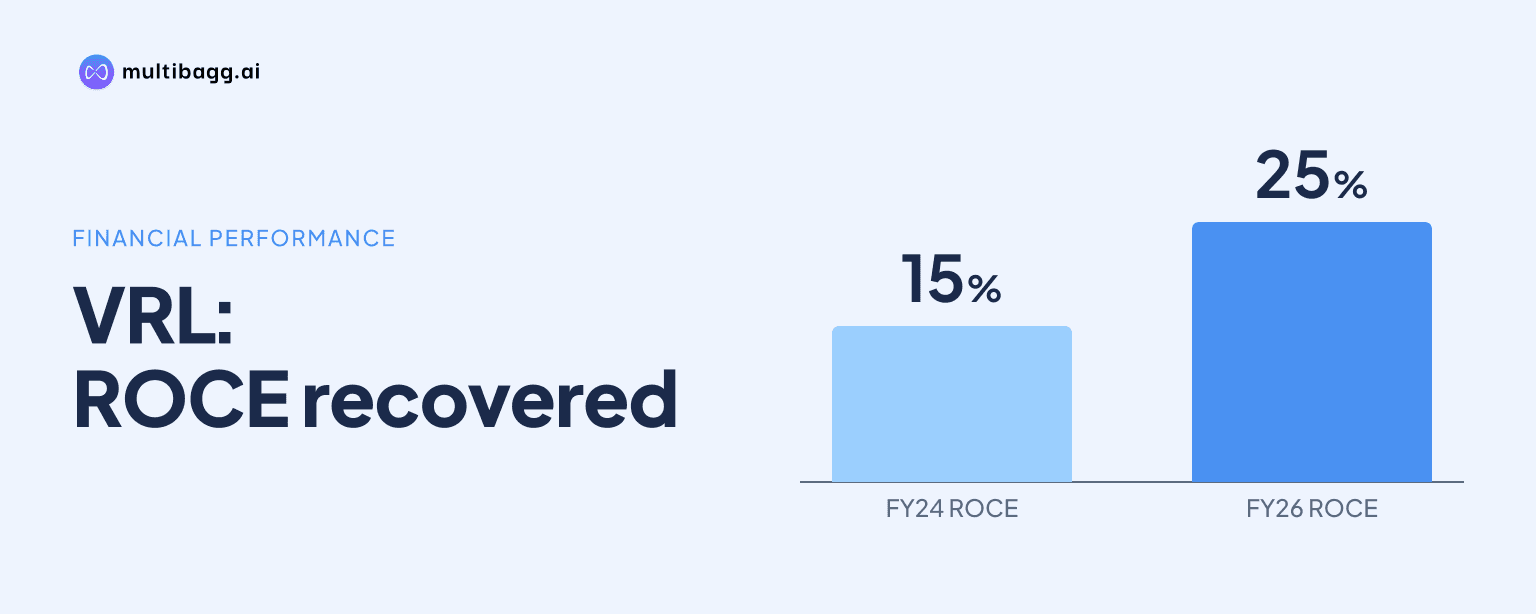
VRL reported return on capital employed of 25% in FY26, up from 15% in FY24, while net cash from operating activities increased to Rs 362.5 crore in SEP-26 from Rs 334.2 crore in SEP-25. The presentation does not provide EBITDA or EBITDA-margin data for FY24 to FY26.
Know VRL Logistics inside out
Results, valuation, peers and who's buying, in one view.
How did VRL’s return ratios change through FY26?
VRL’s return on capital employed, or ROCE, rose to 25% in FY26 from 15% in FY24, after recovering to 21% in FY25. The measure had stood at 30% in FY22 and 21% in FY23, meaning FY26 was 10 percentage points above FY24 but 5 percentage points below FY22. VRL defines ROCE as earnings before interest and tax divided by capital employed.
Return on average equity, or ROAE, followed the same direction from FY24 to FY26. ROAE increased from 9% in FY24 to 18% in FY25 and 21% in FY26, compared with 26% in FY22 and 20% in FY23. VRL calculates ROAE as profit for the year divided by average net worth.
VRL’s trade-receivables turnover improved to 36.1 times in FY26 from 33.9 times in FY24 and 34.9 times in FY25. The FY26 level was also above FY23’s 35.6 times, though 0.4 times below FY22’s 36.5 times. VRL defines the ratio as revenue from operations divided by average trade receivables.
Capital employed in VRL’s ROCE calculation comprises tangible net worth, total borrowings and deferred-tax liabilities. The company defines tangible net worth as net worth less intangible assets, a definition relevant to comparing the 15% FY24 ROCE with the 25% FY26 result. The supplied presentation does not disclose an EBITDA series that would support the stated EBITDA-margin comparison.
What did VRL report for operating cash flow in SEP-26?
VRL reported net cash from operating activities of Rs 362.5 crore in SEP-26, an increase of Rs 28.3 crore from Rs 334.2 crore in SEP-25. Net profit before tax rose to Rs 245.4 crore from Rs 136.3 crore, while operating profit before working-capital changes increased to Rs 415.7 crore from Rs 314.1 crore.
Cash generated from operating activities before tax was Rs 416.5 crore in SEP-26, compared with Rs 341 crore in SEP-25. Changes in working capital were Rs 0.8 crore in SEP-26 and Rs 26.9 crore a year earlier. Income taxes paid increased to Rs 54 crore from Rs 6.8 crore, limiting the increase in net operating cash flow relative to the pre-tax cash generated figure.
VRL used Rs 440.5 crore in investing activities in SEP-26, compared with Rs 43.1 crore in SEP-25. Financing activities generated Rs 74.5 crore in SEP-26, whereas they used Rs 284.5 crore in SEP-25. Cash and cash equivalents ended SEP-26 at Rs 12 crore, down from Rs 15.5 crore at the start of the period and Rs 59.8 crore at the end of SEP-25.
Got a follow-up? Ask IRIS
How did VRL’s debt and equity position move in H1FY27?
VRL disclosed net debt of Rs 337 crore at 30 September 2026, down from Rs 440 crore at 31 March 2026. Its net-debt-to-equity ratio was 0.3 times in the first half of FY27, or H1FY27, compared with 0.4 times in FY25 and FY26. The ratio had been 0.2 times in FY22 and FY23 and 0.3 times in FY24.
VRL defines net debt to equity as borrowings less cash and cash equivalents and investments, divided by total equity. Total equity was Rs 1,324 crore in SEP-26, compared with Rs 1,142.4 crore in SEP-25. Other equity increased to Rs 1,149.1 crore from Rs 967.5 crore, while share capital remained Rs 174.9 crore in both periods.
Reported borrowings increased year on year even as VRL disclosed lower net debt at 30 September 2026. Non-current borrowings were Rs 446.5 crore in SEP-26, up from Rs 334.1 crore in SEP-25, while current borrowings rose to Rs 183.7 crore from Rs 121.6 crore. Current investments of Rs 280.8 crore were shown in SEP-26, while no current-investment balance was shown for SEP-25.
What operating changes could affect VRL’s next results?
VRL added 44 net branches in H1FY27, taking the network to 1,337 branches from 1,293 in FY26. The company opened 67 branches and closed or merged 23 during the period. It also acquired properties in Vijayawada, Nagpur, Chikkamagaluru, Aroor, Lucknow and Raipur for future expansion plans.
VRL’s general transport, or GT, vehicle fleet increased by nine vehicles to 5,941 in H1FY27 from 5,932 in FY26. The company added 238 vehicles, including 225 heavy commercial vehicles, and sold or scrapped 229 vehicles. Capital expenditure was Rs 158 crore in H1FY27, comprising Rs 76 crore in Q1FY27 and Rs 82 crore in Q2FY27.
GT tonnage fell from 1,104 thousand tonnes in Q3FY25 to 935 thousand tonnes in Q1FY26 before recovering to 1,079 thousand tonnes in Q2FY27. Realisation per tonne rose from Rs 6,723 in Q1FY25 to Rs 8,840 in Q2FY27. VRL attributes higher realisation and margins to a price increase from Q2FY25 and an exit from low-margin business in Q4FY25.
VRL’s growth blueprint calls for mass marketing at existing and new branches, identification of profitable freight contracts, and expansion into North and Northeastern geographies. It says fleet additions will be assessed against tonnage growth and demand, while geopolitical developments and potential fuel-rate volatility remain identified risks. Direct fuel procurement fell to 6.86% in H1FY27 from 41.03% in H1FY26 because bulk fuel supply rates increased.
Conclusion
VRL’s reported ratios show a recovery from FY24: ROCE rose from 15% to 25% by FY26, ROAE increased from 9% to 21%, and trade-receivables turnover moved from 33.9 to 36.1 times. SEP-26 operating cash flow reached Rs 362.5 crore, while net debt was Rs 337 crore at 30 September 2026.
The next results will show whether the 44 net branch additions, Rs 158 crore of H1FY27 capital expenditure and higher Q2FY27 realisation support tonnage and cash generation. VRL also expects its buy-back process to be completed through stock-exchange settlement, with the resulting reduction in equity share capital and other equity recognised in results for the quarter and nine months ending 31 December 2026.