










VRL Logistics Limited says diesel cuts preserve 21% EBITDA margin
Key highlights
- VRL said a Rs 5 fuel-rate reduction could result in about a 2.5% decline in freight realization without changing EBITDA margin.
- Management said EBITDA margin above 23% was sustainable at prevailing volumes and costs, while its forward objective is at least around 21%.
- VRL indicated revenue growth of at least 10% to 12% next year if realization is unchanged, supported by expected tonnage growth of about 9% to 10%.
- VRL reported year-on-year tonnage growth of more than 20% in October during festival demand.
powered by IRIS
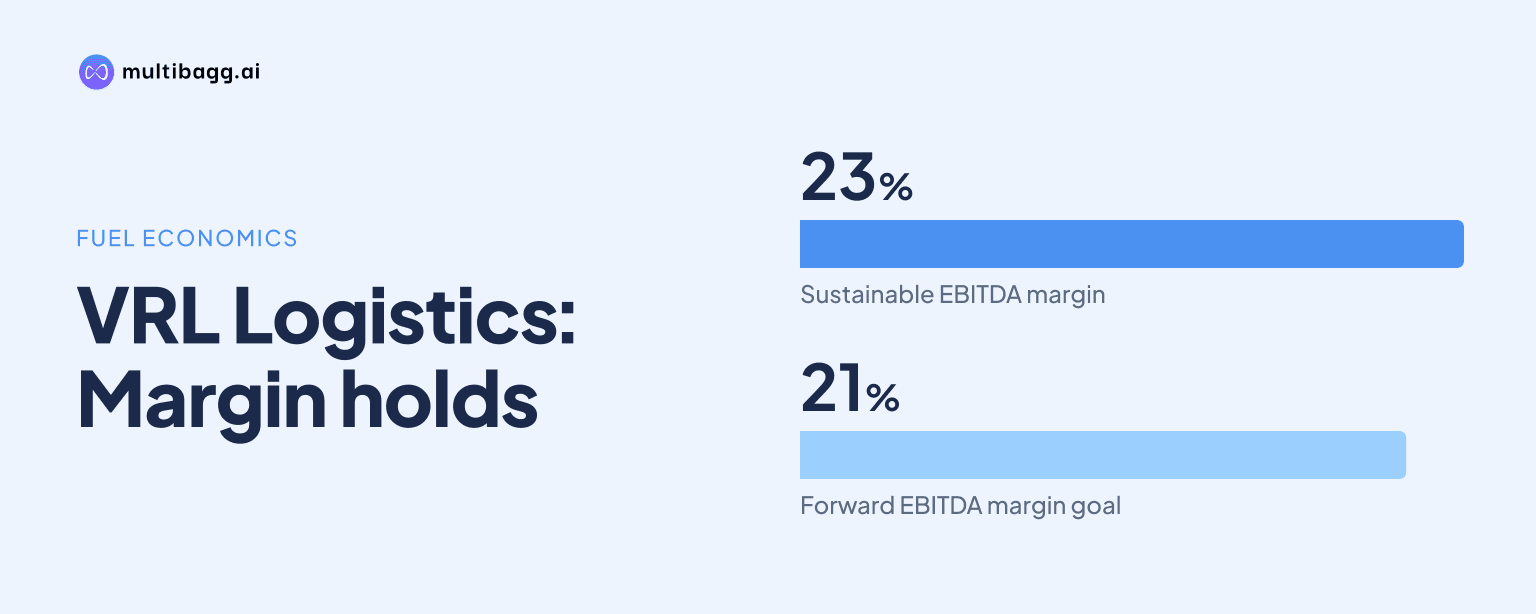
VRL Logistics Limited said on its earnings call that a Rs 5 reduction in fuel rates could lower freight realization by about 2.5% while leaving earnings before interest, tax, depreciation and amortisation (EBITDA) margin unchanged; management said it would seek to maintain EBITDA margin at least around 21% going forward.
Know VRL Logistics inside out
Results, valuation, peers and who's buying, in one view.
Can VRL maintain EBITDA margin above 21% after diesel-price cuts?
Yes. VRL said EBITDA margin would be maintained if fuel rates decline and freight prices are reduced in response, with management’s closing objective being a margin of at least around 21% going forward. In the fuel-cut scenario raised by an analyst, management said a Rs 5 reduction in fuel rates could result in about a 2.5% fall in realization, but that margins would not change.
Management also said the then-current EBITDA margin of more than 23% was sustainable at prevailing volumes and cost structure. It added that higher toll charges, loading and unloading costs, or other overheads could produce a small margin correction. For the next year, assuming realization remains unchanged from current levels, management indicated an EBITDA margin range of 21% to 22% alongside revenue growth of at least 10% to 12%.
How does VRL's fuel-to-freight pass-through work?
VRL said its working formula is that every Rs 2 movement in fuel rates corresponds to a 1% movement in freight rates. Management used that relationship to explain why a Rs 5 fuel-rate reduction could lead to an estimated 2.5% reduction in freight realization, rather than the 5% fall in realization posed in the analyst’s question.
VRL said adjustments need not be simultaneous across every route because there can be a time gap before savings are passed to customers. On routes with less competition, it may retain prevailing prices; where competition is greater, it may pass through more of the benefit. Management said this route-level approach is intended to preserve an optimum EBITDA margin while responding to market conditions.
What supports VRL's 21% to 22% margin range?
VRL attributed its outlook to owned infrastructure, vehicle availability and its network, rather than to charging materially higher freight rates than competitors. Management cited the October festival period, when it said bookings between Ahmedabad and Surat continued without interruption even as some other operators could not book consignments because vehicles were unavailable. VRL reported year-on-year tonnage growth of more than 20% in October.
Management said VRL has a customer base of more than 10 lakh customers and does not depend on a single industry. It also said its claim ratio is in decimal points, compared with a 10% to 12% range it attributed to other operators. The call did not provide a common definition, period or independently comparable calculation for those claim-ratio figures.
VRL also described a strategy of expanding corporate accounts across regions. Where it serves a corporate customer in Karnataka or other southern states, it is identifying opportunities to win all-India contracts in northern and eastern markets. Management did not disclose a revenue target from this initiative, but linked volume growth to its ability to deploy its own vehicles and infrastructure during demand peaks.
Got a follow-up? Ask IRIS
How could lower realization affect VRL revenue growth?
VRL said revenue is the product of volume and realization, so any decline in realization would affect reported revenue growth. An analyst described then-current revenue growth of 20% as comprising 9% realization growth and 10% to 11% volume growth. Management said that, if realization does not change from current levels, revenue could increase at least 10% to 12% next year.
The expected revenue range is supported by management’s forecast of about 9% to 10% tonnage growth and a further 1% to 2% revenue effect from the realization correction between the first and second quarters. Compared with the analyst’s 20% current-growth description, the 10% to 12% outlook would depend more heavily on freight volume than on further price increases. A reduction in fuel-linked realization could therefore lower revenue growth even if tonnage continues to increase.
Management said it was confident in tonnage growth after the nearly 20% October increase, which it attributed to festival demand and capacity availability. It said some operators rely completely on outside or hired vehicles, whereas VRL’s owned infrastructure and vehicle facility allow it to serve markets with peak demand in specific sectors.
Could bulk fuel buying add to VRL's EBITDA margin?
Potentially, according to management. VRL said outside fuel was then available at around Rs 98 to Rs 100, while bulk purchases were in the range of Rs 120 to Rs 125, making bulk buying uneconomical at that point. Management said bulk-purchase options could reopen if crude-linked fuel-price conditions change.
If bulk buying becomes viable, management said the resulting savings could improve EBITDA margins and would not need to be passed through to customers. VRL did not disclose a fuel-price threshold, expected bulk volume, or estimated savings from this mechanism. Its stated operating approach is to monitor expenditure monthly or regularly while seeking to maintain EBITDA margin at least around 21%.
Conclusion
VRL’s stated position is that lower diesel prices need not reduce EBITDA margin because freight-rate changes can be timed and applied selectively by route, while fuel procurement could provide an additional saving if bulk buying becomes viable. The company’s 21% to 22% margin indication for the next year is below its more-than-23% current level and allows for possible increases in toll, handling and other overhead costs.
The next items to watch are whether tonnage growth remains near management’s 9% to 10% expectation after October’s more-than-20% year-on-year increase, whether freight realization changes from current levels, and whether the Rs 120 to Rs 125 bulk-fuel price range becomes competitive. Management also said it would continue with previously projected capital expenditure, without disclosing a revised amount on the call.