










VRL Logistics Limited’s LTL mix puts 83% in spot collections
Key highlights
- LTL contributed 90.4% of VRL’s H1FY27 revenue, compared with 8.2% from FTL.
- To-pay and paid freight together represented 83% of VRL’s H1FY27 revenue.
- VRL reported trade receivables of 10 days in H1FY27.
- VRL had more than 10 lakh customers and 1,337 branches as of September 2026.
powered by IRIS
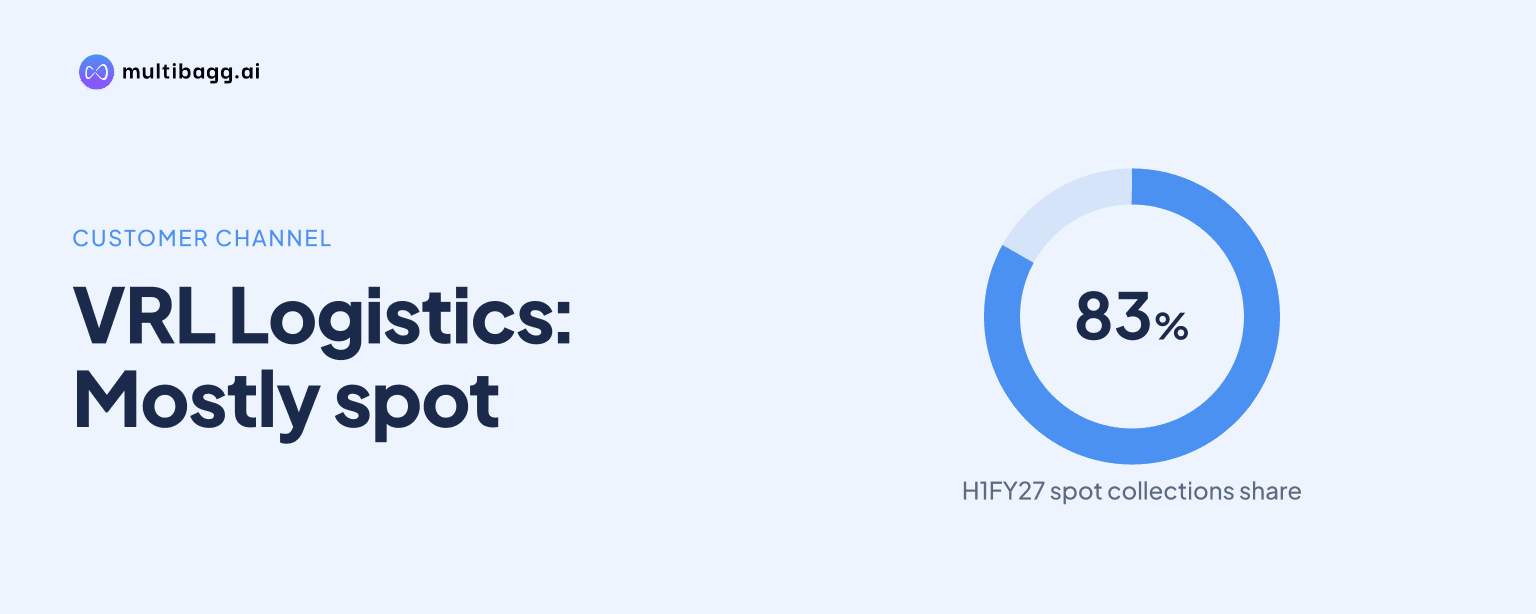
VRL Logistics Limited generated 90.4% of H1FY27 revenue from less-than-truck-load freight, while 83% came through paid or to-pay categories collected at booking or delivery points; it reported trade receivables of 10 days. The model combines largely non-credit freight collections with a diversified B2B customer base of more than 10 lakh customers.
Know VRL Logistics inside out
Results, valuation, peers and who's buying, in one view.
How does VRL generate most of its freight revenue?
VRL generates most of its freight revenue from less-than-truck-load, or LTL, services, which accounted for 90.4% of H1FY27 revenue. Full-truck-load, or FTL, services contributed 8.2%, while other activities accounted for 1.4%. LTL involves transporting consignments from multiple customers in one vehicle, allowing the company to aggregate loads before sending them to their destinations.
The revenue mix makes VRL’s branch and hub system central to its freight model. As of September 2026, the company had 1,337 branches and 50 hubs across 24 states and four Union Territories. It reported 1.87 million square feet of owned hub space and 4.56 million square feet of leased hub space, providing collection, consolidation and distribution points for B2B consignments.
VRL had 5,941 goods-transport vehicles in H1FY27, compared with 5,932 vehicles in FY26. The company added 238 vehicles and sold or scrapped 229 during the half year, producing a net increase of nine vehicles. As of June 2026, the 15-to-20-ton category was its largest disclosed fleet segment, with 2,252 vehicles and carrying capacity of 41,650 tons.
Why were VRL’s trade receivables 10 days in H1FY27?
VRL reported trade receivables of 10 days in H1FY27 because 83% of revenue came from to-pay and paid freight categories designed for collection at delivery or booking. To-pay freight contributed 68% of total revenue and paid freight contributed 15%, while account customers with standard contractual credit periods accounted for 16%.
Under the to-pay category, VRL collects freight at the delivery station from the consignee, with minimal credit days for selected customers. Under the paid category, it collects freight at the booking station from the consignor, again with minimal credit days for select customers. The company describes the two categories as spot collection mechanisms for the majority of its sales.
The disclosed collection percentages total 99%, which reflects the presentation’s stated figures. VRL also says hardly any collectible remains outstanding for more than 90 days. Management says the predominance of paid and to-pay revenue supports cash-flow stability and reduces dependence on working-capital credit lines, although the presentation does not disclose a separate H1FY27 working-capital borrowing balance.
How diversified is VRL’s customer base?
VRL says it serves a diversified base of more than 10 lakh customers across varied commodities and B2B sectors. The company states that it is not dependent on any major customer or product category, although the presentation does not provide customer-level revenue shares, the number of active customers, or a sector-by-sector revenue split.
The customer model is not limited to contractual accounts because account freight represented 16% of H1FY27 revenue, compared with 83% from paid and to-pay freight. This split means the reported 10-day receivable measure is linked both to collection at booking and delivery stations and to the large share of transactions outside standard contractual credit arrangements.
VRL’s disclosed branch distribution illustrates the geographic breadth of this B2B network as of September 2026. Karnataka had 238 branches, Maharashtra had 172, Tamil Nadu had 142 and Gujarat had 113. The company also reported 85 branches in Uttar Pradesh and 68 in West Bengal, alongside its stated focus on further expansion in northern and northeastern geographies.
Got a follow-up? Ask IRIS
What operating assets support VRL’s LTL collections?
VRL supports LTL collections through an owned-asset hub-and-spoke model, a proprietary enterprise resource planning, or ERP, system, and barcode-based consignment tracking. The company says consignments are tagged and scanned, its ERP provides real-time tracking, and vehicles use one-time-password locks as an additional security mechanism.
The fleet and infrastructure are intended to limit use of outside vehicles. As of June 2026, 76% of total vehicles were debt-free and 11% were fully depreciated. Total carrying capacity, excluding cranes and tankers, was 81,985 tons, compared with 77,284 tons in Q2FY26 and 82,378 tons in Q1FY27.
VRL’s balance-sheet data show that net debt fell to Rs 337 crore at September 30, 2026, from Rs 440 crore at March 31, 2026. The company incurred capital expenditure of Rs 158 crore in H1FY27, comprising Rs 76 crore in Q1FY27 and Rs 82 crore in Q2FY27. The expenditure included property purchases at Vijayawada, Nagpur, Chikkamagaluru, Aroor, Lucknow and Raipur, as well as expansion of branch and transshipment areas.
How is VRL planning to expand its LTL network?
VRL plans to expand its LTL network through branches, geographic coverage, marketing and fleet decisions tied to tonnage growth. It opened 67 branches and closed or merged 23 in H1FY27, resulting in a net addition of 44 branches and taking the total from 1,293 in FY26 to 1,337 in H1FY27.
Management’s stated volume plan includes mass marketing at existing and new branch locations and identifying profitable freight contracts. Its fleet strategy is to assess additions against tonnage growth and demand conditions rather than set a fixed fleet target. This approach resulted in only nine net vehicles being added in H1FY27 despite 238 additions, because 229 vehicles were sold or scrapped.
Fuel procurement changed materially between comparable half-year periods. Direct procurement fell to 6.86% in H1FY27 from 41.03% in H1FY26 because bulk-supply fuel rates increased, according to VRL. Management also says it is monitoring geopolitical developments that could create volatility in fuel and other input costs, but the presentation does not disclose a fuel-cost target.
Conclusion
VRL’s H1FY27 disclosures show an LTL-led freight model in which 90.4% of revenue came from LTL and 83% from paid and to-pay collection categories. Its 10-day receivable figure is therefore associated with collection at booking and delivery points, while the stated customer base of more than 10 lakh customers reduces reliance on a limited set of B2B accounts.
The next measures to watch are branch additions, LTL volumes and fleet decisions linked to tonnage demand. VRL added 44 net branches in H1FY27 and has identified northern and northeastern areas for expansion. The company also expects its 2026 buy-back to be completed through the stock-exchange mechanism, with the resulting reduction in equity share capital and other equity recognised in the quarter and nine-month period ending December 31, 2026.